系统性红斑狼疮疾病活动度与人体成分的相关性分析
2022-07-13吴晨敏吕心阳刘剑雯戴逸君高飞
吴晨敏 吕心阳 刘剑雯 戴逸君 高飞
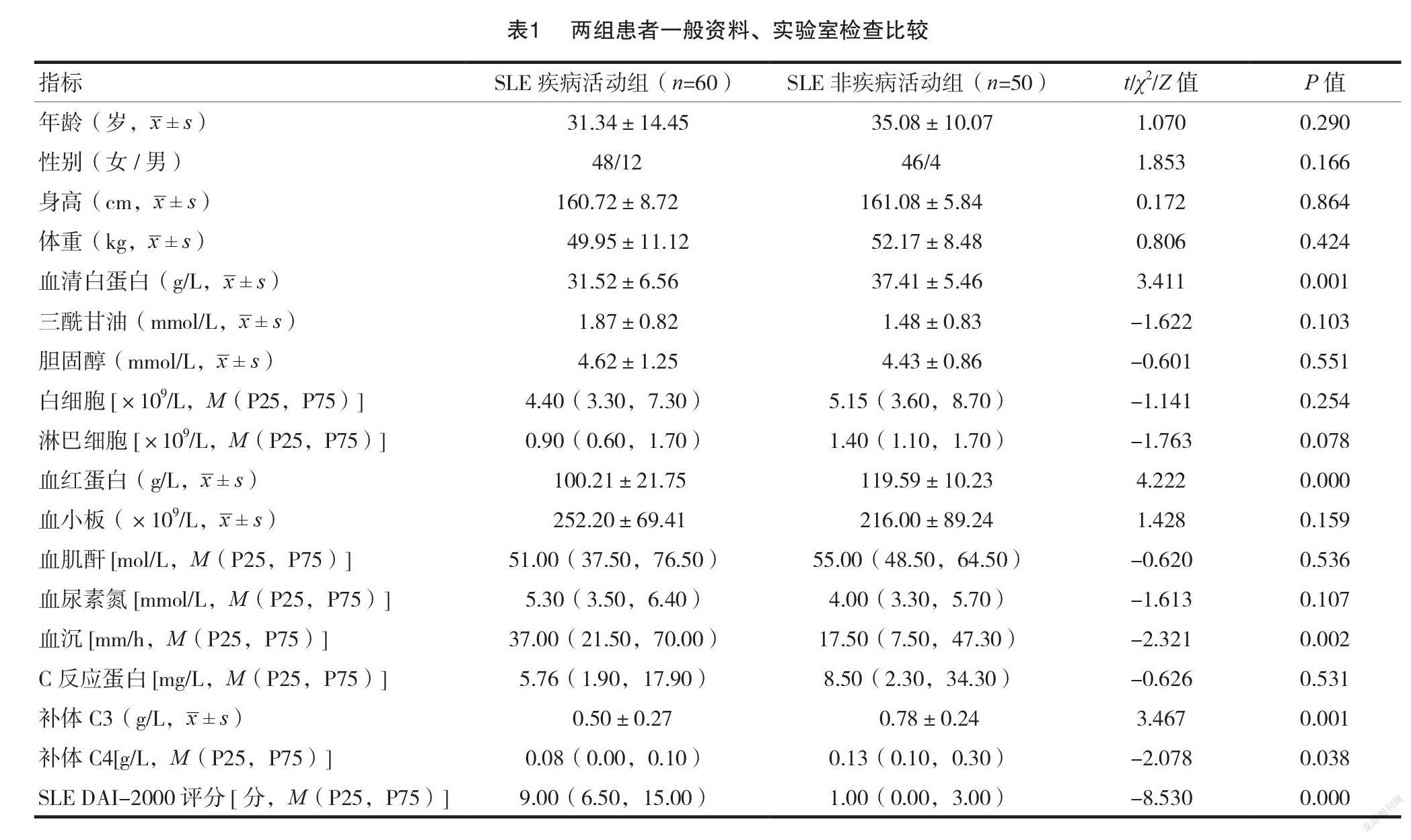
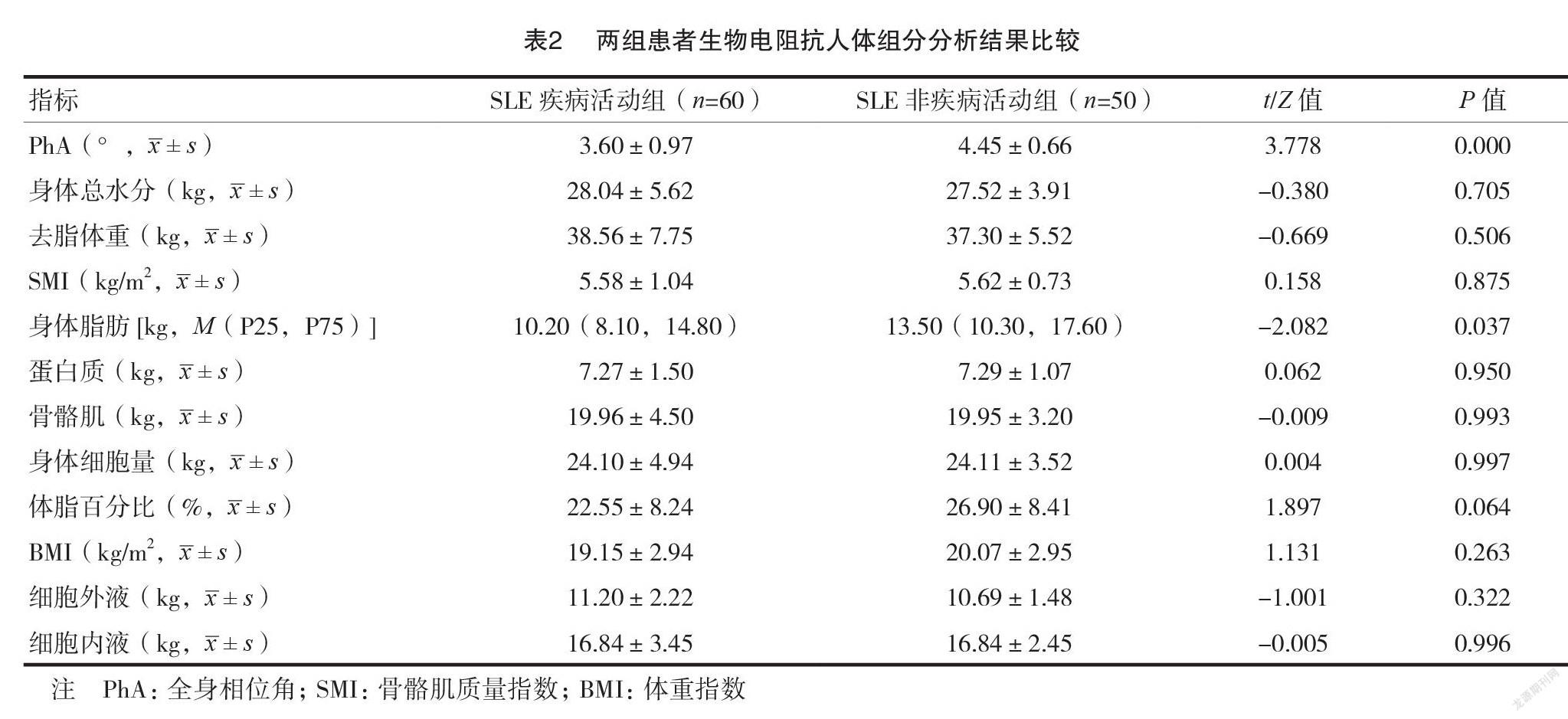
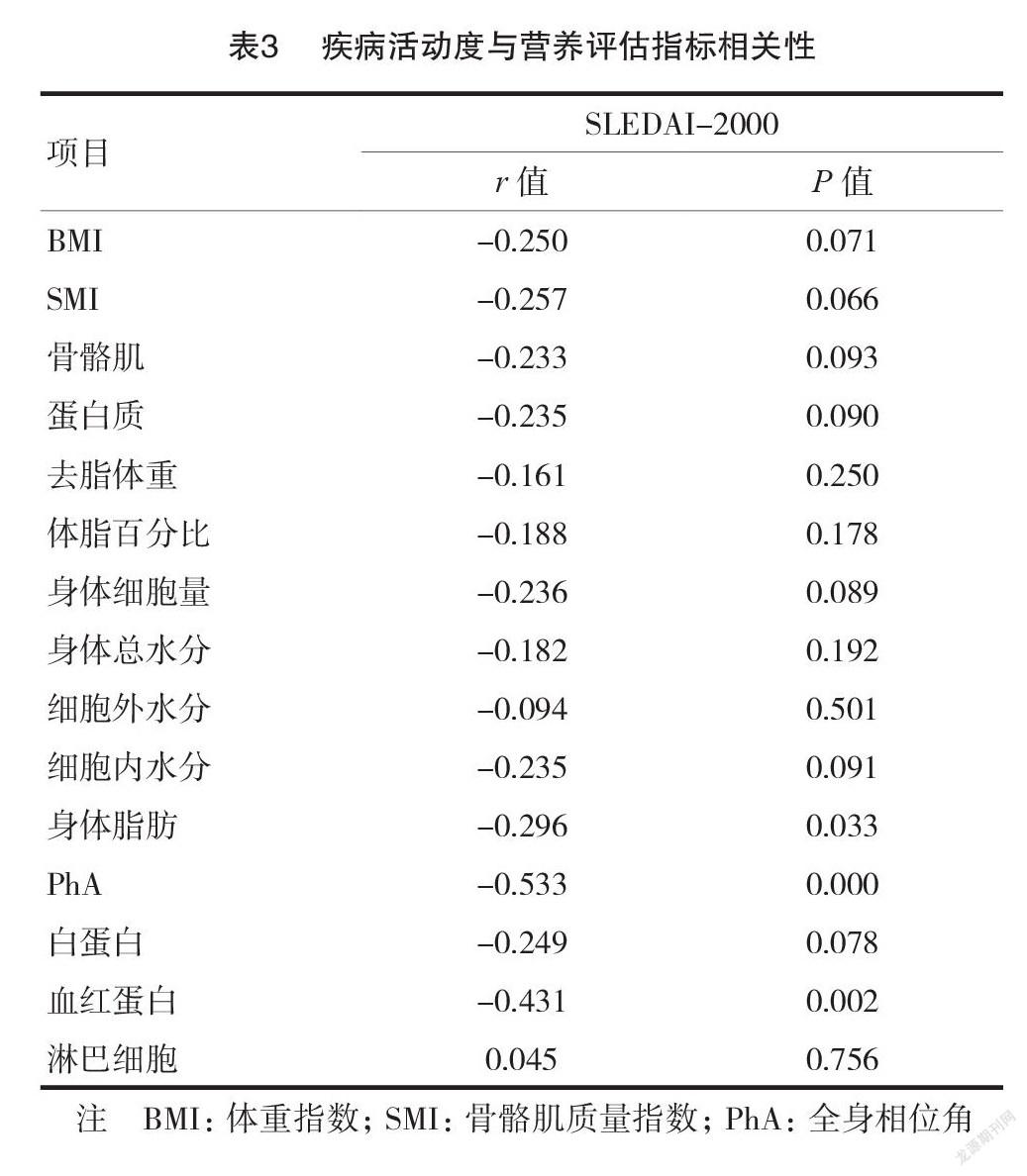
[摘要]目的探究系统性红斑狼疮(SLE)患者疾病活动度与人体成分等营养指标的相关性。方法选取福建省立医院2019年1月至2021年8月收治的110例 SLE 患者,根据 SLE 疾病活动度分为 SLE 疾病活动组(SLE DAI-2000≥5分, n=60)和 SLE 非疾病活动组(SLE DAI-2000<5分,n=50),比较分析两组患者的临床资料、实验室检查、人体成分数据,分析 SLE 疾病活动度与人体成分的相关性。结果与 SLE 非疾病活动组相比,SLE 疾病活动组患者的血红蛋白、血清白蛋白、补体 C3、补体 C4水平均较低,而血沉相对较高,差异有统计学意义(P<0.05);SLE 疾病活動组的全身相位角(PhA)及身体脂肪明显低于 SLE 非疾病活动组( P <0.05)。 SLE 患者疾病活动度与身体脂肪( r=-0.296,P=0.033)、PhA( r=-0.533,P=0.000)及血红蛋白( r=-0.431, P=0.002)呈负相关。结论疾病活动度越高的 SLE 患者人体成分指标越低,其营养风险越大,人体成分分析可作为 SLE 营养筛查的参考指标及营养支持的依据。
[关键词]系统性红斑狼疮;疾病活动度;人体成分:营养评估
[中图分类号] R593.24+1 [文献标识码] A [文章编号]2095-0616(2022)09-0007-05
Analysis on the correlation between systemic lupus erythematosus disease activity and body composition
WU Chenmin LV Xinyang LIU Jianwen DAI Yijun GAO Fei1
1.Department of Rheumatology and Immunology, Fujian Provincial Hospital, Fujian, Fuzhou 350001, China;2.Department of Clinical Nutrition, Fujian Provincial Hospital, Fujian, Fuzhou 350001, China
[Abstract] Objective To investigate the correlation between disease activity and body composition and other nutritional indicators in patients with systemic lupus erythematosus (SLE). Methods A total of 110 SLE patients admitted to Fujian Provincial Hospital from January 2019 to August 2021 were selected and divided into the SLE disease activity group (SLE DAI-2000≥5 points, n=60) and the SLE non-disease activity group (SLE DAI-2000<5 points, n=50) according to SLE disease activity. The clinical data, laboratory examination, and body composition data of the two groups were comparatively analyzed to investigate the correlation between SLE disease activity and body composition. Results The levels of hemoglobin, serum albumin, complement C3 and complement C4 were lower and the erythrocyte sedimentation rate was relatively higher in patients in the SLE disease activity group than those in the SLE non-disease activity group, with statistically significant differences (P <0.05). The whole-body phase angle (PhA) and body fat in the SLE disease activity group were significantly lower than those in the SLE non-disease activity group (P <0.05). The SLE disease activity was negatively correlated with body fat (r=-0.296, P=0.033), whole-body PhA (r=-0.533, P=0.000) and hemoglobin (r=-0.431, P=0.002). Conclusion The higher the SLE disease activity, the lower the body composition index in such patients, and the greater their nutritional risk. And the body composition analysis can be used as a reference index for nutritional screening and nutritional support in SLE patients.
[Key words] Systemic lupus erythematosus; Disease activity; Body composition; Nutritional assessment
系统性红斑狼疮(systemic lupus erythematosus, SLE)为全身性、慢性自身免疫性疾病,其临床表现多样,可累及全身各个器官,包括骨骼肌肉、肾脏及消化系统等[1],筛选与 SLE 疾病活动度密切相关的指标对于患者治疗方式的选择及其预后具有重要意义。越来越多的研究表明,SLE 易合并多种营养问题如贫血、低蛋白血癥及体质异常等[2-4],而营养不良不仅影响疾病预后,也是患者住院率和病死率的重要影响因素[5]。常用的营养评估指标包括体重指数(body mass index, BMI)、血红蛋白、血清白蛋白及生物电阻抗分析法(bioelectrical impedanceanalysis, BIA)人体成分测量。……