青春期后痤疮的发病因素及红蓝光联合强脉冲光治疗的效果分析
2021-11-22谭竞宜张照明
谭竞宜 张照明
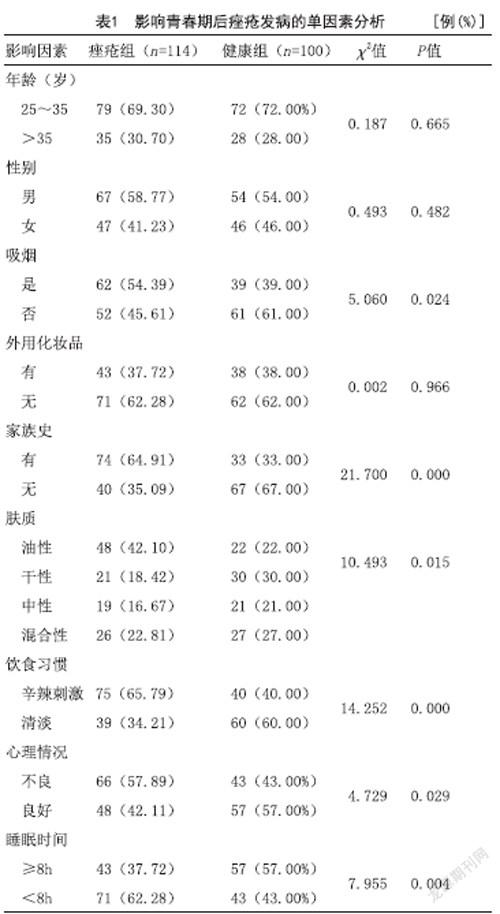
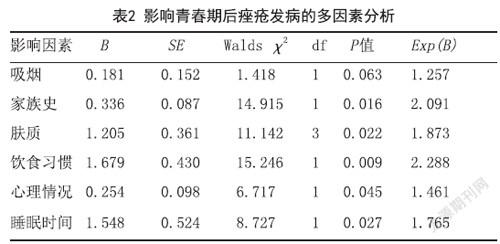

[摘要]目的:探讨青春期后痤疮发病的影响因素,并观察红蓝光联合强脉冲光治疗的临床效果。方法:选取2019年6月-2020年6月笔者医院收治的青春期后痤疮患者114例。根据随机数字法分为对照组和观察组,每组57例。另选取笔者医院同期健康志愿者100名为健康组。对照组采用红蓝光治疗,观察组在对照组基础上加用强脉冲光治疗,比较两组治疗效果及不良反应情况。记录所有研究对象一般情况,采用单因素分析和多元Logistic回归模型分析青春期后痤疮发病的影响因素。结果:吸烟、家族史、肤质、饮食习惯、心理情况、睡眠时间均与青春期后痤疮的发病有关(P<0.05)。多因素Logistic分析显示,家族史、肤质、饮食习惯、心理情况、睡眠时间均是影响青春期后痤疮发病的因素(P<0.05)。观察组总有效率94.74%,高于对照组的82.46%(P<0.05)。两组不良反应总发生率比较,差异无统计学意义(P>0.05)。结论:家族史、肤质、饮食习惯、心理情况及睡眠时间均是影响青春期后痤疮发病的因素。红蓝光联合强脉冲光在青春期后痤疮的治疗中疗效确切,安全性高,值得临床推广应用。
[關键词]青春期后痤疮;发病因素;红蓝光;强脉冲光;临床效果
[中图分类号]R758.73+3 [文献标志码]A [文章编号]1008-6455(2021)06-0094-04
Pathogenic Factors of Post-adolescent Acne and Observation of the Therapeutic Effect of Red and Blue Light Combined with Intense Pulsed Light
TAN Jing-yi1,ZHANG Zhao-ming2
(1.Department of Dermatology,Rheumatism and Immunology,Second Affiliated Hospital of Army Medical University,Chongqing 400037,China; 2.Department of Dermatology, Chongqing Iron and Steel General Hospital, Chongqing 400080,China)
Abstract:Objective To investigate the influencing factors of post-adolescent acne, and observe the clinical effect of red and blue light combined with intense pulsed light. Methods Total of 114 patients with post-adolescent acne admitted to our hospital from June 2019 to June 2020 were selected. According to the random number method, the patients with post-adolescent acne were divided into the control group (n=57) and the observation group (n=57). In addition, 100 healthy volunteers from our hospital during the same period were selected as the healthy group. The control group was treated with red and blue light, and the observation group was treated with intense pulsed light on the basis of the control group, the treatment effect and adverse reactions between the two groups were compared. The general conditions of all subjects were recorded, and the univariate analysis and multiple logistic regression models were used to analyze the influencing factors of post-adolescent acne. Results Smoking, family history, skin type, eating habits, psychological status, and sleep time were all related to the incidence of post-adolescent acne (P<0.05). Multivariate logistic analysis showed that family history, skin type, eating habits, psychological status, and sleep time were all factors that affected the incidence of post-adolescent acne (P<0.05). The total effective rate in the observation group (94.74%) was higher than that in the control group (82.46%), and the difference was statistically significant (P<0.05). There was no significant difference in the total incidence of adverse reactions between the two groups (P>0.05). Conclusion Family history, skin type, eating habits, psychological status, and sleep time were all factors that affected the incidence of post-adolescent acne. In addition, the red and blue light combined with intense pulsed light has a definite effect in the treatment of post-adolescent acne, with high safety, and which is worthy of clinical application.
Key words:post-adolescent acne; pathogenic factors; red and blue light; intense pulsed light; clinical effect
寻常痤疮是一种慢性炎症性皮肤疾病,通常多发于青年人,在青少年中的发病率高达40%~60%[1]。近年来,青春期后痤疮的患病率日益升高,患病人数为痤疮患者的31%左右[2]。青春期后痤疮是25岁之后的痤疮,其主要表现为颜面和胸背等部位出现瘢痕、丘疹、粉刺及脓疱等多形态皮肤损害。该疾病病因复杂,且病程长,对患者的外貌美观及日常生活造成严重困扰[3]。因此,采取有效手段修复青春期后痤疮患者的皮肤具有重要意义。……