正念冥想结合康复训练对卒中后抑郁患者心理及躯体功能的影响
2021-09-13江潭耀许秀
江潭耀 许秀
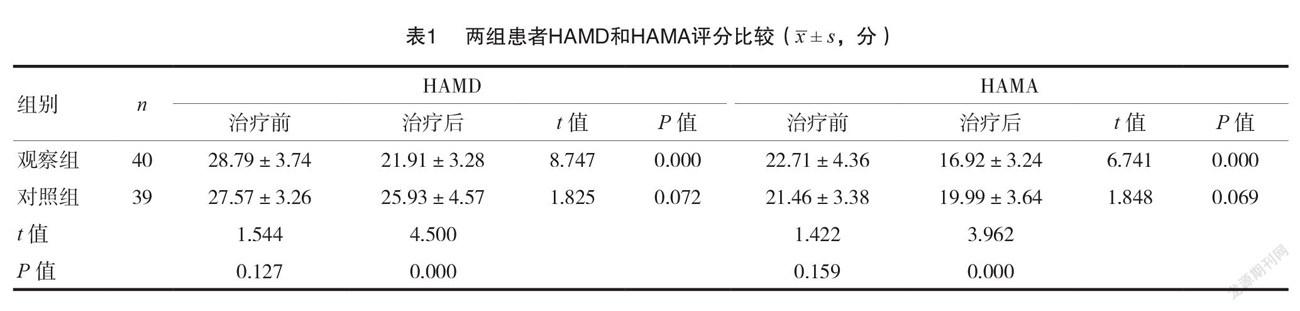
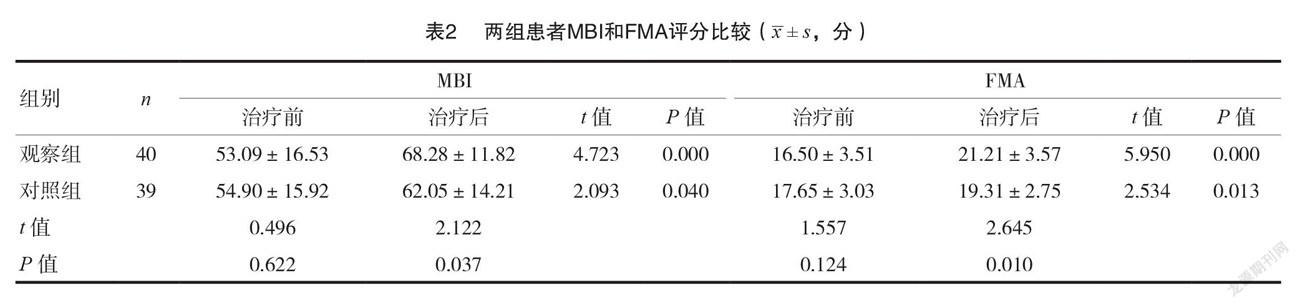
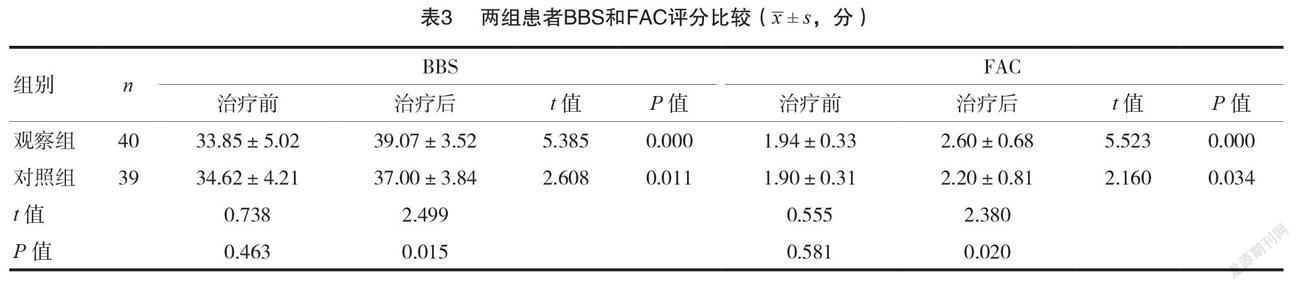
[摘要]目的觀察正念冥想结合康复训练对卒中后抑郁患者心理及躯体功能的影响。方法选取2018年12月至2020年12月于广东祈福医院康复中心接收治疗的卒中后抑郁患者80例作为研究对象,按照随机数字表法分为观察组和对照组,两组均接受常规康复治疗,对照组同时给予康复心理宣教,观察组同时给予正念冥想训练,比较分析两组患者治疗后心理及躯体功能的疗效。结果治疗4周后,对照组患者的汉密尔顿抑郁量表(HAMD)、汉密尔顿焦虑量表(HAMA)评分与本组治疗前比较,差异无统计学意义( P >0.05);对照组患者的改良 Barthel 指数(MBI)、Fugl-Meyer 运动功能评定量表(FMA)、Berg 平衡量表(BBS)、Holden 步行功能分级(FAC)评分均高于本组治疗前,差异有统计学意义( P <0.05);观察组患者的 HAMD、 HAMA 评分均明显低于治疗前,且低于对照组,差异有统计学意义( P <0.01);观察组患者的 MBI、FMA、 BBS、FAC 评分均高于治疗前,且高于对照组,差异有统计学意义( P <0.05)。结论针对卒中后抑郁患者,采用正念冥想结合康复训练更有利于提高患者的心理及躯体功能,值得临床推广。
[关键词]正念冥想;抑郁;卒中;康复训练;心理
[中图分类号] R743.3 [文献标识码] A [文章编号]2095-0616(2021)22-0169-05
The effect of mindfulness meditation combined with rehabilitation training on psychological and physical functions of the patients with post-stroke depression
JIANG Tanyao XU Xiu
Rehabilitation Center, Clifford Hospital in Guangdong Province, Guangdong, Guangzhou 511495, China
[Abstract] Objective To observe the effect of mindfulness meditation combined with rehabilitation training on psychological and physical functions of the patients with post-stroke depression. Methods A total of 80 patients with post-stroke depression who received treatment in Rehabilitation Center of Clifford Hospital in Guangdong Province from December 2018 to December 2020 were taken as the subjects of research. They were divided into the observation group and the control group according to random number table method. Both groups received routine rehabilitation treatment, while the control group was also given rehabilitation psychological education and the observation group was also given mindfulness meditation training. The curative effect on the psychological and physical functions of patients was analyzed and compared between the two groups. Results After 4 w of treatment, when the scores of Hamilton Depression Scale (HAMD) and Hamilton Anxiety Scale (HAMA) of the patients in the control group were compared with those before treatment, the differences were statistically insignificant (P >0.05). The Modified Barthel Index (MBI) and the scores of Fugl-Meyer motor function assessment (FMA), Berg Balance Scale (BBS) and Holden functional ambulation category scale (FAC) of the patients in the control group were all higher than those before treatment, and the differences were statistically significant (P <0.05). The scores of HAMD and HAMA of the patients in the observation group were significantly lower than those before treatment and the control group, and the differences were obviously statistically significant (P <0.01). The MBI, FMA, BBS and FAC scores of the patients in the observation group were all higher than those before treatment and the control group, and the differences were statistically significant (P <0.05). Conclusion As far as the patients with post-stroke depression are concerned, mindfulness meditation combined with rehabilitation training can better ameliorate their psychological and physical functions. It is worthy of clinical promotion.
[Key words] Mindfulness meditation; Depression; Stroke; Rehabilitation training; Psychological
脑卒中具有高发病率、高致残率、高复发率、高死亡率四高的特点[1]。其中20%~40%的脑卒中患者伴有抑郁和焦虑等情绪障碍[2]。抑郁和焦虑致使卒中患者在康复治疗中出现紧张烦躁、消极淡漠的情绪,甚至产生拒绝抵抗治疗的行为,康复治疗主动参与度下降,严重影响患者的康复效率和生存质量[3]。正念冥想训练能明显提升幸福感、勇敢向上等正面情绪,降低自我不满、忧伤、愤怒、烦躁等负性情绪[4]。因此改善卒中患者的情绪障碍有助于提高康复效率,促进躯体功能的康复。本研究将正念冥想结合康复训练应用于卒中后抑郁患者心理及躯体功能的治疗取得了较为满意的效果,现报道如下。