实施循证护理对急性心肌梗死后心律失常患者病情产生的效果
2021-09-10于艳霞
于艳霞

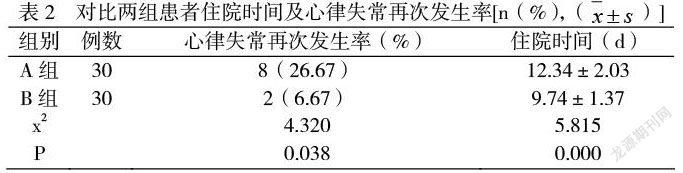
摘要:目的 探讨对急性心肌梗死后心律失常患者实施循证护理的效果。方法 将60例于2020年3月-2021年3月收治的急性心肌梗死后心律失常患者纳入研究,并以等量电脑随机法均分成AB两组。予以A组常规护理干预,B组循证护理干预,并对比干预效果。结果 B组心电图检查各项指标均优于A组,住院时间及心律失常再次发生率均少于A组,对比存在统计学意义(P〈0.05)。结论 对急性心肌梗死后心律失常患者实施循证护理可确保临床疗效提升心功能,减少心律失常再次发生率,并缩短住院时间,具有较高应用价值,值得被推广。
关键词:急性心肌梗死;心律失常;循证护理;心功能
[Abstract]Objective To explore the effect of evidence-based nursing on patients with arrhythmia after acute myocardial infarction. Methods 60 patients with arrhythmia after acute myocardial infarction from March 2020 to March 2021 were included in the study,and they were randomly divided into AB group and ab group. Group A was given routine nursing intervention,group B was given evidence-based nursing intervention,and the intervention effect was compared. Results the indexes of ECG examination in group B were better than those in group A,the hospitalization time and the recurrence rate of arrhythmia were less than those in group A,and the comparison was statistically significant(P ﹤ 0. 05). Conclusion the implementation of evidence-based nursing for patients with arrhythmia after acute myocardial infarction can ensure the clinical curative effect,improve cardiac function,reduce the incidence of arrhythmia again,and shorten the length of hospital stay,which has high application value and is worthy of promotion.
[Key words]acute myocardial infarction;Arrhythmia;Evidence based nursing;Cardiac function
急性心肌梗死会导致心肌急性缺血及心肌细胞坏死,从而影响心肌收缩功能及心肌电活动,并诱发心律失常【1】。发作时患者表现为严重的胸闷、胸疼、气短和窒息感,严重者还会出现晕厥和猝死。针对该疾病需要积极展开治疗,并辅以高质量护理干预,才可改善疾病预后。而本次纳入研究急性心肌梗死后心律失常患者60例,并于2020年3月-2021年3月开展医学研究,着重分析循证护理的应用效果。现将详细内容进行如下报告:
1 资料和方法
1.1一般资料
经院内伦理委员会批准,将60例于2020年3月-2021年3月收治的急性心肌梗死后心律失常患者纳入研究,并以等量电脑随机法均分成AB两组,且均签署知情文件。同时排除沟通及精神异常、病情不稳定、合并恶性肿瘤及其他严重器质性病变患者。男女比例A组16:14,B组17:13;平均年龄A组(68.65±4.54)岁,B组(68.15±4.61)岁。……
