对全过程优质护理在肝硬化患者临床治疗中的效果进行观察分析
2021-09-10李秀华
李秀华

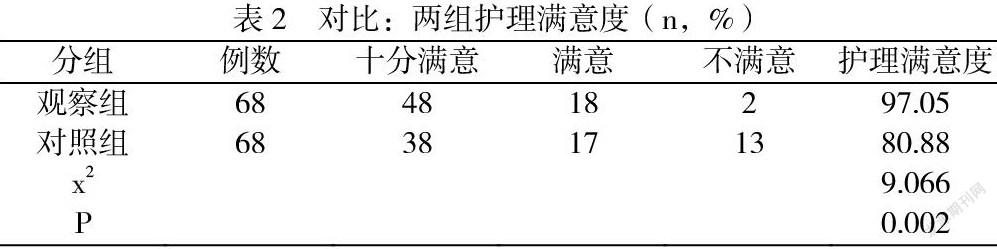
摘要:目的 分析全过程优质护理在肝硬化患者临床治疗中的效果。方法 选取本院2019年5月到2020年5月期间收治的136例肝硬化患者进行研究,采用随机数字表法把其分成观察组和对照组,各68例,对照组采用常规的护理方法,观察组在常规护理的基础上加入全过程优质护理干预,并对两组的临床效果和护理满意度进行比较。结果 观察组总有效率为98.52%显著高于对照组的77.94%,同时获得的护理满意度为97.05%显著比对照组的80.88%高,两组存在较大差异,有统计学意义(P<0.05)。结论 针对肝硬化患者护理的过程中在常规护理的基础上加入全过程优质护理,能够显著的对临床治疗效果进一步的提升,能够收获更多的护理满意度,值得在临床上进行推广和应用。
关键词:全过程优质护理;肝硬化;效果;护理满意度
[Abstract]Objective To analyze the effect of whole process high quality nursing in the clinical treatment of patients with liver cirrhosis. Methods 136 patients with liver cirrhosis in our hospital from May 2019 to may 2020 were selected and randomly divided into the observation group and the control group,68 cases in each group. The control group was given routine nursing,and the observation group was given whole process high-quality nursing intervention on the basis of routine nursing. The clinical effect and nursing satisfaction of the two groups were compared. Results the total effective rate of the observation group was 98.52%,which was significantly higher than 77.94% of the control group. The nursing satisfaction of the observation group was 97.05%,which was significantly higher than 80.88% of the control group. There was a big difference between the two groups,with statistical significance(P < 0.05). Conclusion for patients with liver cirrhosis in the process of nursing,in addition to routine nursing,adding the whole process of high-quality nursing can significantly improve the clinical treatment effect,and can harvest more nursing satisfaction,which is worthy of clinical promotion and application.
[Key words]whole process high quality nursing;liver cirrhosis;effect;nursing satisfaction
肝硬化屬于内科在临床中经常会遇到的一种慢性发展性肝脏病变,致病因有很多,多种致病因长期、反复作用下形成的弥漫性肝脏损伤【1】。病情控制不良会容易并发肝腹水、继发性感染、上消化道出血等症状,严重的威胁到患者身体健康和生活质量【2】。因此,为了促进肝硬化患者更快的恢复,单纯的依靠治疗手段很难实现,还要对护理质量和水平进行提升。针对肝硬化患者不仅要进行及时的、有效的治疗,还要给予全面的、优质的护理【2】。本研究选取本院2019年5月到2020年5月期间收治的136例肝硬化患者作为研究对象,分析全过程优质护理在肝硬化患者临床治疗中的效果,取得显著的效果,现报告如下。
1 资料和方法
1.1一般资料
选取本院2019年5月到2020年5月期间收治的136例肝硬化患者进行研究,采用随机数字表法把其分成观察组和对照组,各68例,观察组男35例,女33例,年龄在33-75岁之间,平均年龄(58.26±3.23)岁;对照组男30例,女38例,年龄36-73岁之间,平均年龄(59.14±2.86)岁。……
