番石榴产区橘小实蝇转移为害规律研究
2021-08-26黄爱玲李媛黄慧欣王小云陆温郑霞林
黄爱玲 李媛 黄慧欣 王小云 陆温 郑霞林
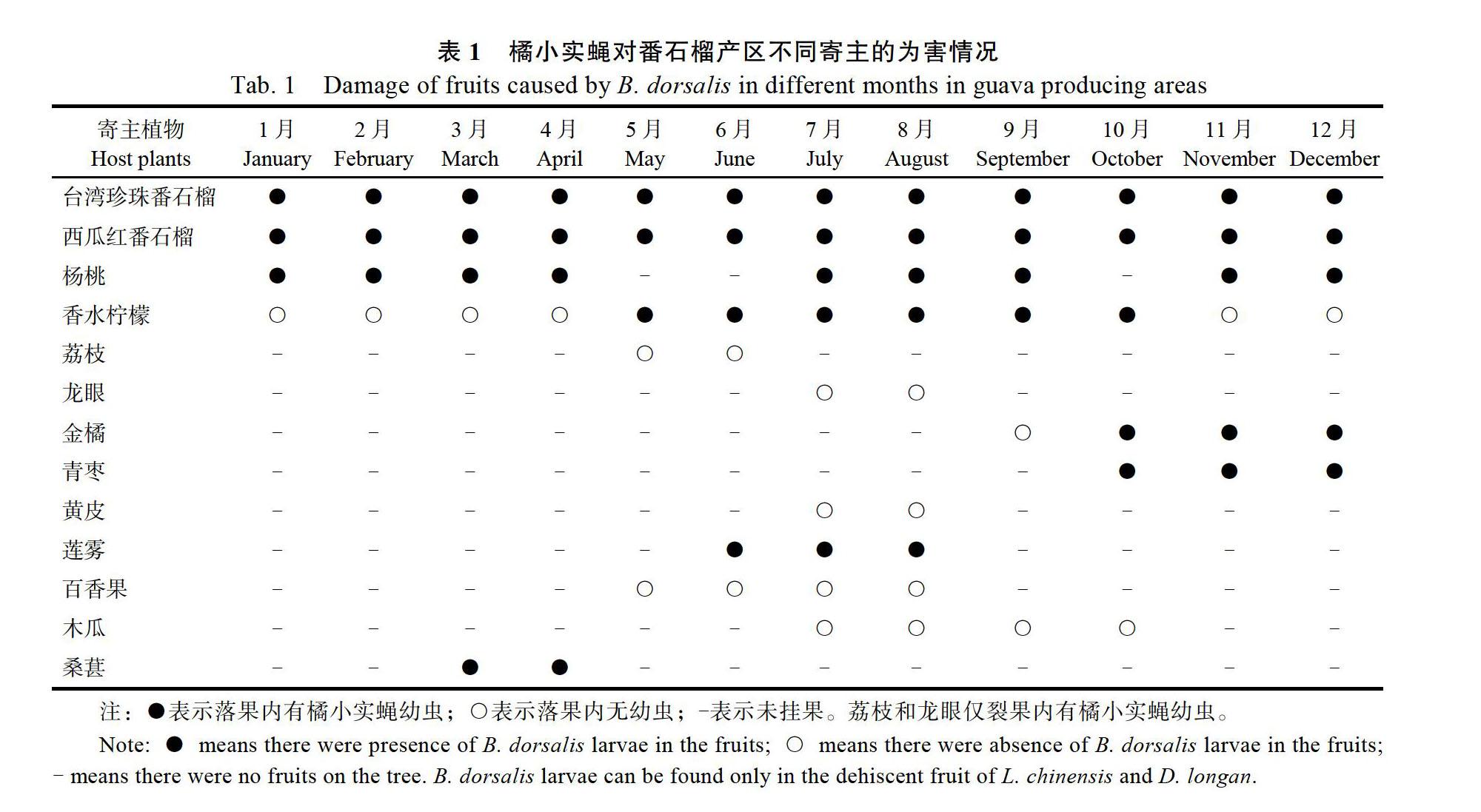
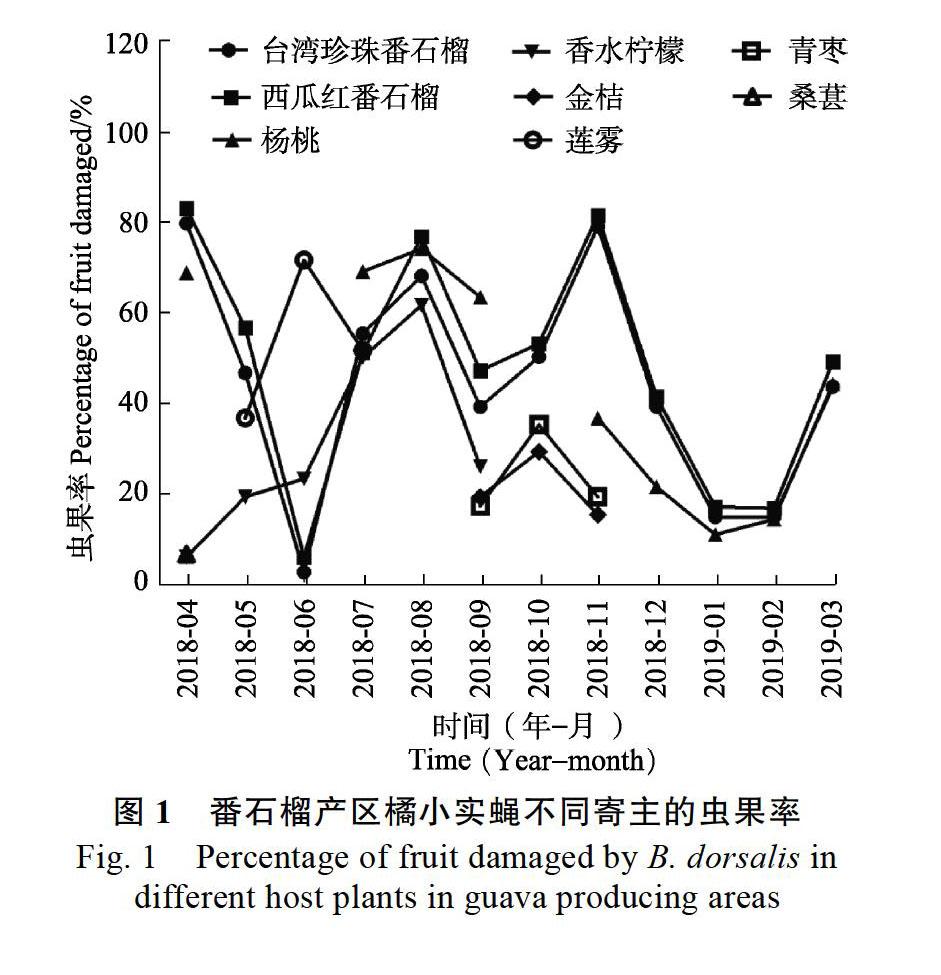
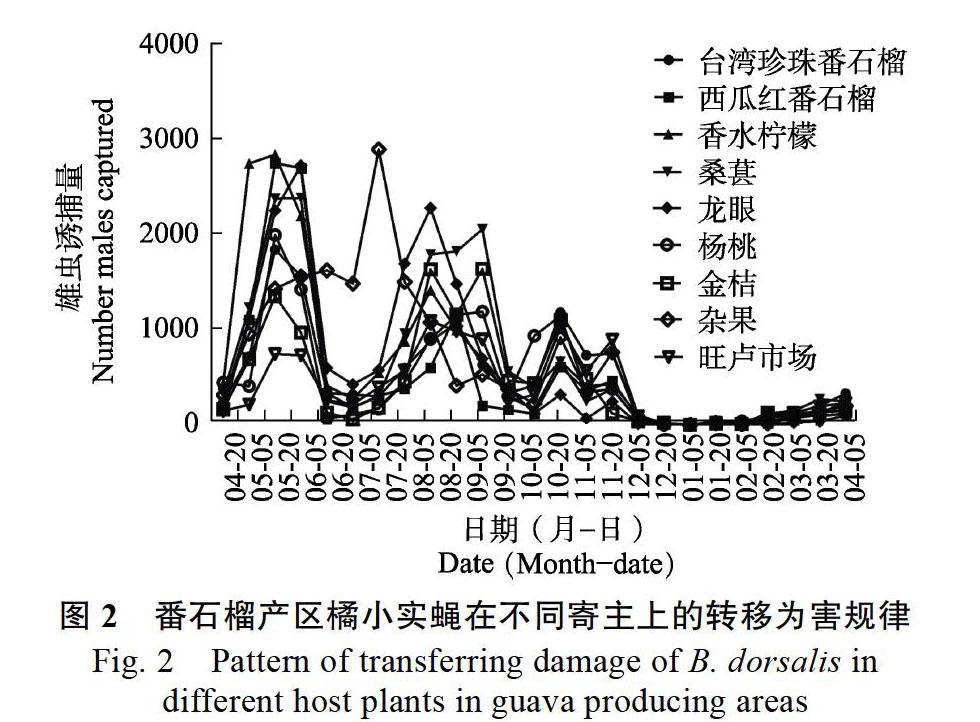
摘 要:諸多室内研究结果表明番石榴(Psidium guajava L.)是橘小实蝇[Bactrocera dorsalis (Hendel)]最嗜好的寄主。然而,自然条件下番石榴的果实成熟期均有明显的季节性,当其采收后橘小实蝇种群如何生存和繁衍尚不明确。假设番石榴果实成熟采收前后橘小实蝇会转移为害,且其转移为害规律与气象因子紧密相关。为验证该假设,本研究选择广西番石榴主产区,调查了橘小实蝇寄主种类、为害率、转移为害规律及其与气象因子的关系。结果表明,番石榴产区不同月份成熟的13种瓜果中有10种受橘小实蝇为害,番石榴的受害率最严重,最高达84.00%;橘小实蝇的转移为害规律为番石榴和杨桃(Averrhoa carambola L.)(1—2月)→番石榴、杨桃和桑葚(Morus alba L.)(3—4月)→番石榴和香水柠檬[Citrus limon (L.) Burm. f.](5月)→番石榴、香水柠檬、莲雾[Syzygium samarangense (Bl.) Merr. et Perry]、荔枝(Litchi chinensis Sonn.)和龙眼(Dimocarpus longan Lour.)裂果(6月)→番石榴、杨桃、香水柠檬和莲雾(7—9月)→番石榴、杨桃、香水柠檬、金橘[Fortunella margarita (Lour.) Swingle]和青枣(Zizyphus mauritiana Lam.)(10—12月);番石榴产区全年均可诱捕到橘小实蝇成虫,共有5个成虫发生高峰期,分别为5月下旬、7月下旬、8月下旬至9月下旬、11月上旬和12月上旬。气温和降水量分别是影响番石榴产区橘小实蝇转移为害规律的主要和次要因子。研究结果明确了番石榴产区橘小实蝇的转移为害规律及其与气象因子的相关性,为制定其种群控制策略和防治技术提供重要参考。
关键词:番石榴;橘小实蝇;转移为害;种群动态;气象因子
中图分类号:S436.67 文献标识码:A
Pattern of Transferring Damage of Bactrocera dorsalis (Hendel) Adults in Guava Producing Areas
HUANG Ailing, LI Yuan, HUANG Huixin, WANG Xiaoyun, LU Wen, ZHENG Xialin*
College of Agriculture, Guangxi University, Nanning, Guangxi 530004, China
Abstract: Results of many lab experiments show that Bactrocera dorsalis (Hendel) prefer to oviposit in Psidium guajava L. fruits. However, P. guajava fruits harvested has a season in the fields, and there is unclear that B. dorsalis population how to survive and reproduce after P. guajava fruits are harvested. We hypothesize that B. dorsalis would transfer to damage other fruits after P. guajava fruits are harvested, and the pattern of transferring damage is correlated with meteorological factors. To test our hypothesis, the host species, damage rate, and pattern of transferring damage of B. dorsalis are investigated, and the correlations between the pattern of transferring damage and meteorological factors in guava producing area of Guangxi are also analyzed. Results showed that a total of 13 species of fruit matured in different months in guava producing areas, and 10 of the fruits were damaged by B. dorsalis. The percentage of damaged fruit of P. guajava was the highest (84.00%) among of all damaged fruit. The pattern of transferring damage of B. dorsalis in guava producing areas was: P. guajava and Averrhoa carambola (January to Februarry) → P. guajava, A. carambola and Morus alba (March and April) → P. guajava and Citrus limon (May) → P. guajava, A. carambola, C. limon, Litchi chinensis and Dimocarpus longan (June) → P. guajava, A. carambola, C. limon and Clausena lansium (July to September) → P. guajava, A. carambola, C. limon, Fortunella margarita and Zizyphus mauritiana (October to December). Male B. dorsalis could be trapped by sex pheromone for whole year in guava producing areas, and five occurrence peaks of B. dorsalis adults were observed in late May, late July, late August to late September, early November and early December. Temperature and precipitation were the most important meteorological factors affecting the pattern of transferring damage of B. dorsalis in guava producing area. Results from the current study clarified the pattern of transferring damage of B. dorsalis and its correlation with meteorological factors in guava producing areas, which would provide helpful information to determine the strategy and technology for control of this pest.
Keywords: Psidium guajava; Bactrocera dorsalis; pattern of transferring damage; population dynamic; meteorological factor
DOI: 10.3969/j.issn.1000-2561.2021.07.028
橘小实蝇[Bactrocera dorsalis (Hendel)](双翅目Diptera:实蝇科Tephritidae)是水果和蔬菜上的重要害虫,寄主达46科250多种[1]。……