帕立骨化醇联合西那卡塞治疗终末期肾衰竭患者甲状旁腺功能亢进的研究
2021-07-01魏培丹徐石张陈效易建伟罗子云何志红
魏培丹 徐石张 陈效 易建伟 罗子云 何志红
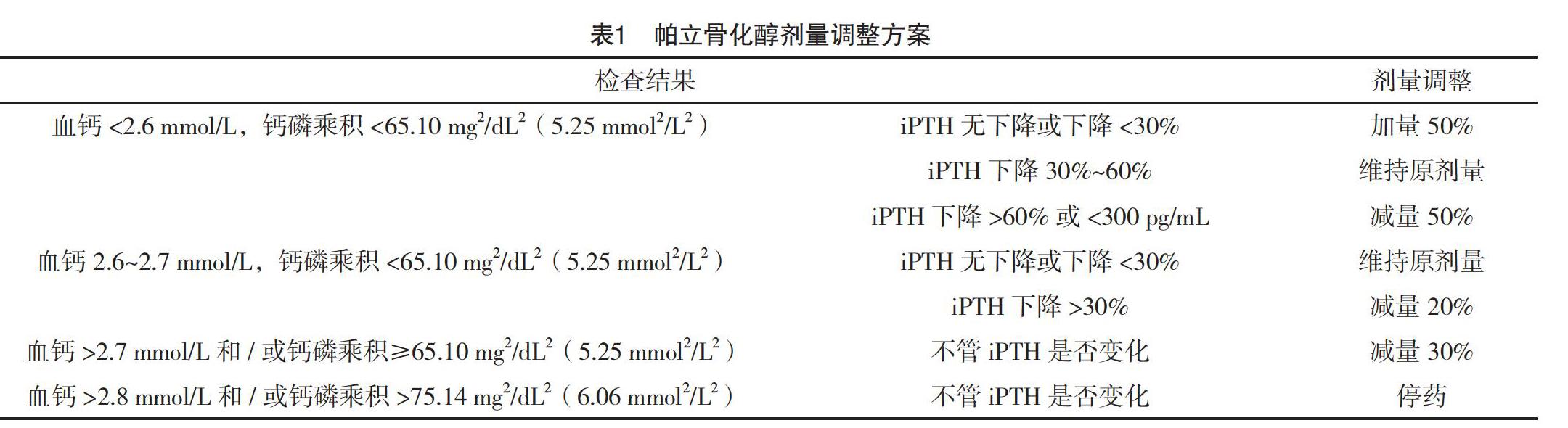

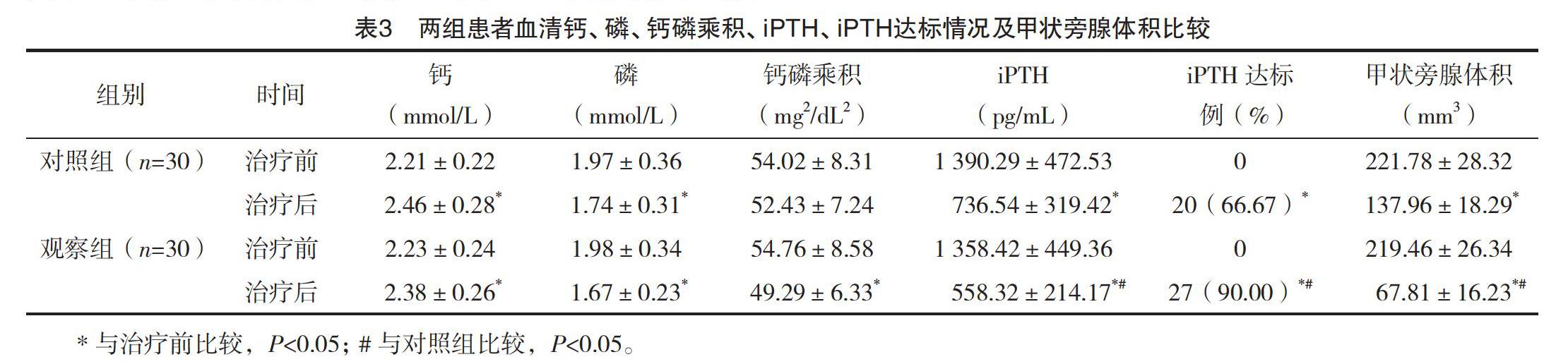
【摘要】 目的:探究帕立骨化醇联合西那卡塞治疗终末期肾衰竭患者甲状旁腺功能亢进的效果。方法:选取2018年1月-2019年1月于本院接受血液透析的终末期肾衰竭继发性甲状旁腺功能亢进(SHPT)患者60例为研究对象。按照随机数字表法分为对照组和观察组,各30例。对照组患者采用帕立骨化醇个体化剂量单药治疗,观察组患者采用帕立骨化醇联合西那卡塞治疗,两组患者均每4周复查血清钙、磷、血清全段甲状旁腺素(iPTH),并依据检测结果调整药物剂量。比较两组12周后的疗效、血清钙、磷、iPTH、iPTH达标情况、肾功能、骨代谢指标及不良反应发生情况。结果:观察组患者治疗总有效率为93.33%,显著高于对照组的73.33%,差异有统计学意义(P<0.05)。治疗后,两组患者血钙水平均较治疗前升高,血磷较治疗前均降低(P<0.05),但组间比较差异无统计学意义(P>0.05);治疗后,观察组患者钙磷乘积较治疗前降低(P<0.05)。兩组iPTH水平、甲状旁腺体积水平较治疗前均降低,且观察组均低于对照组(P<0.05)。观察组患者治疗后iPTH达标率显著高于对照组(P<0.05)。治疗后,两组患者尿素氮、肌酐及尿素清除指数与治疗前比较,差异均无统计学意义(P>0.05);治疗后,两组患者的尿素氮、肌酐及尿素清除指数比较,差异均无统计学意义(P>0.05)。治疗后,两组患者ALP、OC、β-cross水平均较治疗前降低,且观察组均低于对照组,差异均有统计学意义(P<0.05)。观察组患者不良反应发生率为10.00%,显著低于对照组的33.33%,差异有统计学意义(P<0.05)。结论:帕立骨化醇联合西那卡塞是治疗终末期肾衰竭患者SHPT的有效方案,能够降低iPTH水平、缩小甲状旁腺体积、改善骨代谢,且对血钙、磷影响较小,安全有效。
【关键词】 帕立骨化醇 终末期肾衰竭 甲状旁腺功能亢进
A Study on Paricalcitol Combined with Cinacalcet in the Treatment of Hyperparathyroidism in Patients with End-stage Renal Failure/WEI Peidan, XU Shizhang, CHEN Xiao, YI Jianwei, LUO Ziyun, HE Zhihong. //Medical Innovation of China, 2021, 18(13): 0-077
[Abstract] Objective: To investigate the effect of Paricalcitol combined with Cinacalcet in the treatment of hyperparathyroidism in patients with end-stage renal failure. Method: A total of 60 patients with end-stage renal failure secondary hyperparathyroidism (SHPT) who received hemodialysis in our hospital from January 2018 to January 2019 were selected as the research subjects. According to random number table method, they were divided into control group and observation group, 30 cases in each group. Patients in control group were treated with individualized dose of Paricalcitol monotherapy, and patients in observation group were given Paricalcitol combined with Cinacalcet. Serum calcium, phosphorus and serum intact parathyroid hormone (iPTH) were reexamined every 4 weeks, and the drug dose was adjusted according to the detection results. The curative effect, serum calcium, phosphorus, iPTH, iPTH compliance rate, renal function, bone metabolism indexes and occurrence of adverse reactions were compared between the two groups after 12 weeks. Result: The total effective rate of treatment of observation group was 93.33%, which was significantly higher than 73.33% of control group (P<0.05). After treatment, serum calcium levels in two groups were increased and serum phosphorus levels were decreased compared with before treatment (P<0.05), but there were no statistically significant differences between groups (P>0.05). The calcium-phosphorus product in observation group after treatment was lower than that before treatment (P<0.05). The iPTH level and parathyroid volume in both groups were lower than those before treatment, and the two indexes of observation group were significantly lower than those of control group (P<0.05). The iPTH compliance rate in observation group was significantly higher than in control group after treatment (P<0.05). After treatment, there were no significant differences in blood urea nitrogen, creatinine and urea clearance index of two groups compared with before treatment (P>0.05). After treatment, there were no statistical significance in blood urea nitrogen, creatinine and urea clearance index between two groups (P>0.05). After treatment,the levels of ALP, OC and β-cross in two groups were reduced compared with those before treatment, and the levels in observation group were lower than those in control group (P<0.05). The incidence rate of adverse reactions (ADR) was 10.00% in observation group, which was significantly lower than 33.33% in control group (P<0.05). Conclusion: Palicalcitol combined with Cinacalcet is an effective regimen for the treatment of SHPT in patients with end-stage renal failure, which can reduce iPTH level, reduce parathyroid volume and improve bone metabolism, and it has little effect on serum calcium and phosphorus, which is safe and effective.
[Key words] Paricalcitol End-stage renal failure Hyperparathyroidism
First-authors address: Yichun Peoples Hospital, Yichun 336000, China
doi:10.3969/j.issn.1674-4985.2021.13.018
继发性甲状旁腺功能亢进(secondary hyperparathyroidism, SHPT)是指多种因素导致机体钙磷代谢紊乱,刺激甲状旁腺增生,过度分泌甲状旁腺激素的综合征[1],是终末期肾脏病患者严重的并发症,发病与活性维生素D减少、钙磷代谢紊乱有关[2],会严重损害骨骼,引起贫血、神经组织和心血管并发症等不良后果[3]。目前该病主要采用药物治疗来平衡甲状旁腺激素分泌,新型活性维生素……