扭曲拉盖尔—高斯关联光束对大气湍流传输影响的抑制
2021-06-15马超群朱时军刘晓旭安国斐
张 滢,马超群,朱时军,刘晓旭,蔡 和,安国斐,王 浟
(1. 西南技术物理研究所,四川 成都 610041;2. 南京理工大学 理学院,江苏 南京 210094)
1 Introduction
In the process of free-space transmission, the laser beam will be affected by atmospheric turbulence, resulting in beam drift, light intensity scintillation and other phenomena that may degrade the beam transmission quality. Therefore, suppressing the influence of atmospheric turbulence through light field regulation has become an important research subject[1-5]. Researchers have found that the suppression effect of partially coherent light on atmospheric turbulence is stronger than that of completely coherent light. The theory of partially coherent light with twisted phase has been developed rapidly in recent 20 years. The concept of twisted phase was originally proposed by Simon and Mukunda et al. in 1993, and could not be decomposed into the product of two one-dimensional coordinate parameters at that time. Meanwhile, they theoretically constructed the theoretical module of twisted Gaussian Schell-model beam, and analyzed the transmission characteristics of this new beam[6]. In 1994, Friberg et al. combined previous theories with the first experiment in this regard to obtain the twisted Gaussian Schell-model beam, but their experimental optical path was complex with poor repeatability[7]. Because the magnitude of twisted-phase factor was limited by positive definiteness, not all beams could carry the twisted phase. Since then, the research has been limited to the common coherent beams. It was not until 2007 that the situation changed. In 2007,Gori et al. proposed the positive-definiteness criteria for the theory of reproducing kernel in Hilbert space, which provided an important theoretical support for the exploration of coherent structure in new stochastic light field[8]. Later, Borghi and Gori proposed the twisting conditions of axisymmetric Schell-mode correlated beam in 2015[9]. Then in 2018, they proved that the beam twisting was only related to the coherent structure of light field. They also provided the criteria for determining whether the coherent structure could carry a twisted phase[10-11]. By constructing a new coherent structure to regulate the phase, the anti-turbulence capability of the twisted beam can be further enhanced. In addition, the beam can carry orbital angular momentum[12-13], thus possessing an important application prospect in the fields such as free space optical communication, optical imaging and nonlinear optics[14-16]. As a novel beam with special correlation structure, Laguerre-Gaussian correlated (LGC)beam has received extensive attention from researchers in the application fields such as free space optical communication and optical capture. To study the suppression effect of a laser beam with special correlation structure and twisted phase on atmospheric turbulence, the Twisted Laguerre-Gaussian Correlated (TLGC) beam was specially chosen by this study to deduce the cross spectral density function and beam quality factor of this laser beam in atmospheric turbulence and to analyze its transmission characteristics.
2 Theoretical derivation
2.1 Derivation process
From the cross spectral density function at the source point of TLGC beam as well as the expanded Huygens-Fresnel diffraction integral formula and the atmospheric turbulence model, we derived the cross spectral density function and beam quality factorM2of the propagating beam. To visually display the theoretical derivation process, the flow chart of theoretical derivation is given below, as shown in Fig. 1.

Fig. 1 Flow chart of theoretical derivation图1 理论推导的流程图
2.2 Cross spectral density function
If the beam propagates along the +zaxis and the TLGC beam is located in the source plane(z=0), the cross spectral density function of any set of position vectorsr1=(x1,y1) andr2=(x2,y2) can be expressed as:
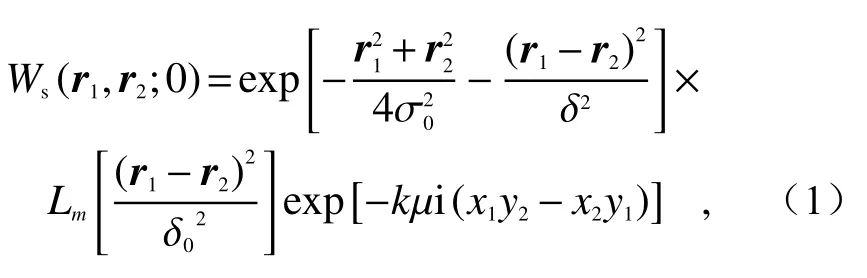
where σ0is the beam waist width, δ0is the crosssectional coherence,Lmis standard Laguerre polynomial of them-th order,kis the wave number, µ is the distortion factor, and
Un der the paraxial approximation condition,the cross spectral density functionW(ρ1,ρ2)=〈E∗(ρ1,z)E(ρ2,z)〉of a beam propagating for a distance ofzin atmospheric turbulence can be expressed as the following equation by using the expanded Huygens-Fresnel diffraction integral[17-20]:
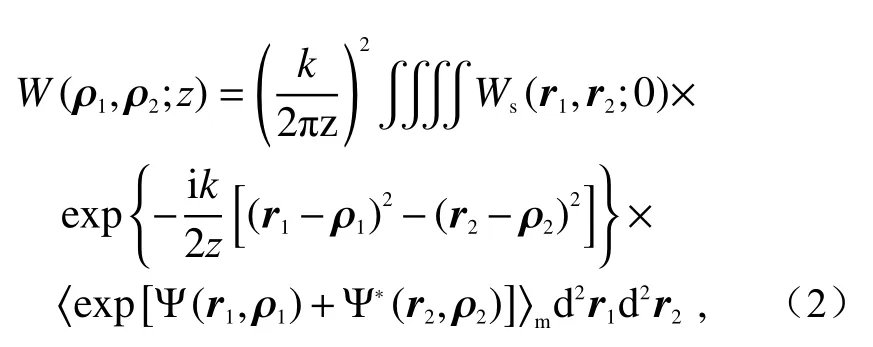
where “< >” represents the ensemble average; “*”represents the complex conjugate; ρ1=(u1,v1) and ρ2=(u2,v2)constitute any set of position vectors in the receiving plane; Ψ is the random term of complex phase when the spherical wave is transmitted from the source plane to the receiving plane in atmospheric turbulence. The exponential term containing the conjugate part can be written as[21]:
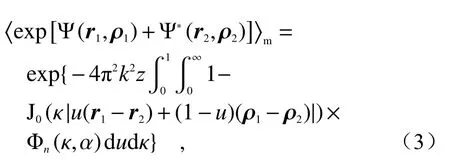
where Φn(κ,α) is the power spectrum function of refractive index fluctuation of turbulent medium, κ is the two-dimensional spatial frequency, and J0is the first class of zero-order Bessel function. If κ|u(r1−r2)+(1−u)(ρ1−ρ2)|≪1, J0can be approximately expressed as[22]:

According to Tosell's non-k spectrum turbulence theory, Φn(κ,α) can be expressed as[19]:

where α is the power index; κ0=2π/L0, κm=c(α)/l0;L0andl0respectively represent the outer and inner scales of turbulence;is the generalized refract ive index structure constant, in m3−α;1/(α−5),where Γ (·) is Gamma function.
The substitution of Eq. (4) and Eq. (5) into Eq. (3) can obtain:

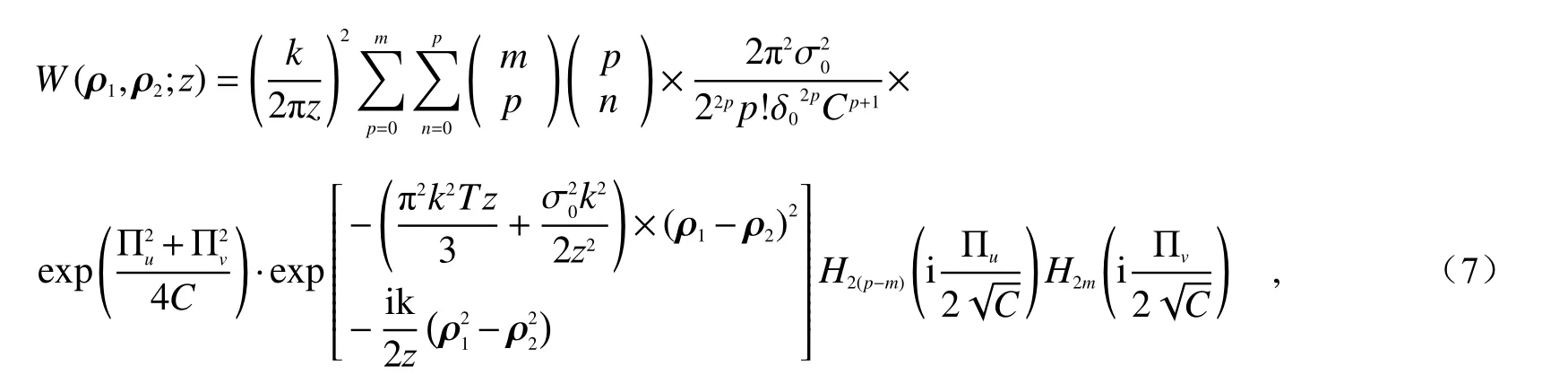
whereHm(·) is a Hermitian polynomial of them-th order;
2.3 Beam quality factor
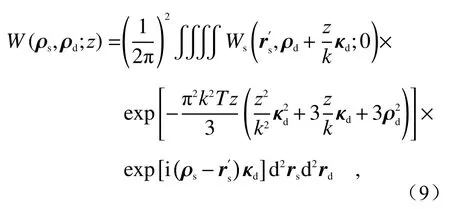
The beam quality factorM2is an important index to evaluate the beam transmission quality in atmospheric turbulence. Based on the second-order matrix of Wigner distribution function, the factorM2of TLGC beam is calculated below. To simplify the calculation, the coordinate substitution is carried out, namely: ρs=(ρ1+ρ2)/2 and ρd=ρ1−ρ2. Then the Eq. (2) can be written in the sum-difference form:

By using the algorithm proposed in the reference [23], we denoteandrd=. Then the Eq. (8)can be expressed as:
After substituting Eq. (6) into Eq. (2) and solving a series of integrals, the cross spectral density function of TLGC beam at the transmission distancezcan be obtained:
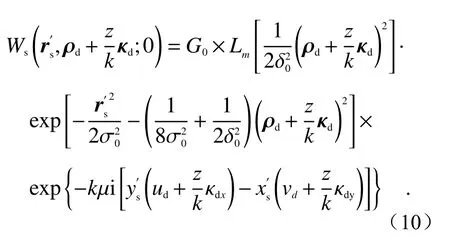
The Wigner distribution function of partially coherent light can be obtained through the two-dimensional Fourier transform of cross spectral density equation, i.e.:
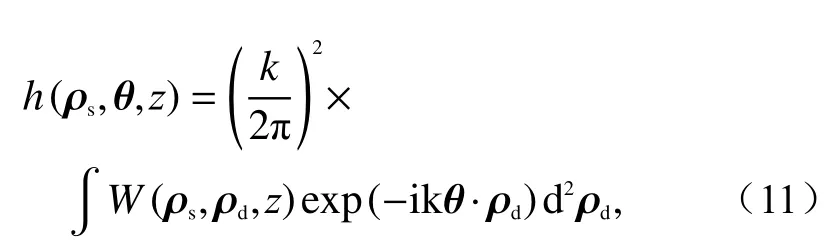
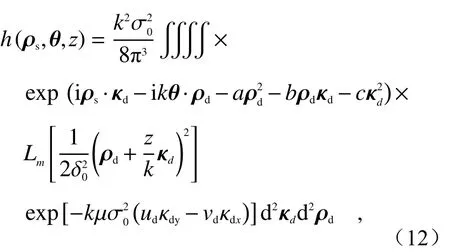
Then1+n2+m1+m2-order matrix of the Wigner distribution function of partially coherent light is defined as[24-25]:

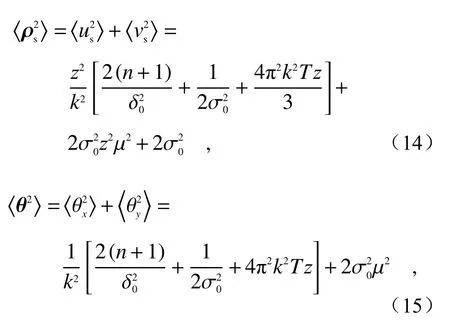
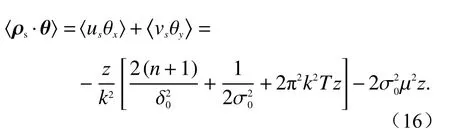
The factor M2of partially coherent beam after propagating in atmospheric turbulence is defined as the following second-order matrix[25]:

By substituting the equations (14), (15) and(16) into Eq. (17), the factorM2of TLGC beam after propagating in atmospheric turbulence can be obtained:

3 Numerical calculation and result
According to the theory of partially coherent light, the average light intensity of the beam arriving at the receiving surface is defined asI(ρ)=W(ρ1,ρ2). Based on the above definition, the average light intensity distribution of TLGC beam in atmospheric turbulence can be studied. When the parameters of laser beam and atmosphere are not given specifically, they can be selected as follows:
The average light intensity distribution curves of TLGC beam at different transmission distances are shown in Fig. 2. The average light intensity distribution of the beam near the source plane is Gaussian distribution. With the increase of distance, the beam is gradually hollowed due to the reciprocity between the initial coherent structure of light source and the far field intensity. When the propagation distance further increases, the average light intensity of the beam will be gradually degraded into Gaussian distribution under the influence of atmospheric turbulence. In addition, the ordermof TLGC beam will affect the rate of change of average light intensity distribution over distance. Ifm= 0,the TLGC beam will be degraded into the twisted Gaussian Schell-model beam. The higher the ordermis, the flatter the light distribution curve will be.This indicates that the higher-order beam has a stronger suppression effect on atmospheric turbulence.
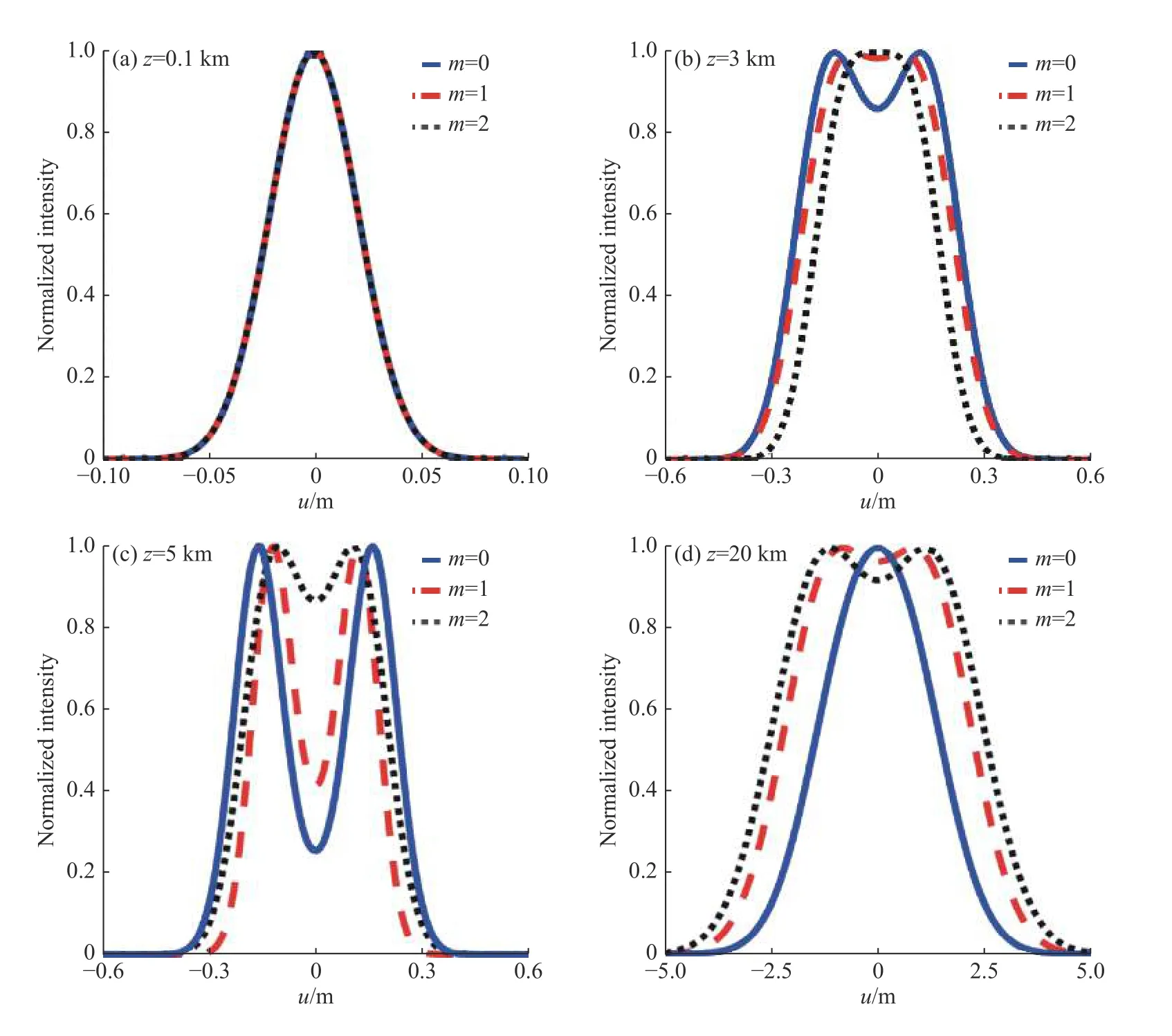
Fig. 2 Average light intensity distribution of a TLGC beam in atmospheric turbulence at different propagation distances图2 扭曲拉盖尔—高斯光束在大气湍流中不同传输距离下的平均光强分布
To analyze the influence of beam parameters and atmospheric parameters on turbulence suppression, we analyze the influence of the following parameters on average light intensity distribution atz=5km (see the Fig. 3): (a) power index α; (b) turbulent outer scaleL0and turbulent inner scalel0;(c) distortion factor µ; (d) cross-sectional coherence degree δ0. The influence of atmospheric parameters on beam propagation is shown in Fig. 3(a)−(b).When the power index α and the turbulent inner scalel0are smaller or the turbulent outer scaleL0is larger, the light intensity distribution will be converted into hollow distribution more quickly. In other?words, the stronger the turbulence is, the more obvious the variation trend of light intensity distribution will be. This is consistent with the conclusion in ref.[19], and also verifies the validity of the numerical calculation in this paper. The suppression effect of beam parameters on atmospheric turbulence is shown in Fig. 3(c)−(d). When the distortion factorµis increased or the cross-sectional coherence degree δ0is decreased, the transformation of light intensity distribution into hollow distribution will be slowed down, indicating that the influence of atmospheric turbulent environment on light intensity distribution will be suppressed.
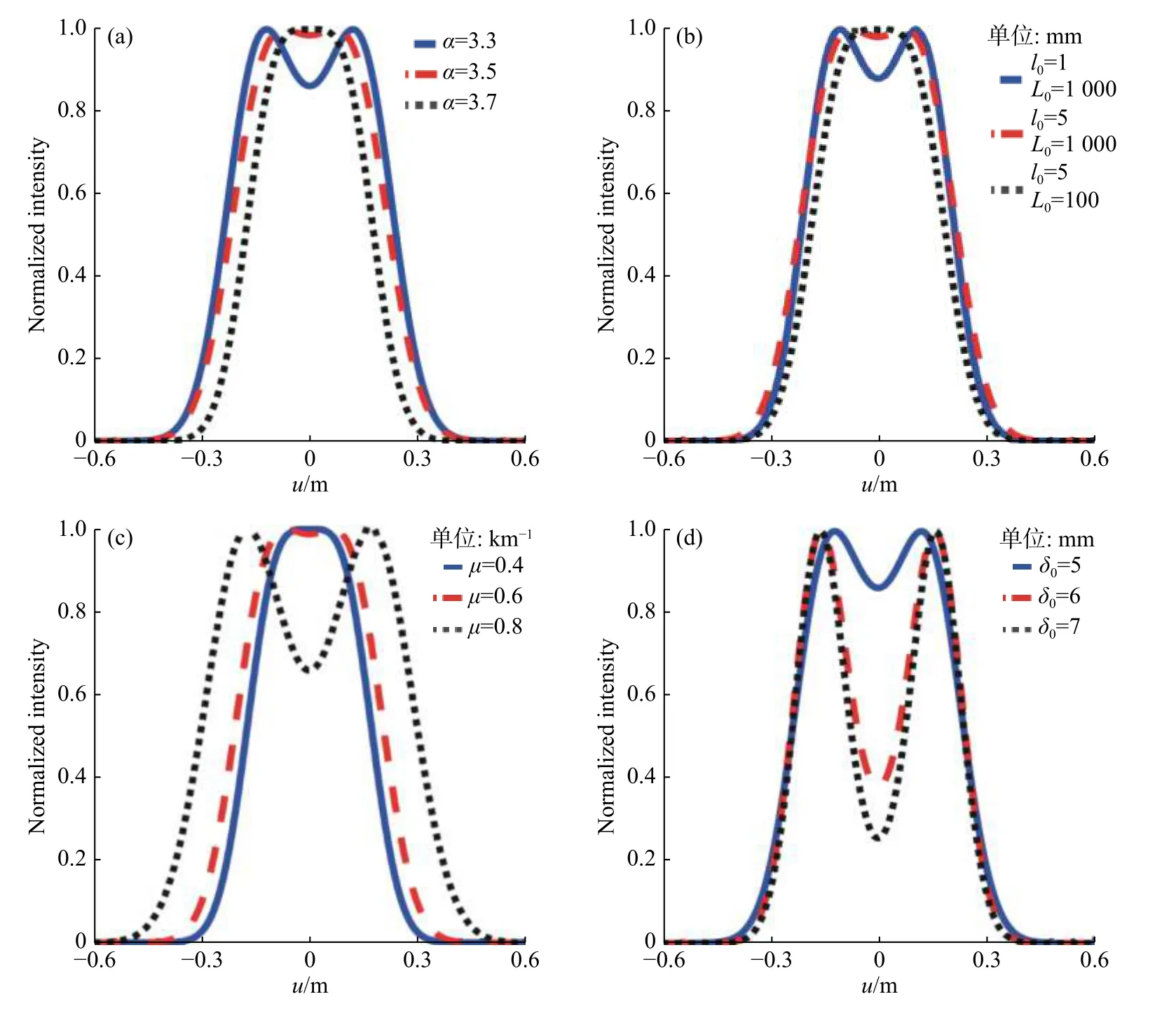
Fig. 3 Average light intensity distribution of a TLGC beam in atmospheric turbulence at z =5km changing with different parameters: (a) power index α; (b) turbulent outer scale L0 and turbulent inner scale l0 ; (c) distortion factor µ and (d)cross-section coherence δ0图3 扭曲拉盖尔—高斯光束在z=5km 处不同参数影响下的平均光强分布。(a)不同功率指数α ;(b)湍流外尺度L 0和湍流内尺度l0 ;(c)扭曲因子µ ;(d)横截面相干度δ0
The Fig. 4 shows how the normalized factorM2of TLGC beam varies with the beam parameters and atmospheric parameters. The smaller the factorM2is, the higher the beam quality will be. From Fig. 4(a), Fig. 4(c) and Fig. 4(d), it can be found that for the beam with a higher orderm, itsM2factor changes more slowly and is less affected by turbulence. As shown in Fig. 4 (a), with the increase of the power index α, the normalized factorM2will increase rapidly at first and then decrease slowly,achieving the maximum value near α=3.11. This is because the atmospheric turbulence is strongest near α=3.11, producing the greatest effect on the beam.It can be seen from Fig. 4 (b) that the beam quality will decline with the increase of propagation distance in atmospheric turbulence. However, the increase ofM2factor can be slowed down by increasing the turbulent inner scalel0or decreasing the turbulent outer scaleL0, that is, by weakening the influence brought by atmospheric turbulence. In addition, compared with the decrease of the turbulent outer scaleL0, the increase of the turbulent inner scalel0has a more significant suppression effect on atmospheric turbulence. It is not difficult to find from Fig. 4(c) and Fig. 4(d) that with the increase of the distortion factor and the decrease of the coherence, the factorM2will be reduced and the beam transmission quality will be degraded, which is consistent with the conclusion of the previous analysis.
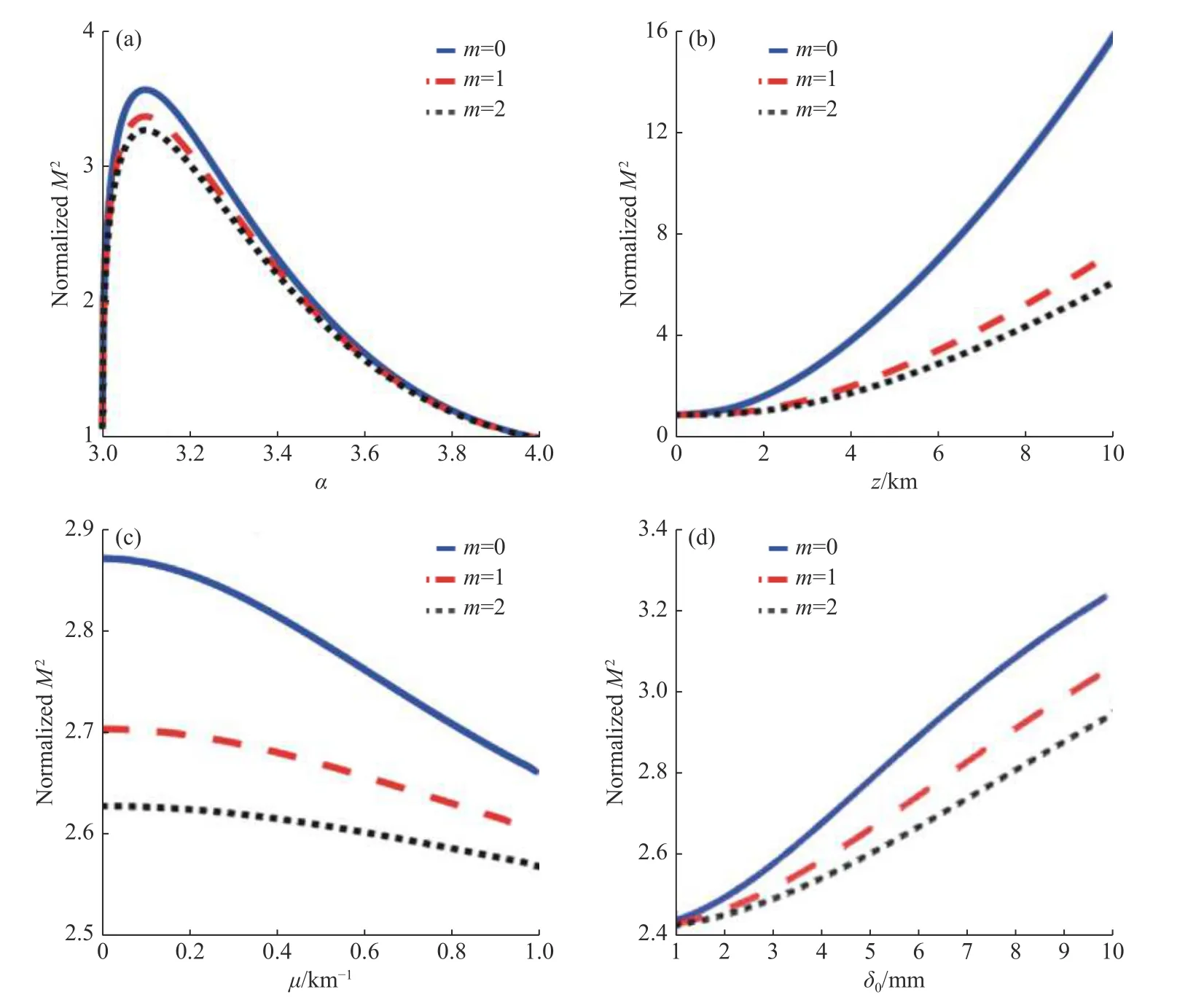
Fig. 4 Normalized M2-factor of a TLGC beam in atmospheric turbulence changing with different parameters: (a) power index α; (b) transmission distance z; (c) distortion factor µ; and (d) cross-section coherence δ0图4 扭曲拉盖尔—高斯关联光束在大气湍流传输中的归一化M2因子随不同参数的变化情况。(a)功率指数α ;(b)传输距离z;(c)扭曲因子µ ;(d)横截面相干度δ0
4 Conclusion
Based on the expanded Huygens-Fresnel principle and the Wigner function distribution, the negative effect of TLGC beam on atmospheric turbulence is investigated and suppressed. It is found by numerical simulation that the negative effect of turbulence on beam transmission quality can be effectively reduced by appropriately increasing the distortion factor of laser beam or decreasing the coherence of initial light field. For the TLGC beam, its transmission quality is affected by both beam parameters and atmospheric turbulence parameters. The TLGC beam with higher order, larger distortion factor and lower coherence has better transmission quality in atmospheric turbulence. However, the beam transmission quality will be degraded in the atmosphere with a larger turbulent outer scale and a smaller turbulent inner scale. The conclusion of this paper has certain theoretical guiding significance for the atmospheric communication and long-distance transmission of laser beam.
——中文对照版——
1 引 言
激光在自由空间的传输过程中受大气湍流的影响会出现光束漂移、光强闪烁等现象,这将导致其光束传输质量下降。通过光场调控来抑制大气湍流的影响已成为重要的研究课题[1-5]。研究者们发现,部分相干光对大气湍流的抑制效应比完全相干光要强,其中,携带扭曲相位的部分相干光理论在近20多年得到了快速发展。扭曲相位这一概念最初是由Simon和Mukunda等人于1993年提出的,它无法分解为两个一维坐标参量的乘积,他们同时理论构建了高斯-谢尔模光束被扭曲后的理论模块,并分析了该新型光束的传输特性[6]。1994年,Friberg等人结合前人的理论首次实验产生了扭曲高斯-谢尔模光束,但是,他们的实验光路复杂而且重复性较差[7]。由于扭曲相位因子的大小受正定性的限制,并非所有光束都能携带扭曲相位,所以,从那以后的研究一直局限于常见的相干光束。直……
