两种护理模式分别联合改良截石位对剖宫产后下肢DVT形成的影响
2021-05-10张佳佳陈丽佳王寒
张佳佳 陈丽佳 王寒
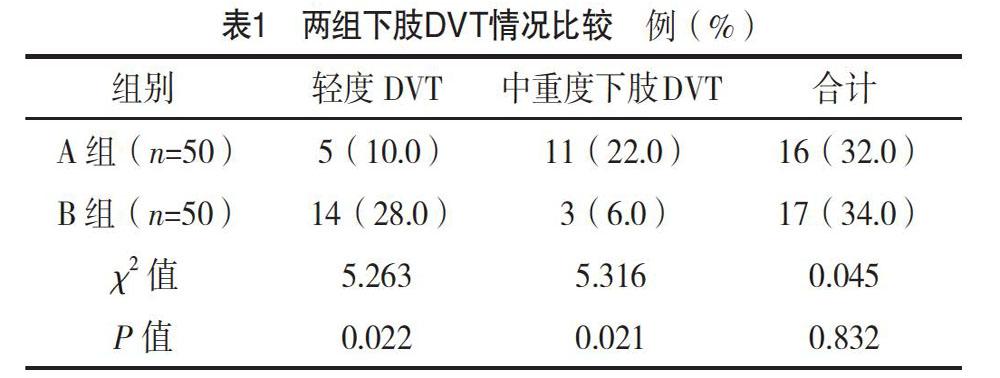
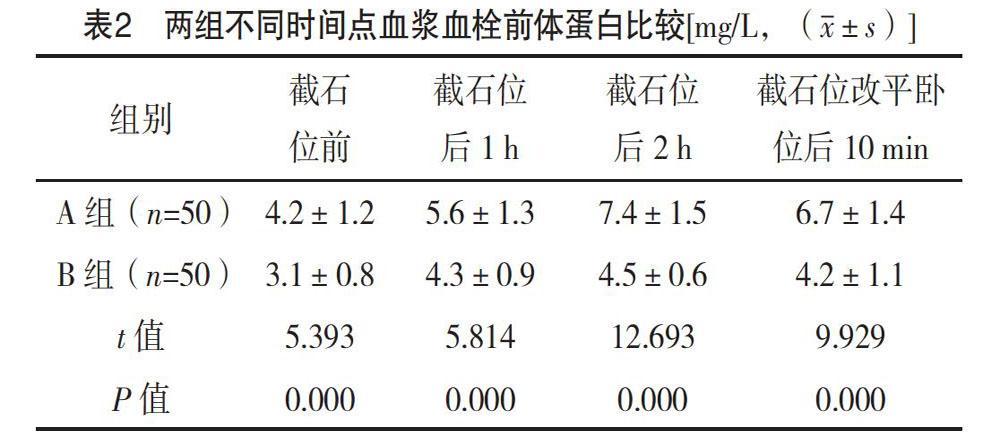

【摘要】 目的:探讨两种护理模式分别联合改良截石位对剖宫产后下肢深静脉血栓(DVT)形成的影响。方法:选取2018年1月-2020年1月于本院行剖宫产的100例产妇作为研究对象。按照不同护理方法分为A组和B组,每组50例。两组均采用改良截石位,A组给予臨床路径护理模式,B组给予循证护理模式。比较两组下肢DVT发生情况、不同时间点的血浆血栓前体蛋白水平、术后下肢舒适度及疾病相关知识掌握程度。结果:B组轻度DVT发生率高于A组,而中重度DVT发生率低于A组(P<0.05);两组下肢DVT发生率比较,差异无统计学意义(P>0.05)。B组截石位前、截石位后1、2 h及改为平卧位后10 min时血浆血栓前体蛋白均低于A组(P<0.05);A组下肢术后舒适度优于B组(P<0.05)。A组疾病相关知识总掌握率高于B组(P<0.05)。结论:临床路径护理和循证护理模式均可显著预防剖宫产后下肢DVT形成,但两种护理方法的护理效果侧重点不同,临床路径护理可增强患者下肢舒适度和疾病知识掌握程度;循证护理可减少中重度下肢DVT例数、降低血浆血栓前体蛋白水平,在临床中可根据患者实际情况进行护理模式选择。
【关键词】 改良截石位 剖宫产 下肢DVT 循证护理 临床路径
[Abstract] Objective: To investigate the effects of two nursing modes combined with improved lithotomy position on the formation of deep vein thrombosis (DVT) in lower limbs after cesarean section. Method: A total of 100 women underwent cesarean section in our hospital from January 2018 to January 2020 were selected as the research objects. According to different nursing methods, the patients were divided into group A and group B, with 50 patients in each group. Both groups were treated with improved lithotomy position, group A was given clinical pathway nursing mode, and group B was given evidence-based nursing mode. The incidence of lower limbs DVT, plasma thrombus precursor proteins level at different time points, postoperative comfort level of lower limbs and mastery of disease-related knowledge were compared between the two groups. Result: The incidence of mild DVT in group B was higher than that in group A, while the incidence of moderate and severe DVT was lower than that in group A (P<0.05). There was no statistically significant difference in the incidence of lower limbs DVT between the two groups (P>0.05). Plasma thrombus precursor proteins before, 1 and 2 h after the lithotomy position and 10 min after the supine position in group B were lower than those in group A (P<0.05). Postoperative comfort level of lower limbs in group A was better than that in group B (P<0.05). The total mastery rate of disease-related knowledge in group A was higher than that in group B (P<0.05). Conclusion: Both clinical pathway nursing and evidence-based nursing can significantly prevent the formation of DVT in lower limbs after cesarean section, but the two nursing methods have different emphasis on the nursing effect. Clinical pathway nursing can enhance the comfort level of lower limbs and the mastery of disease-related knowledge of patients. Evidence-based nursing can reduce the number of moderate and severe DVT of lower limbs and decrease the level of plasma thrombus precursor protein, in clinical practice, nursing mode can be selected according to the actual situation of patients.
[Key words] Improved lithotomy position Cesarean section DVT of lower limbs Evidence-based nursing Clinical pathwayFirst-authors address: Jiamusi Maternal and Child Health Hospital, Jiamusi 154002, China
下肢深静脉血栓(DVT)是指下肢深静脉血液在血管中凝结,导致血液无法正常回流,是妇产科手术后的常见并发症。通常会引起一系列临床症状,如下肢肿胀、疼痛感强烈,严重者可并发肺栓塞,呼吸困难,危及生命[1]。随着临床技术的不断提升,改良截石体位逐渐应用于剖宫产手术中,这种手术体位虽然相比于传统截石位有较多优势,但是产妇术后仍然会出现下肢DVT,因此采用优质护理方法极为重要[2]。临床路径护理模式是一种新型的护理方法,能够严格根据患者治疗方法制定科学合理的护理方案,监督患者的各项护理流程,提升治疗效果[3]。而循证护理也称为求证护理,提倡找出护理证据,对症实施护理方法,已经取得了较好的效果[4]。本研究选取100例行剖宫产的产妇,分析两种护理模式对于剖宫产后下肢DVT的影响,现报道如下。……