生态学视野下孤独症儿童家庭-社会支持体系的构建
2021-05-10朱俊丽聂颖姜志梅郭岚敏
朱俊丽 聂颖 姜志梅 郭岚敏

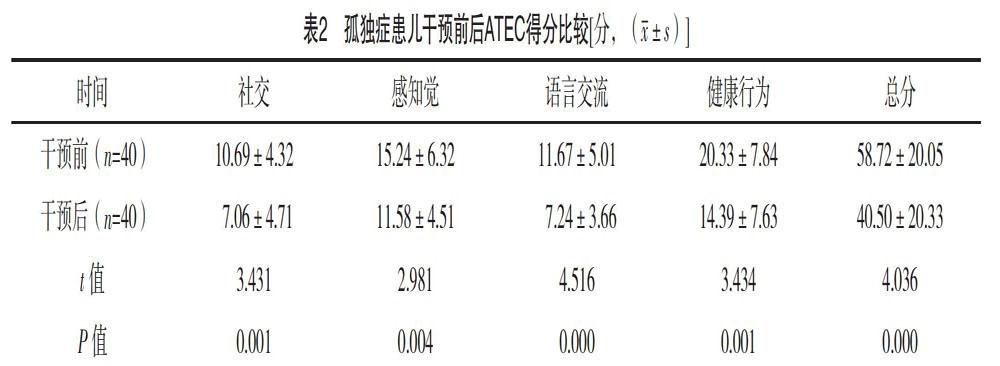
【摘要】 目的:分析探究生态学视野下孤独症儿童家庭-社会支持体系的构建。方法:选取本市孤独症患儿40例及其家庭作为研究对象,于2017年6月参与该研究,研究人员在2018年3月-2019年5月深入到被选家庭进行观察与访谈,收集了有关其日常生活的质性资料。于2019年7月-2020年2月开始实施干预。比较干预前后儿童孤独症家长评定量表(ABC)、儿童孤独症评定量表(CARS)以及孤独症治疗评估量表(ATEC)评分。结果:干预后,孤独症患儿ABC及CARS量表评分均较干预前明显降低,差异均有统计学意义(P<0.05)。干预后,孤独症患儿ATEC量表各因素评分及总分均较干预前明显降低,差异均有统计学意义(P<0.05)。结论:在生态学视野下进行孤独症患儿家庭-社会支持体系的构建,能够有效缓解患儿的症状,值得在临床推广应用。
【关键词】 生态学 孤独症儿童 家庭-社会支持体系
[Abstract] Objective: To analyze and explore the construction of family-social support system in children with autism from the perspective of ecology. Method: A total of 40 autistic children and their families in this city were selected as the research objects. They participated in the study in June 2017. The researchers went to the selected families for observation and interview from March 2018 to May 2019, and collected qualitative data about their daily life. From July 2019 to February 2020, the intervention began. The scores of parents rating scale (ABC), childrens autism rating scale (CARS) and autism treatment assessment scale (ATEC) were compared before and after the intervention. Result: After intervention, the scores of ABC and CARS scale in children with autism were significantly lower than those before intervention, the differences were statistically significant (P<0.05). After intervention, the scores of each factor and the total score of ATEC in children with autism were significantly lower than those before intervention, the differences were statistically significant (P<0.05). Conclusion: The construction of family-social support system in the perspective of ecology can effectively alleviate the symptoms of children with autism, which is worthy of clinical application.
[Key words] Ecology Children with autism Family-social support system
孤独症是一种小儿发育障碍疾病,患儿多有兴趣狭窄、语言障碍、行为刻板等临床表现,多数患儿伴有智力发育迟缓现象。因此较多孤独症患儿日常生活常常难以自理,难以融入周围群体[1]。目前孤独症还不能治愈,因此大多数有孤独症小孩的家庭都背负着终身照顾患儿的责任以及高额医疗费用的压力。目前我国孤独症患者人数呈逐年上升趋势,而社会层面的支持和救助仍然局限在小范围内,能容纳孤独症患儿的康复机构数量仍远远不够,且也没有关于孤独症患儿的足量就学机构以及完善的政策,因此为孤独症患儿及其家庭建立一个完善持续的社会支持网络,帮助其家庭减少负担是很有必要的[2]。生态系统理论认为人与环境是相互影响的,每一个人都处于多个环境系统中,这对孤独症患儿治疗的启发是患儿的康复治疗不能只是考虑单一水平,需要考虑患儿与社会、家庭以及学校多因素间的关系,并了解这些关系对患儿治疗效果的影响[3]。……