子痫前期患者外周血炎症指标水平变化及临床价值分析
2021-05-06汪田田崔世红职云晓刘贝贝綦越
汪田田 崔世红 职云晓 刘贝贝 綦越
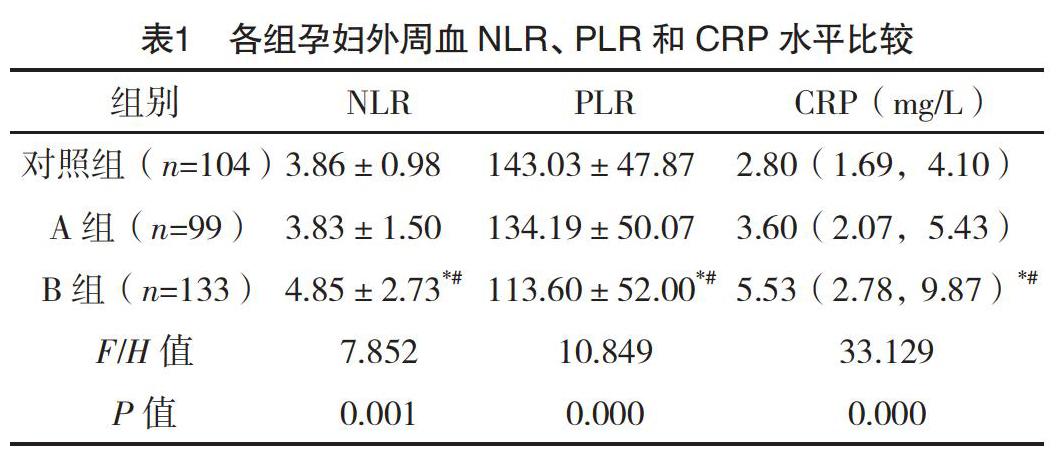


【摘要】 目的:分析子癇前期患者外周血炎症指标水平变化,探讨其与围产结局的相关性及临床意义。方法:选取2018年1月-2019年12月本院收治的232例子痫前期患者(病例组),根据病情严重程度分为非重度子痫前期(A组,99例)、重度子痫前期(B组,133例),另选取同期产检的正常妊娠孕妇104例为对照组,回顾性分析相关临床资料及实验室检验结果。结果:B组中性粒细胞与淋巴细胞比值(NLR)和C反应蛋白(CRP)均较对照组和A组显著增加,血小板与淋巴细胞比值(PLR)显著降低(P<0.05);但A组各指标与对照组比较,差异均无统计学意义(P>0.05)。病例组的NLR和CRP与新生儿出生体重、Apgar评分均存在显著负相关性(P<0.05);NLR与患者平均动脉压呈明显正相关(P<0.05)。NLR、PLR和CRP联合预测重度子痫前期的ROC曲线下面积(AUC)最大,为0.774,敏感度和特异度分别为54.3%、90.2%。结论:重度子痫前期患者外周血中NLR、PLR及CRP变化更明显,该炎症指标在评估病情及预后方面具有临床应用价值。
【关键词】 子痫前期 炎症反应 中性粒细胞与淋巴细胞比值 血小板与淋巴细胞比值 C反应蛋白
[Abstract] Objective: To analyze the changes of peripheral blood inflammatory markers in patients with preeclampsia and discuss its correlation with perinatal outcomes and its clinical significance. Method: A total of 232 patients (cases group) with preeclampsia admitted to our hospital from January 2018 to December 2019 were selected and divided into non-severe preeclampsia (group A, n=99) and severe preeclampsia (group B, n=133) according to the severity of the disease. In addition, 104 pregnant women with normal gestation who underwent antenatal examination during the same period were selected as the control group. Relevant clinical data and laboratory test results were analyzed retrospectively. Result: The neutrophils to lymphocytes ratio (NLR) and C-reactive protein (CRP) in group B were significantly increased compared with those in the control group and group A, and the platelets to lymphocytes ratio (PLR) was significantly decreased (P<0.05). However, there were no significant differences in the indexes between group A and the control group (P>0.05). In the cases group, NLR and CRP were significantly negatively correlated with birth weight and Apgar score (P<0.05). There was a significant positive correlation between NLR and mean arterial pressure (P<0.05). The area under the ROC curve (AUC) of combination of NLR, PLR and CRP in predicting severe preeclampsia was the largest, it was 0.774, the sensitivity and specificity were 54.3% and 90.2% respectively. Conclusion: The changes of NLR, PLR and CRP in peripheral blood of patients with severe preeclampsia are more obvious, and this inflammatory indicator has clinical application value in the evaluation of the condition and prognosis.
[Key words] Preeclampsia Inflammatory response Neutrophil to lymphocyte ratio Platelet to lymphocyte ratio C-reactive protein
First-authors address: The Third Affiliated Hospital of Zhengzhou University, Zhengzhou 450052, China
doi:10.3969/j.issn.1674-4985.2021.09.004
子痫前期(preeclampsia,PE)是妊娠期特发疾病,常发生在妊娠约20周以后,是孕产妇和围生儿发病率和死亡率增加的主要原因之一[1]。其中重度PE围生期不良结局的发生风险明显增加,且病情进展较快。因此,如何快速评估PE病情进展,已成为改善不良结局的重要环节之一。多年来有关PE预测指标的研究较多集中在妊娠早期,而有效预测病情的临床指标并未明确。虽PE的发病机制至今尚未确定,但多数研究认为炎症反应在PE病情进展中发挥了重要作用[2]。PE胎盘处的异常可通过释放趋化因子、促炎细胞因子、抗血管生成因子进入母体外周血,激活炎性细胞、血小板等诱发炎症,促进PE的临床表现和病情进展[3]。近年来,中性粒细胞与淋巴细胞比值(NLR)、血小板与淋巴细胞比值(PLR)作为炎症反应指标已引起广泛关注,且这些指标仅需计算外周血细胞计数均可获得。……
