2种嫁接番茄根系分泌活性物质对番茄青枯病及根际微生物的影响
2021-04-15刘斯晗郑旭阳钟川王鹏阳燕娟于文进
刘斯晗 郑旭阳 钟川 王鹏 阳燕娟 于文进
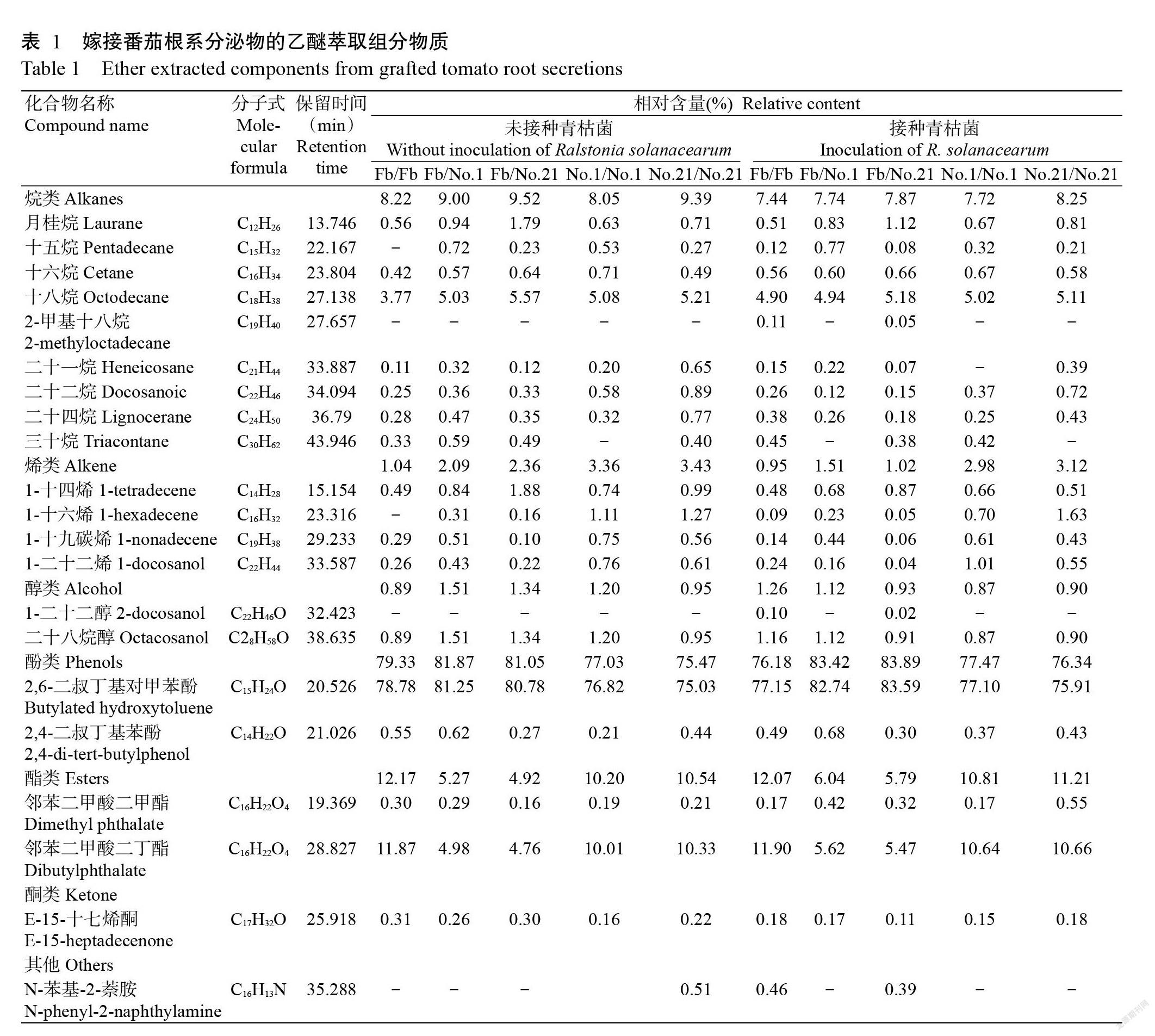
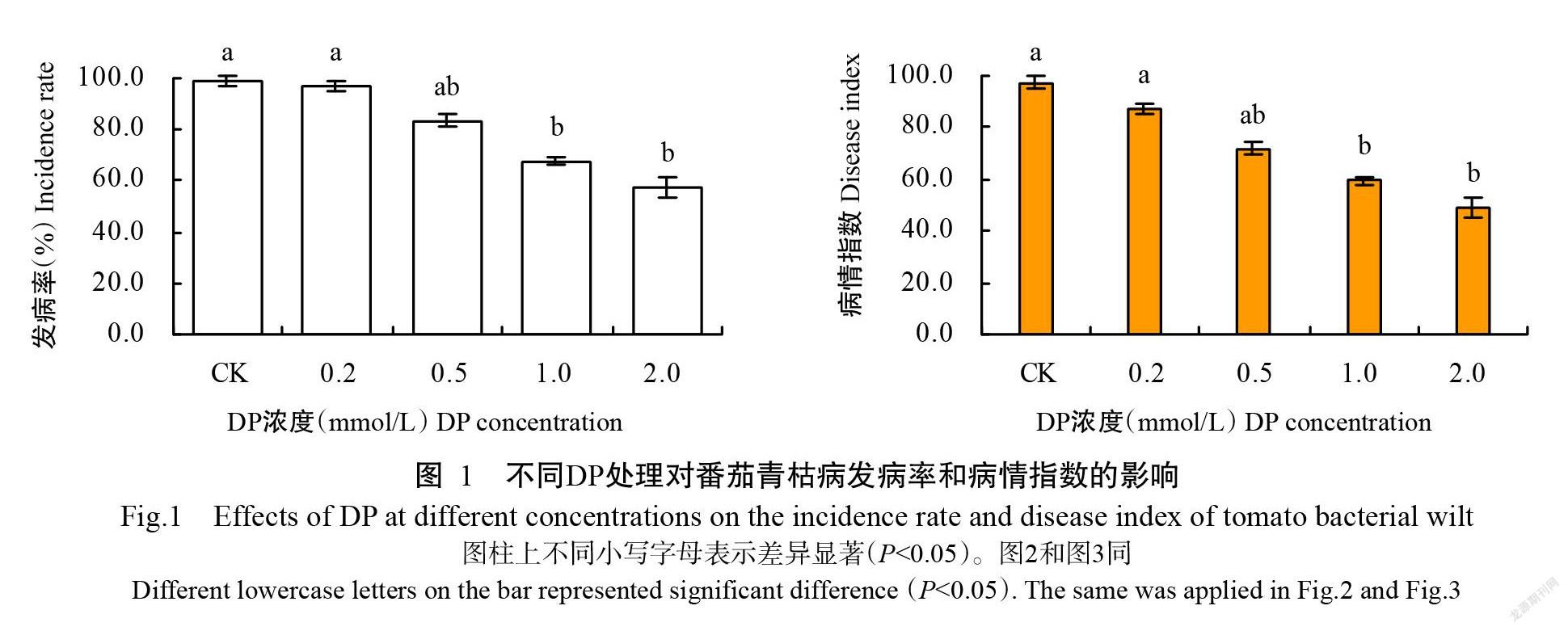

摘要:【目的】鑒定分析嫁接番茄根系分泌物,研究其活性成分对番茄抗青枯病、番茄体内青枯菌及根际微生物数量的影响,为番茄青枯病的防治提供新思路。【方法】以高感青枯病番茄品种粉贝贝(Fb)、高抗青枯病番茄砧木番砧 1号(No.1)和茄砧21号(No.21)为试验材料,设自根嫁接(Fb/Fb)、砧穗嫁接(Fb/No.1、Fb/No.21)和砧木自嫁接(No.1/No.1、No.21/No.21)5个嫁接组合。利用气相色谱—质谱联用仪(GC-MS)对嫁接番茄接种青枯菌前后的根系分泌物进行鉴定分析,用筛选出的活性物质对高感病番茄进行灌根处理后接种青枯菌,采用稀释平板法分离测定番茄体内和根际青枯菌及根际微生物数量。【结果】从嫁接番茄根系分泌物中鉴定筛选出邻苯二甲酸二甲酯(DP)和2,6-二叔丁基对甲苯酚(BHT)2种活性物质,其中1.0 mmol/L DP与1.0 mmol/L BHT混合灌根处理的抗青枯病效果最好,使高感病番茄的青枯病发病率和病情指数显著降至46.7%、42.5(P<0.05,下同)。2种活性物质灌根处理均能使根际微生物总量和细菌数量明显下降;均可降低根际真菌数量,其中BHT的抑制效果更强;均可在发病初期显著抑制放线菌的增殖,且DP的抑制效果强于BHT。【结论】筛选出DP和BHT 2种活性物质,其可通过改善根际微环境、降低植株体内和根际的青枯菌数量而提高番茄对青枯病的抗性。
关键词: 番茄;嫁接;青枯病;根系分泌物;气相色谱—质谱联用;根际微生物
中图分类号: S436.412.15 文献标志码: A 文章编号:2095-1191(2021)12-3382-10
Effects of active substances secreted from roots of two grafted tomato plants on tomato bacterial wilt and rhizosphere microorganisms
LIU Si-han, ZHENG Xu-yang, ZHONG Chuan, WANG Peng,
YANG Yan-juan, YU Wen-jin*
(College of Agriculture, Guangxi University, Nanning 530004, China)
Abstract:【Objective】The purpose of this study was to identify and analyze the root exudates of grafted tomato, and to study the effect of its active components on tomato resistance to bacterial wilt, bacterial wilt bacteria in tomato and the number of rhizosphere microorganisms, so as to provide new ideas for the control of tomato bacterial wilt. 【Method】Tomato varieties with high susceptibility to bacterial wilt disease, Fanbei (Fb), tomato rootstocks with high resistance to bacterial wilt, Fanzhen No.1 (No.1) and Qiezhen No.21 (No.21) were used as experimental materials. There were five grafting combinations, which wereself-root grafting seedling (Fb/Fb), rootstock grafting (Fb/No.1, Fb/No.21) and rootstock self-grafting (No.1/No.1, No.21/No.21). Gas chromatography-mass spectrometry (GC-MS) was used to identify and analyze the root exudates before and after inoculation of Ralstonia solanacearum in grafted tomatoes. Hypersusceptible tomatoes roots were treated with selected active substances then were inoculated by R. solanacearum. The dilution plate method was used to isolate and determine the amount of R. solanacearum and rhizosphere microorganisms in tomato and rhizosphere. 【Result】Two active substances, dimethyl phthalate (DP) and 2,6-di-tert-butyl-p-cresol (BHT), were identified and screened from the root exudates of grafted tomato, among which 1.0 mmol/L DP and 1.0 mmol/L BHT mixed root irrigation treatment had the best disease resistance effect, which significantly reduced the incidence and di-sease index of bacterial wilt in highly susceptible tomato to 46.7% and 42.5 (P<0.05, the same below). The two active substances in the root irrigation treatment significantly decreased the number of rhizosphere microorganisms and bacteria, both could reduce the number of rhizosphere fungi, in which BHT inhibition was more effective. They could both significantly inhibited number of fungiin the early stage of disease, and DP had better effects than BHT. 【Conclusion】Two active substances, DP and BHT, are screened out, which can improve the resistance of tomato to bacterial wilt by improving the rhizosphere microenvironment and reducing the number of bacterial wilt bacteria in the plant and in the rhizosphere.
Key words: tomato;grafting; bacterial wilt;root exudates;gas chromatography-mass spectrometry(GC-MS);soil microorganism
Foundation items: National Natural Science Foundation of China(31660568); Guangxi Science and Technology Major Special Project(Guike AA17204039-2, Guike AA17204026-1)
0 引言
【研究意义】番茄青枯病是我国华南地区番茄生产最严重的土传病害之一,采用抗病砧木嫁接可显著提高番茄对青枯病的抗性(王岳霞等,2018)。研究表明,用抗病砧木嫁接的番茄植株的根系分泌物具有抑制根际土壤中青枯菌侵染和繁殖的作用(赵文宗,2019)。然而,目前关于番茄嫁接植株根系分泌物的物质成分和含量,以及根系分泌物对嫁接植株的青枯病抗性及作用机理尚不明确。……
