黑鲷催乳素基因PRL1和PRL2在急性盐胁迫环境下的表达分析
2021-04-15林李泉韦信贤林国荣谭红连黄婷刘明珠杨艳童桂香
林李泉 韦信贤 林国荣 谭红连 黄婷 刘明珠 杨艳 童桂香
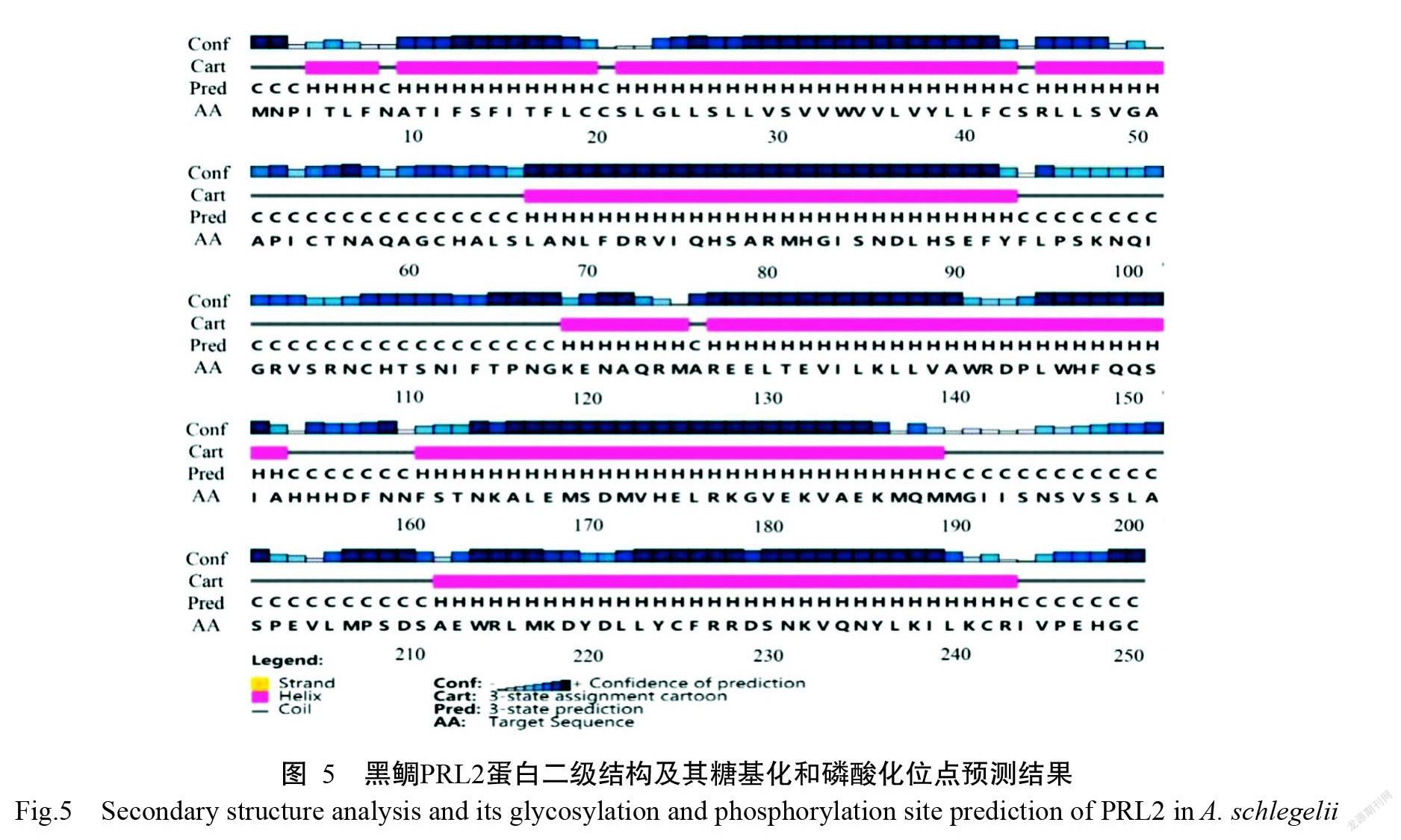
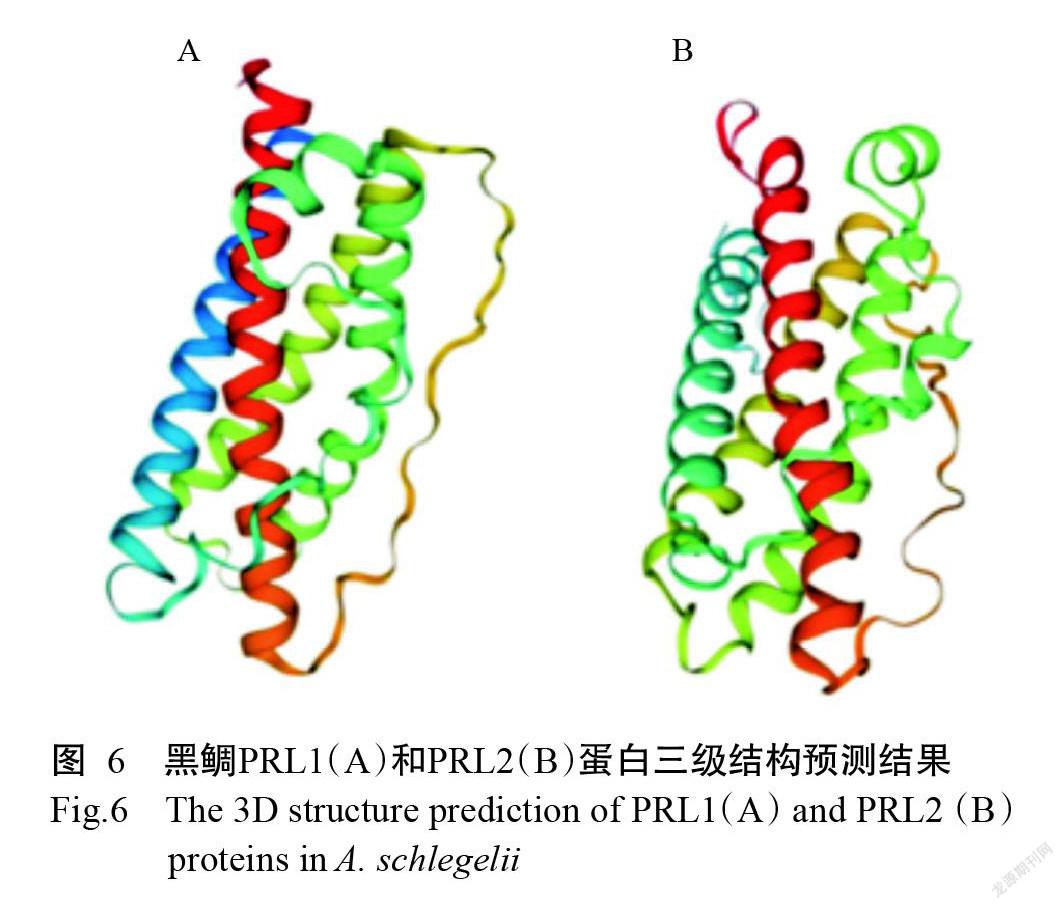
摘要:【目的】明確催乳素基因(PRL1和PRL2)在黑鲷不同组织及不同盐度胁迫下的表达模式,为黑鲷养殖过程中最适盐度范围的确定提供参考依据。【方法】通过RT-PCR扩增黑鲷PRL1和PRL2基因,以ExPASy、NetNGlyc及SWISS-MODEL等在线软件进行生物信息学分析,并采用实时荧光定量PCR检测PRL1和PRL2基因在黑鲷不同组织及不同盐度胁迫下的表达情况。【结果】黑鲷PRL1基因开放阅读框(ORF)全长639 bp,共编码212个氨基酸残基,其编码蛋白分子量为23.32 kD,理论等电点(pI)为6.70;黑鲷PRL2基因ORF全长750 bp,共编码249个氨基酸残基,其编码蛋白分子量为28.31 kD,pI为8.37。黑鲷PRL1和PRL2蛋白均由1个为信号肽结构域和1个为Hormone 1结构域组成;黑鲷PRL1蛋白二级结构中α-螺旋占69.34%、无规则卷曲占30.66%,包含1个糖基化位点及37个磷酸化位点;黑鲷PRL2蛋白二级结构中α-螺旋占67.07%、无规则卷曲占32.93%,包含1个糖基化位点及21个磷酸化位点。黑鲷PRL1和PRL2基因在12个待检测组织中均有表达,且均以脑组织中的相对表达量最高,显著高于其他组织中的相对表达量(P<0.05,下同);在盐度5‰处理组中,黑鲷PRL1基因在胁迫4 h开始显著上调,黑鲷PRL2基因在胁迫8 h开始极显著上调(P<0.01),二者均在胁迫24 h时达峰值,随后开始缓慢下降,至胁迫72 h时其相对表达量仍显著高于对照组;在盐度25‰和35‰处理组中,黑鲷PRL1和PRL2基因在胁迫72 h时其相对表达量均显著低于对照组。【结论】低盐胁迫能促进黑鲷PRL1和PRL2基因的表达,高盐胁迫则抑制黑鲷PRL1和PRL2基因的表达,即黑鲷PRL1和PRL2基因在其适应淡水环境的过程中发挥重要调节作用。
关键词: 黑鲷;催乳素(PRL);PRL1基因;PRL2基因;盐胁迫;组织表达
中图分类号: S917.4 文献标志码: A 文章编号:2095-1191(2021)12-3254-11
Expression analysis of Acanthopagrus schlegelii PRL1 and
PRL2 in response to acute salinity stress
LIN Li-quan1, WEI Xin-xian2, LIN Guo-rong1, TAN Hong-lian2, HUANG Ting2,
LIU Ming-zhu3, YANG Yan2, TONG Gui-xiang2*
(1Hengsheng Aquaculture Professional Cooperative of Yangxi, Yangjiang, Guangdong 529500, China; 2Guangxi Academy of Fishery Science/Guangxi Key Laboratory of Aquatic Genetic Breeding and Healthy Aquaculture, Nanning 530021, China; 3Guangxi Academy of Sciences/Guangxi Engineering Research Center for Fishery Major Diseases
Control and Efficient Healthy Breeding Industrial Technology (GERCFT), Nanning 530007, China)
Abstract:【Objective】To understand the expression patterns of prolactin genes (PRL1 and PRL2) in different tissues and under different salinity stresses, so as to provide a reference for the determination of the optimal salinity range in the breeding process of Acanthopagrus schlegelii. 【Method】PRL1 and PRL2 genes of A. schlegelii were amplified by RT-PCR, and bioinformatics analysis was performed by ExPASy, NetNGlyc, Swiss-Model and other online softwares. The expression of PRL1 and PRL2 genes in different tissues and under different salinity stresses was detected by real-time fluorescence quantitative PCR. 【Result】The full length of PRL1 open reading frame (ORF) was 639 bp, encoding 212 amino acids with a molecular weight of 23.32 kD and an isoelectric point(pI) of 6.70; and the ORF of PRL2 gene was 750 bp, encoding 249 amino acids with a molecular weight of 28.31 kD and pI of 8.37. PRL1 and PRL2 proteins were both composed of a signal peptide domain and a Hormone 1 domain. In the secondary structure of PRL1 protein, 69.34% of α-helix and 30.66% of random curl were found, including 1 glycosylation site and 37 phosphorylation sites. In the secondary structure of PRL2 protein, α-helix accounted for 67.07% and random curl accounted for 32.93%, including 1 glycosyla-tion site and 21 phosphorylation sites. The results of tissue expression analysis showed that PRL1 and PRL2 genes were expressed in all 12 tested tissues. The highest expression levels of PRL1 and PRL2 were both detected in brain, significantly higher than the relative expression levels in other tissues (P<0.05, the same below). In the 5‰ salinity treatment group, PRL1 gene was significantly up-regulated at 4 h under salt stress, PRL2 gene was extremely significantly up-regulated at 8 h under stress (P<0.01). Both of them reached peak value at 24 h, then began to decline slowly, and their expression levels were still significantly higher than those of the control group at 72 h of stress. The expression levels of PRL1 and PRL2 genes in the 25‰ and 35‰ salinity treatment groups were significantly lower than those in the control group after 72 h stress. 【Conclusion】Low salinity stress can promote the expression of PRL1 and PRL2 genes, while high salinity stress can inhibit the expression of PRL1 and PRL2 genes. In other words, A. schlegelii PRL1 and PRL2 genes play important regulatory roles in the adaptation to fresh water.
Key words: Acanthopagrus schlegelii; prolactin(PRL); PRL1 gene; PRL2 gene; salinity stress; tissue expression
Foundation item: Regional Project of National Natural Science Foundation of China(41966004);Guangdong Science and Technology Development (Vertical Coordinated Management and Linkage Between Provinces and Cities) Special Project(2017B020246046);Guangxi Innovation Team Project of National Modern Agricultural Industrial Technology System (nycytxgxcxtd-20-02);Independent Research Project of Guangxi Key Laboratory of Aquatic Genetic Breeding and Healthy Breeding (2020-A-03-01)
0 引言
【研究意義】催乳素(Prolactin,PRL)是一种单链多肽类激素,由动物脑垂体合成及分泌,广泛参与机体各种生物学功能,包括生长发育、内分泌代谢、繁殖泌乳、免疫调节及电解质平衡等(Kelly et al.,2001;刘瑞鑫等,2013)。在鱼类研究中,同样证实PRL是调节硬骨鱼类渗透压和离子平衡的主要激素(Manzon,2002),在海水鱼类适应淡水的过程中PRL在脑垂体和血浆中的合成与分泌显著增加,认为PRL是通过改变鳃、皮肤、肾脏及肠道等渗透压调节器官的渗透性及离子运输途径以减少水分吸收或增加离子吸收来实现水盐平衡(左映平和曹劲松,2007)。……
