上海市徐汇区徐家汇街道中老年人群膝骨性关节炎流行病学研究
2021-04-07陈嵘张源侯小琦魏淋王剑波
陈嵘 张源 侯小琦 魏淋 王剑波
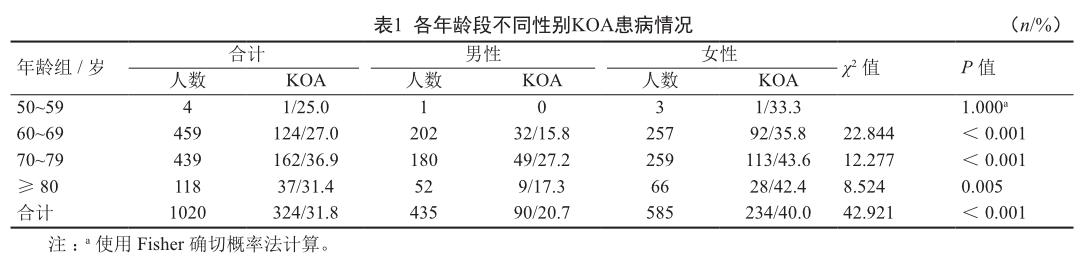
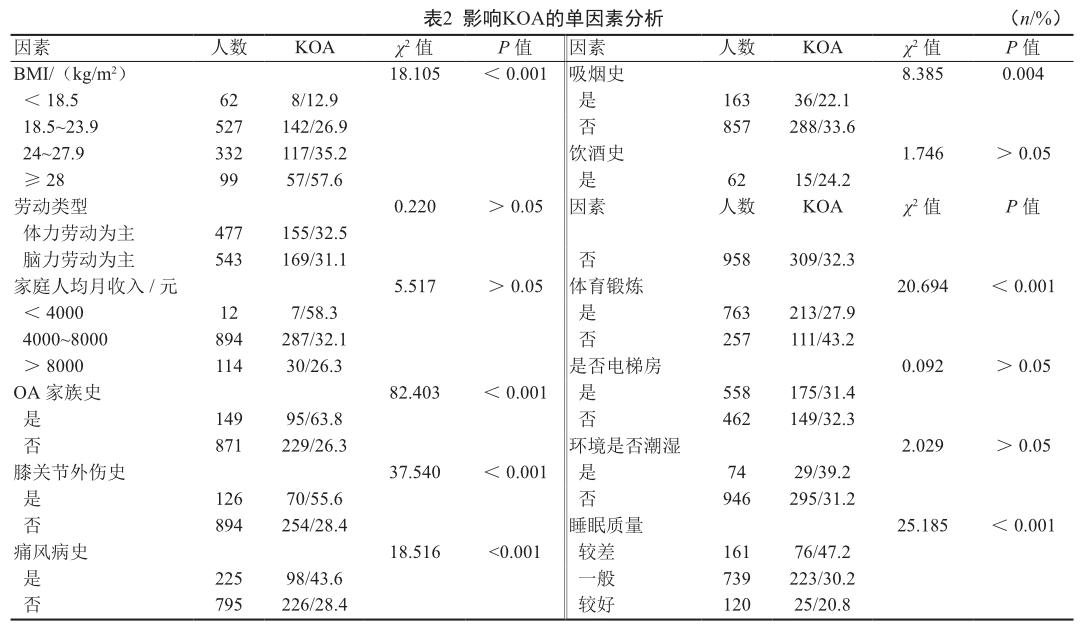
摘 要 目的:了解城市社区中老年人膝骨性关节炎(KOA)的患病率,探讨其发病特点及相关影响因素,为早期預防与治疗提供科学依据。方法:于2019年6月至10月随机抽取6个社区服务站点1 020名汉族居民为研究对象,其中男性435人,女性585人,平均年龄为(72.40±5.96)岁。采用自行设计的量表和WOMAC评分量表开展问卷调查。结果:中老年人KOA患病率为31.8%。单因素分析结果显示KOA与性别、年龄、体重指数(BMI)、骨关节炎(OA)家族史、膝关节外伤史、痛风史、吸烟史、体育锻炼及睡眠质量显著相关(P<0.05)。Logistic回归分析显示女性、高龄、BMI偏高、OA家族史、膝关节外伤史、缺乏体育锻炼、睡眠质量差是患KOA的危险因素(P<0.05)。此外女性,高年龄,有OA家族史、有膝关节外伤,不经常体育锻炼患者WOMAC评分较高(P<0.05)。结论:性别、年龄、BMI、OA家族史、膝关节外伤史、体育锻炼、睡眠质量与患KOA相关,应在预防与治疗中给予重视。
关键词 骨性关节炎;膝关节;影响因素;WOMAC评分
中图分类号:R684.3 文献标志码:A 文章编号:1006-1533(2021)06-0039-05
Epidemiological study of knee osteoarthritis in the middle and old aged population in Xujiahui Community, Xuhui District, Shanghai
CHEN Rong1, ZHANG Yuan2, HOU Xiaoqi3, WEI Lin1, WANG Jianbo4(1.Rehabilitation Department of Xujiahui Community Health Service Center of Xuhui District, Shanghai 200030, China; 2.Community Department of Xujiahui Community Health Service Center of Xuhui District, Shanghai 200030, China; 3.Traditional Chinese Medicine Department of Xujiahui Community Health Service Center of Xuhui District, Shanghai 200030, China; 4.Office of Xujiahui Community Health Service Center of Xuhui District, Shanghai 200030, China)
ABSTRACT Objective: To investigate the prevalence of knee osteoarthritis(KOA) in middle and old aged people in urban communities, and to explore its characteristics and related influencing factors so as to provide scientific basis for early prevention and treatment of knee osteoarthritis. Methods: From June to October 2019, 1 020 Han residents from 6 community service stations were randomly selected as the research objects, there were 435 males and 585 females with an average age of(72.40±5.96) years. The self-designed scale and western Ontario and McMaster(WOMAC) rating scale were used to carry out the questionnaire survey. Results: The prevalence of KOA in middle and old aged people was 31.8%. Univariate analysis showed that KOA was significantly related to gender, age, body mass index(BMI), family history of osteoarthritis(OA), history of knee injury, history of gout, history of smoking, physical exercise and sleep quality(P<0.05). Logistic regression analysis showed that female, advanced age, high BMI, family history of OA, history of knee trauma, lack of physical exercise, and poor sleep quality were risk factors for KOA(P<0.05). In addition, female, advanced age, family history of OA, knee joint trauma, and infrequent physical exercise patients had higher WOMAC scores(P<0.05). Conclusion: Gender, age, BMI, family history of OA, history of knee injury, physical exercise and sleep quality are related to suffering from KOA, which should be paid more attention to prevention and treatment.
KEY WORDS osteoarthritis; knee joint; influencing factor; WOMAC score
*基金项目:上海徐汇区卫健委(SHXH201816)
随着中国老年化进程的加快,我国60岁及以上老年人口比例已达到总人口的17.9%,与老年相关的许多健康问题也日渐增多,半数以上的老年人患有慢性病[1]。其中膝骨性关节炎(knee osteoarthritis,KOA)作为一种常见的关节疾病困扰着许多中老年人。作为一种慢性退行性疾病,KOA的典型特征是疼痛,功能受损和生活质量下降。在存在危险因素的情况下,随着病情进展可增加疼痛和残疾的风险[2]。因此,分析骨关节炎(OA)危险因素,及早进行危险因素干预,成为社区OA防治的重要手段。虽已有流行病学研究发现年龄和体重指数(BMI)的增加与KOA的患病率相关[3],但不同调查的结果差异很大,难以直接用来指导社区慢病管理实践。本文旨在了解上海市徐家汇街道中老年人KOA的患病率,探讨其发病特点及影响因素,为早期预防与治疗提供科学依据。……
