退变性腰椎滑脱CARDS分型中各亚组患者在脊柱骨盆矢状位参数上的差异
2021-04-02李宗欢刘金龙耿伟
李宗欢 刘金龙 耿伟

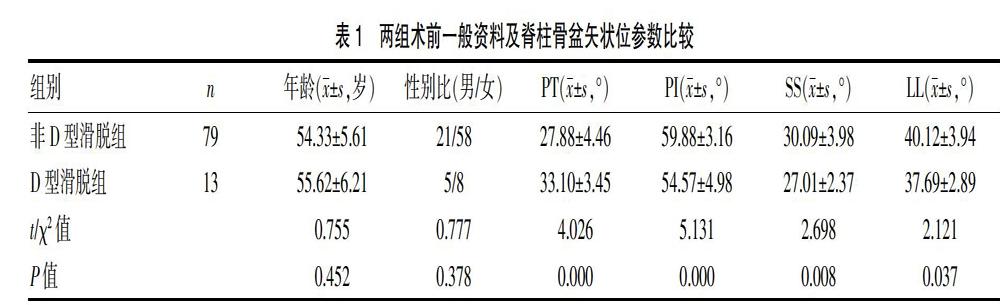

[摘要] 目的 探討退变性腰椎滑脱临床与影像学(CARDS)分型中各亚组患者在脊柱骨盆矢状位参数上的差异。 方法 回顾性分析 2018年1月至 2019 年12月我院收治的92例 L4~5单阶段退变性腰椎滑脱患者的临床资料。依据腰椎正侧位X线或动力位腰椎 X 线正侧位上滑脱节段椎间隙是否后凸成角分为D 型滑脱组和非 D 型滑脱组(即A、B、C三型)。术前、术后均测量入组患者的脊柱骨盆矢状位参数,同时采用 Oswestry功能障碍指数(ODI)和腰部疼痛视觉模拟评分法(VAS)对患者生活质量进行评估。 结果 术前D型滑脱组LL、PI、SS均显著低于非D型滑脱组,而PT显著高于非D型滑脱组,差异有统计学意义(P<0.05)。术前D型滑脱组ODI评分和腰痛VAS评分均显著高于非D型滑脱组,差异有统计学意义(P<0.05)。 结论 退变性腰椎滑脱CARDS分型中D型患者与非D型患者在脊柱骨盆矢状位参数存在差异,D型可以作为一种独特的亚型进行探讨,可以推广为临床常用的术前评估分类系统之一。D 型患者术前腰椎生理前凸丢失,容易表现出更严重的临床症状。
[关键词] 退变性腰椎滑脱;CARDS 分型;脊柱骨盆矢状位参数
[Abstract] Objective To investigate the difference of sagittal parameters of spine and pelvis among different subgroups of patients in clinical and radiographic degenerative spondylolisthesis(CARDS) classification of degenerative lumbar spondylolisthesis. Methods The clinical data of 92 cases of patients with L4-5 single stage degenerative lumbar spondylolisthesis admitted to our hospital from January 2018 to December 2019 were analyzed retrospectively. According to whether the intervertebral space of the spondylolisthesis segment of the lumbar anteroposterior and lateral X-ray or the dynamic position lumbar X-ray anteroposterior and lateral was kyphosis or not, the patients were divided into the D-type spondylolisthesis group and the non-D-type spondylolisthesis group(namely type A, B and C). The sagittal parameters of spine and pelvis were determined before and after operation,and the quality of life of patients was evaluated by oswestry disability index(ODI) and visual analogue scale(VAS) for lumbar pain. Results The LL, PI, SS in the D-type spondylolisthesis group were all obviously lower than those in the non-D-type spondylolisthesis group before operation, PT was obviously higher than that in the non-D-type spondylolisthesis group, with significant difference(P<0.05). The ODI score and VAS of lumbar pain in the D-type spondylolisthesis group were all obviously higher than those in the non-D-type spondylolisthesis group before operation, with significant difference(P<0.05). Conclusion In CARDS classification of degenerative lumbar spondylolisthesis, there are differences in sagittal parameters of spine and pelvis between patients with type D and patients without type D. Type D can be discussed as a unique subtype,and can be promoted as one of the commonly used preoperative evaluation classification systems in clinical practice. The loss of lumbar lordosis in type D patients before operation is easy to show more severe clinical symptoms.
[Key words] Degenerative lumbar spondylolisthesis; CARDS classification; Sagittal parameters of spine and pelvis
退变性腰椎滑脱(Degenerative lumbar spondylolisthesis,DLS)是脊柱外科常见疾病[1]。DLS是由于腰椎间盘及椎间上下关节突等结构增生、老化、退变所导致的邻近椎体之间产生滑移,一般保留完整椎弓根,该疾病的病理机制目前尚不清楚。流行病学研究显示,DLS好发于50岁以上PI值较高的女性患者的L4-L5節段[2-5],并常合并腰椎管狭窄[6]。这些退行性改变会引发患者出现以下症状:下腰部顽固性疼痛、下肢疼痛、神经性跛行等。DLS患者在腰椎标准正侧位及过伸过屈位X线片的影像学表现为上下相邻椎体产生位移、椎间隙变窄和局部腰椎前凸角度消失[7-9]。根据上述基本影像学表现及综合患者是否合并腰腿痛临床症状,Kepler教授等[10]提出了DLS的临床与影像学(Clinical and radiographic degenerative spondylolisthesis,CARDS)分型,此分型中D型作为特殊的一种亚型进行单独研究,D型患者影像学主要表现为滑脱节段椎间局部后凸,且相关研究显示,相比于CARDS分型中 A、B和C其他三型患者,D型患者在临床上表现出更严重的腰腿痛症状[11-12]。……