基于织物的柔性电路制备方法及应用研究进展
2021-03-28王瑾缪旭红
王瑾 缪旭红
摘要: 智能可穿戴技术的快速发展,使得以织物为基底的柔性电路因其优异的柔性和透气性,受到广泛关注。文章综述了几种常用的织物柔性电路的制备方法,并指出这些方法在柔性、工艺、规模化生产等方面存在的问题;其次,结合智能纺织品的应用,总结了织物柔性电路在传感器、发光二极管和织物天线等领域的应用;最后,对织物柔性电路在智能可穿戴系统中存在的问题,提出织物柔性电路应具有趋同服用的性能、实现更为复杂的电路设计、保证稳定低功耗的电流传输及无缝集成等特性,为织物柔性电路发展提供方向。
关键词: 智能纺织品;柔性电路;导电纱线;导电油墨;针织
Abstract: With the rapid development of intelligent wearable technology, fabric-based flexible circuits have attracted wide attention because of their excellent flexibility and permeability. In this paper, several methods of fabric flexible circuits are reviewed, and the problems of these methods in flexibility, technology and large-scale production are pointed out. Combined with the application of intelligent textiles, the application of fabric flexible circuits in sensors, light-emitting diodes and fabric antennas is summarized. Finally, the problems of fabric flexible circuits in intelligent wearable systems are discussed. It is suggested that fabric flexible circuits should have the properties of convergence, realize more complex circuit design, and ensure stability and low power. The characteristics of current transmission and seamless integration provide a direction for the development of fabric flexible circuits.
Key words: intelligent textiles; flexible circuit; conductive yarn; electrically conductive ink; knitting
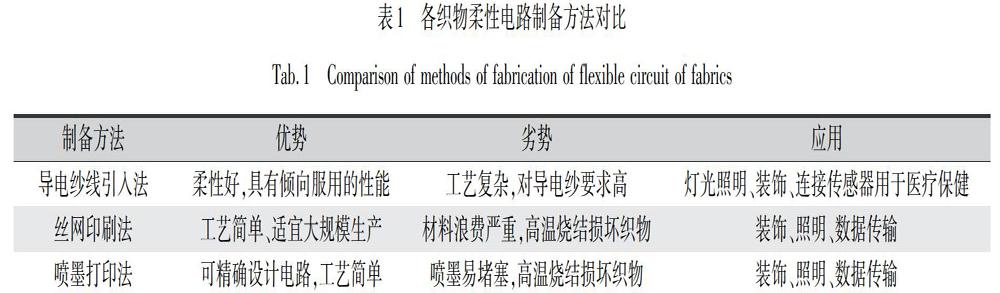
随着科技发展及人们对更舒适生活的向往,智能纺织品的需求逐年增长,尤其是在运动识别、健康监测等领域。智能纺织品的电子信息系统一般由电路、传感器、数据处理和电源等组成[1]。织物导电线路将各主要电子元件连接起来,是智能纺织品的重要组成部分[2]。传统的智能纺织品通常由较粗的电线将刚性材料或半导体与织物结合[3],其笨重、易磨损且无法随织物变形等缺点不能满足人们生活多元化的需求,由此催生了一种轻便、柔软与人体皮肤贴合的柔性电路。柔性电路有将金属纳米颗粒、金属氧化物、导电聚合物[4]等导电材料与柔性衬底如纸张、塑料、硅胶等掺杂复合而成的电路,这种柔性电路通常具有较高的弹性和耐磨性,但透气性差;相比之下,以织物为基底的柔性电路具有更为理想的柔性和透气性,几乎可以实现任意角度的弯曲、扭转、拉伸等变形,能够满足日常生活的使用要求。……