尿激酶原溶栓联合经皮冠状动脉介入术治疗ST段抬高型心肌梗死的效果研究
2021-03-25黄春李岳迪力·热巴
黄春 李岳 迪力·热巴
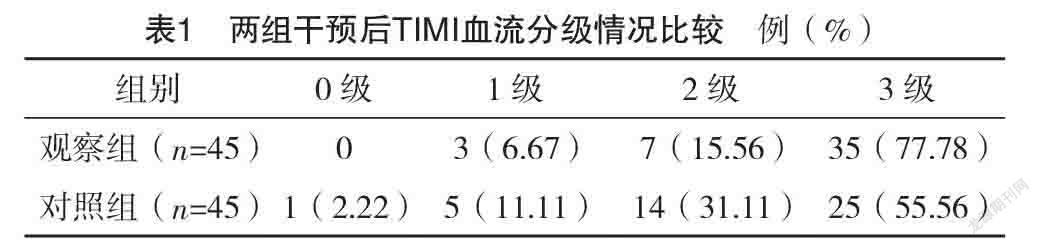
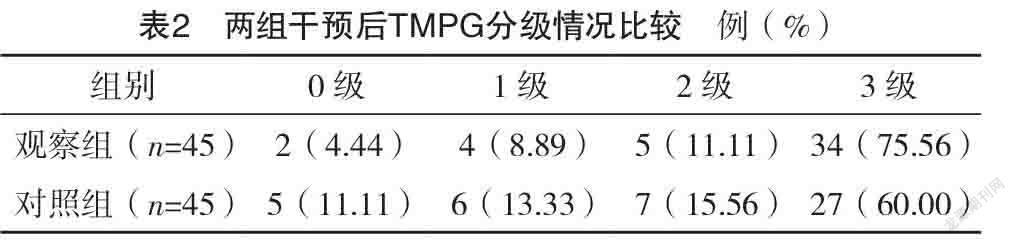
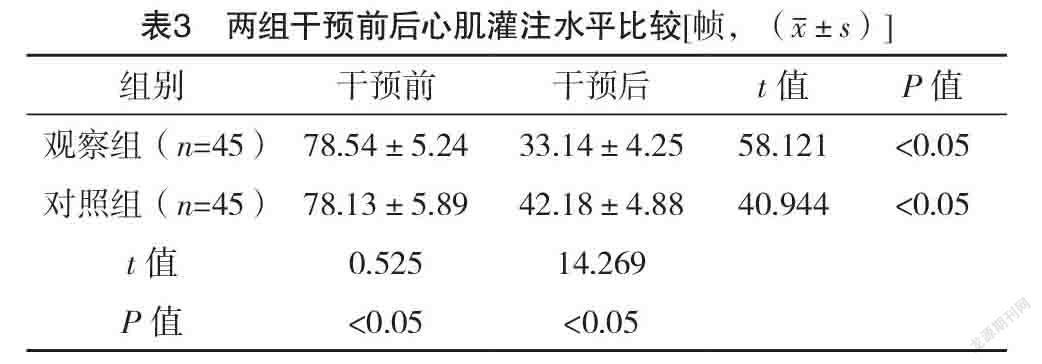
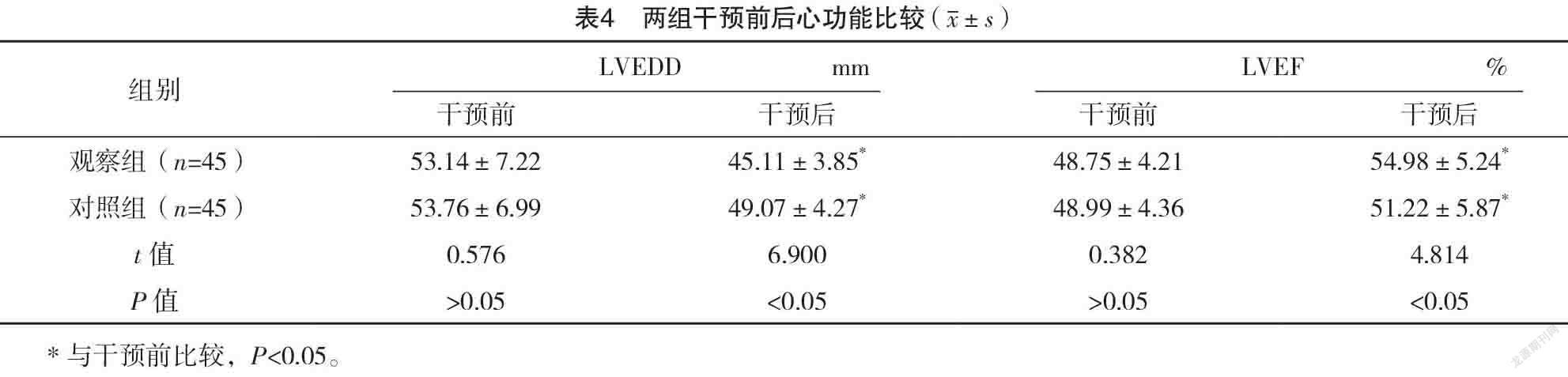
【摘要】 目的:探討尿激酶原溶栓联合经皮冠状动脉介入术(PCI)治疗ST段抬高型心肌梗死的效果。方法:选择2018年4月-2020年4月本院进行治疗的90例STEMI患者,按照随机数字表对照法将其分为对照组和观察组,每组45例。对照组行PCI治疗。观察组行PCI联合使用尿激酶原治疗。比较两组TIMI血流分级、TMPG分级、心肌灌注水平和心功能。结果:观察组干预后TIMI血流分级、TMPG分级均优于对照组,差异均有统计学意义(P<0.05)。干预前,两组心肌灌注水平比较,差异无统计学意义(P>0.05);干预后,两组心肌灌注水平均优于干预前,且观察组优于对照组,差异均有统计学意义(P<0.05)。干预前,两组LVEDD、LVEF比较,差异均无统计学意义(P>0.05);干预后,两组LVEDD均低于干预前,LVEF均高于干预前,且观察组LVEDD低于对照组,LVEF高于对照组,差异均有统计学意义(P<0.05)。结论:尿激酶原溶栓联合PCI治疗STEMI效果较好,可以改善患者的TIMI血流分级、TMPG分级、心肌灌注水平、心功能,应用价值较高。
【关键词】 尿激酶原 经皮冠状动脉介入术 ST段抬高型心肌梗死
Effect of Urokinase Thrombolysis Combined with Percutaneous Coronary Intervention in the Treatment of ST-segment Elevation Myocardial Infarction/HUANG Chun, LI Yue, DILI Reba. //Medical Innovation of China, 2021, 18(28): 037-041
[Abstract] Objective: To investigate the effect of urokinase thrombolysis combined with percutaneous coronary intervention (PCI) in the treatment of ST-segment elevation myocardial infarction. Method: A total of 90 STEMI patients treated in our hospital from April 2018 to April 2020 were selected, and they were divided into control group and observation group according to random number table control method, 45 cases in each group. The control group was treated with PCI, the observation group was treated with PCI combined with Urokinase. TIMI blood flow grading, TMPG grading, myocardial perfusion level and cardiac function were compared between two groups. Result: The TIMI blood flow grading and TMPG grading after intervention in the observation group were superior than those in the control group, the differences were statistically significant (P<0.05). Before intervention, there was no significant difference in myocardial perfusion level between two groups (P>0.05), after intervention, the myocardial perfusion level in both groups was better than those before intervention, and that in the observation group was better than that in the control group, the difference was statistically significant(P<0.05). Before intervention, there were no significant difference in LVEDD and LVEF between two groups (P>0.05); after intervention, LVEDD in both groups were lower than those before intervention, LVEF in both groups were higher than those before intervention, LVEDD in the observation group was lower than that in the control group, LVEF in the observation group was higher than that in the control group, the differences were statistically significant (P<0.05). Conclusion: Urokinase thrombolysis combined with PCI is effective in the treatment of STEMI, and can improve TIMI blood flow grading, TMPG grading, myocardial perfusion level and cardiac function in patients, with high application value.
[Key words] Urokinase Percutaneous coronary intervention ST-segment elevation myocardial infarction
First-author’s address: The First Division Hospital of Xinjiang Production and Construction Corps, Akesu 843000, China
doi:10.3969/j.issn.1674-4985.2021.28.009
ST段抬高型心肌梗死(STEMI)对机体的生命有很大的威胁,患者主要表現为疼痛、心力衰竭、心律失常等[1]。现阶段,急诊经皮冠状动脉介入术(PCI)是STEMI的主要治疗措施,可以恢复心肌供血情况,减少因缺血而造成的细胞死亡[2-3]。已有研究发现,患者经PCI治疗后,部分患者依然会发生心血管不良事件,影响预后[4]。经研究表明,STEMI患者,血栓负荷较重,尿激酶原作为常用溶栓药物,可以用于此情况,改善血管的微循环状态,达到溶栓效果,减少心血管不良事件的发生[5-6]。……