非酒精性脂肪性肝病与阿尔茨海默病的相关性分析
2021-03-25张延霞郭宗君刘蕾张增红
张延霞 郭宗君 刘蕾 张增红



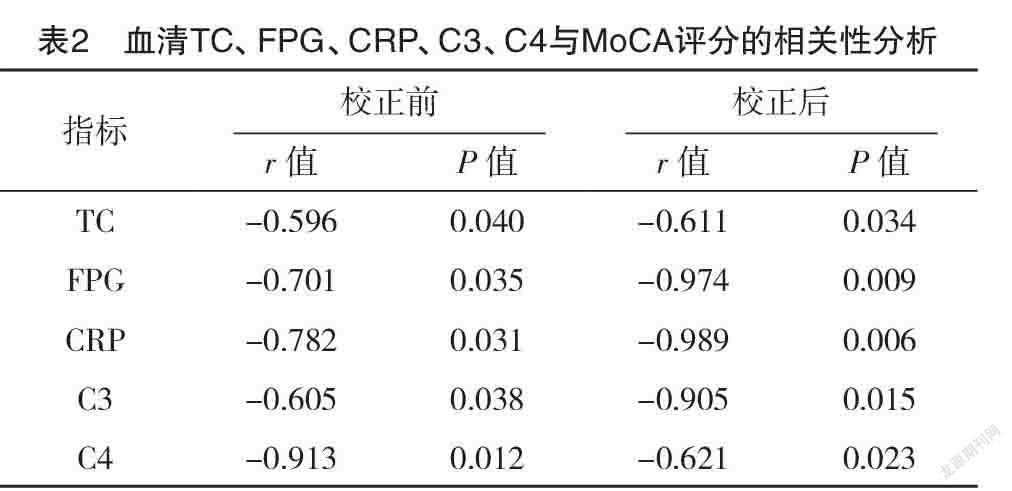
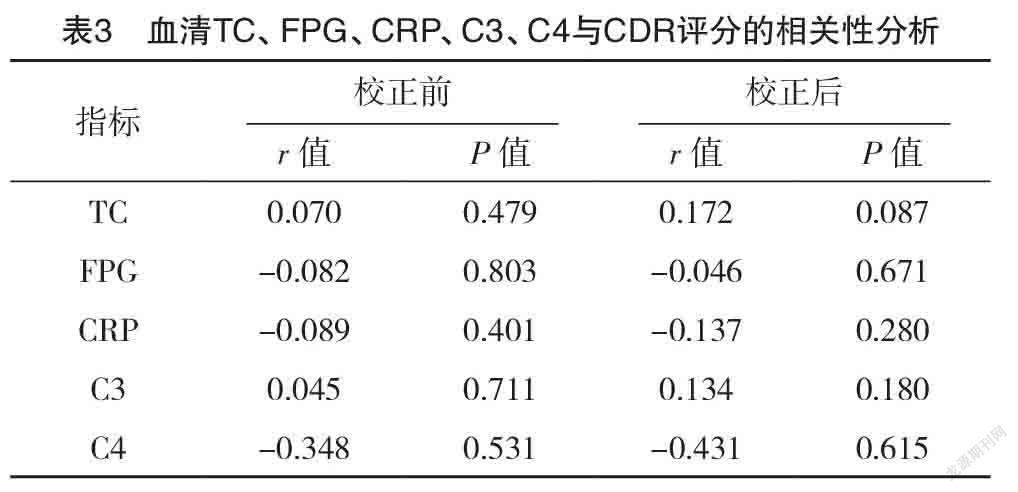
【摘要】 目的:通過分析阿尔茨海默病(AD)合并非酒精性脂肪性肝病(NAFLD)老年患者的临床特征,探讨NAFLD与AD的相关性及可能的机制。方法:选取2012年6月-2020年8月本院干部病房收治的AD患者66例,根据肝脏彩超分为AD+NAFLD组(观察组,n=32)和AD+肝脏正常组(对照组,n=34)。收集两组一般资料及疾病信息,并采用蒙特利尔认知评估量表(MoCA)和临床痴呆评定量表(CDR)评估其认知功能及日常行为能力。比较两组空腹血糖(FPG)、餐后2 h血糖(2 h PG)、糖化血红蛋白(HbA1c)、总胆固醇(TC)、甘油三酯(TG)、高密度脂蛋白胆固醇(HDL-C)、低密度脂蛋白胆固醇(LDL-C)、尿酸(UA)、丙氨酸氨基转移酶(ALT)、天门冬氨酸氨基转移酶(AST)、胆红素(TB)、C反应蛋白(CRP)、血清补体C3、C4水平及MoCA、CDR评分,筛选AD的可能影响因素,分析各影响因素与MoCA评分和CDR评分的相关性。结果:两组血清ALT、AST、TB、2 h PG、UA、HbA1c、TG、HDL-C、LDL-C水平比较,差异均无统计学意义(P>0.05);观察组MoCA评分低于对照组,C3、C4、CRP、FPG、TC水平均高于对照组,差异均有统计学意义(P<0.05)。且观察组C3、C4、CRP、FPG、TC水平与MoCA评分均呈负相关(P<0.05),但与CDR评分均无相关性(P>0.05)。结论:NAFLD与AD患者认知障碍密切相关,可能是AD的危险因素,考虑NAFLD患者可通过升高TC水平损害脑细胞而导致神经细胞退行性疾病AD、升高FPG水平加重胰岛素抵抗导致AD发生发展、通过加重机体免疫炎症反应升高CRP、C3、C4水平而发生AD。
【关键词】 非酒精性脂肪性肝病 阿尔茨海默病 认知障碍
Analysis of Correlation between Nonalcoholic Fatty Liver Disease and Alzheimer’s Disease/ZHANG Yanxia, GUO Zongjun, LIU Lei, ZHANG Zenghong. //Medical Innovation of China, 2021, 18(28): 00-013
[Abstract] Objective: By analyzing the clinical features of Alzheimer’s disease (AD) patients with nonalcoholic fatty liver disease (NAFLD), to explore the correlation between NAFLD and AD. Method: From June 2012 to January 2019, 66 patients with AD admitted to cadre ward of our hospital were selected and divided into AD+NAFLD group (the observation group, n=32) and AD+liver normal group (the control group, n=34). The general data and disease information of two groups were collected, and the cognitive function and daily behavioral ability of two groups were evaluated by Montreal Cognitive Assessment scale (MoCA) and clinical dementia rating scale (CDR). Fasting blood glucose (FPG), 2 h PG, glycosylated hemoglobin (HbA1c), total cholesterol (TC), glycerol (TG), high density lipoprotein cholesterol (HDL-C), low density lipoprotein cholesterol (LDL-C), uric acid, alanine aminotransferase (ALT), aspartate aminotransferase (AST), bilirubin (TB), C-reactive protein (CRP), complement C3 and C4 levels, and MoCA, CDR scores were compared between two groups. The possible influencing factors of AD were screened. The correlation between the influencing factors and MoCA score and CDR score was analyzed. Result: There were no significant differences in serum ALT, AST, TB, 2 h PG, UA, HbA1c, TG, HDL-C, LDL-C levels between two groups (P>0.05). The MoCA score of the observation group was lower than that of the control group (P<0.05), the levels of serum C3, C4, CRP, FPG, TC in the observation group were significantly higher than those in the control group (P<0.05). The levels of serum C3, C4, CRP, FPG, TC in the observation group were negatively correlated with the MoCA scores (P<0.05), but there were no correlation with CDR score (P>0.05). Conclusion: NAFLD is closely related to cognitive impairment in patients with AD and may be a risk factor for AD, considering that NAFLD patients can cause the neure cell degenerative disease AD by damaging brain cells with elevated TC levels, elevated FPG levels exacerbate insulin resistance leading to the development of AD, AD occurs by exacerbating elevated the levels of CRP, C3, C4 in the body’s immune inflammatory response.
[Key words] Nonalcoholic fatty liver disease Alzheimer’s disease Cognitive impairment
First-author’s address: Cadre Ward of PLA 960th Hospital, Tai’an 271000, China
doi:10.3969/j.issn.1674-4985.2021.28.003
阿尔茨海默病(Alzheimer’s disease,AD)是以进行性认知障碍和记忆力损害为主的中枢神经系统退行性病变,近年来其发病率有上升趋势,对老年人群和其家人的生活质量造成严重威胁[1]。AD的特点是起病隐匿,自然病程长,往往不能做到早期确诊,多数患者直到发展到中重度具有明显临床症状时才被家人发现得以就诊、确诊[2]。……