贵州苗族服饰色彩意象认知的KCQ-KE模型构建
2021-03-15吴艳华林丽
吴艳华 林丽
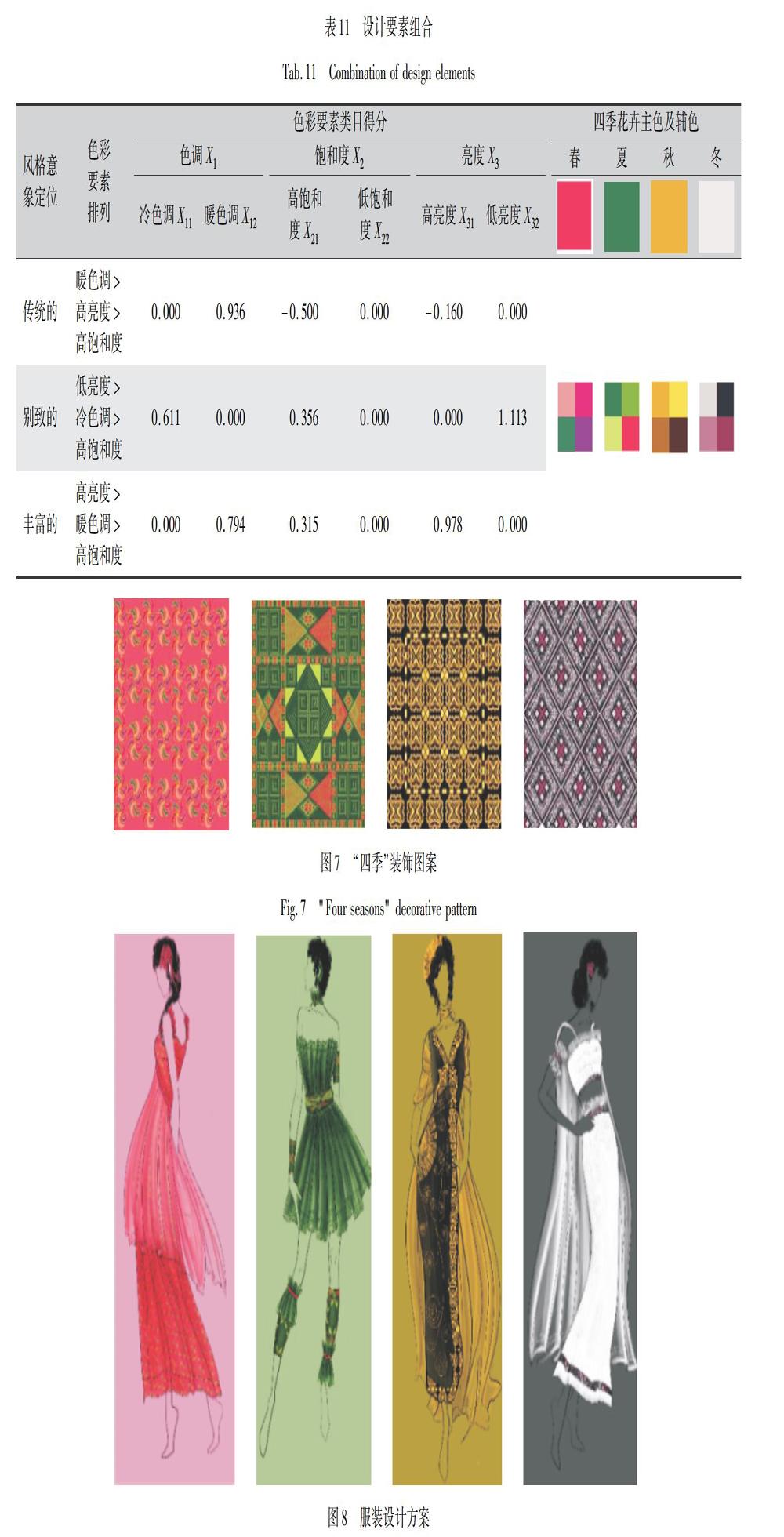
摘要: 为了找到契合用户心理诉求的苗族服饰色彩,将之更好地应用于现代设计,文章提出了贵州苗族服饰色彩意象认知模型构建方法。首先,通过语意差异法(SD法)获得用户对于苗族服饰的认知数据源,结合多元尺度分析及聚类分析等方法降维提炼实验数据,量化表达对苗族服饰色彩的意象认知;其次,基于K均值色彩量化算法,在HSL色彩空间下构建色彩样本的分群,获得代表性样本集;最后,依据数量化I类分析方法建立“色彩—意象”的联立关系,构建基于色彩的K均值聚类算法和感性工学结合的KCQ-KE模型。通过模型将用户对苗族服饰的色彩感性意象认知转换为设计要素,并以苗族围腰图片为认知实验样本,建立苗族服饰色彩的KCQ-KE模型,同时以“四季”为题材的服装设计验证了该模型的可行性。
关键词: 感性工学;色彩量化;苗族服饰;意象认知;色彩聚类
Abstract: In order to find Miao costume colors that fit consumers demands and better apply them to modern design, this paper proposes a way to build a color image cognition model for Miao costumes in Guizhou. First, users cognition data of Miao costumes are obtained through semantic difference(SD) method and the dimensionality is reduced by means of multidimensional scaling and cluster analysis, etc., in order to extract experimental data and the image cognition of Miao costume colors is quantified. Secondly, based on the K-means color quantization algorithm, color samples are grouped under HSL color space to obtain a representative sample set. Finally, a "color-image" relationship is established according to type I quantitative analysis method, and a KCQ-KE model that combines color-based K-means clustering algorithm and kansei engineering is constructed. Through this model, users color image cognition of Miao costumes is converted into design elements. By taking Miao loincloth pictures as samples for the cognitive experiment, the author establishes a KCQ-KE model for Miao costumes colors. At the same time, the feasibility of this model is verified by designing costumes with the theme of "four seasons".
Key words: kansei engineering; color quantization; Miao costumes; image cognition; color clustering
苗族是一個历史悠久、有深厚传统文化和鲜明特色的古老民族,在民族服饰用色上形成了一套自己的独特系统。服饰色彩不仅承载着这个民族的文化历史内涵,也是向人们传达文化的载体。周梦[1]认为苗族的生活习性、历史文化、宗教信仰等是其在服饰上的色彩选取、运用原则的重要来源。金蕾等[2]从民俗和宗教两个角度解析黎族服饰色彩内涵,认为其民族服饰色彩具有其民族文化的象征功能,承载着该民族生活、文化及信仰的演变和传承过程。高星[3]从地理学角度探索了民族服饰色彩的形成和演变过程,试图找出蕴含在地理环境中的地域文化色彩因素,并以此指导当代服饰设计。……