不同种植方式对水稻根结线虫病发生危害的影响
2021-03-12唐蓓王东伟王剑何清聪刘勇张德咏成飞雪
唐蓓 王东伟 王剑 何清聪 刘勇 张德咏 成飞雪
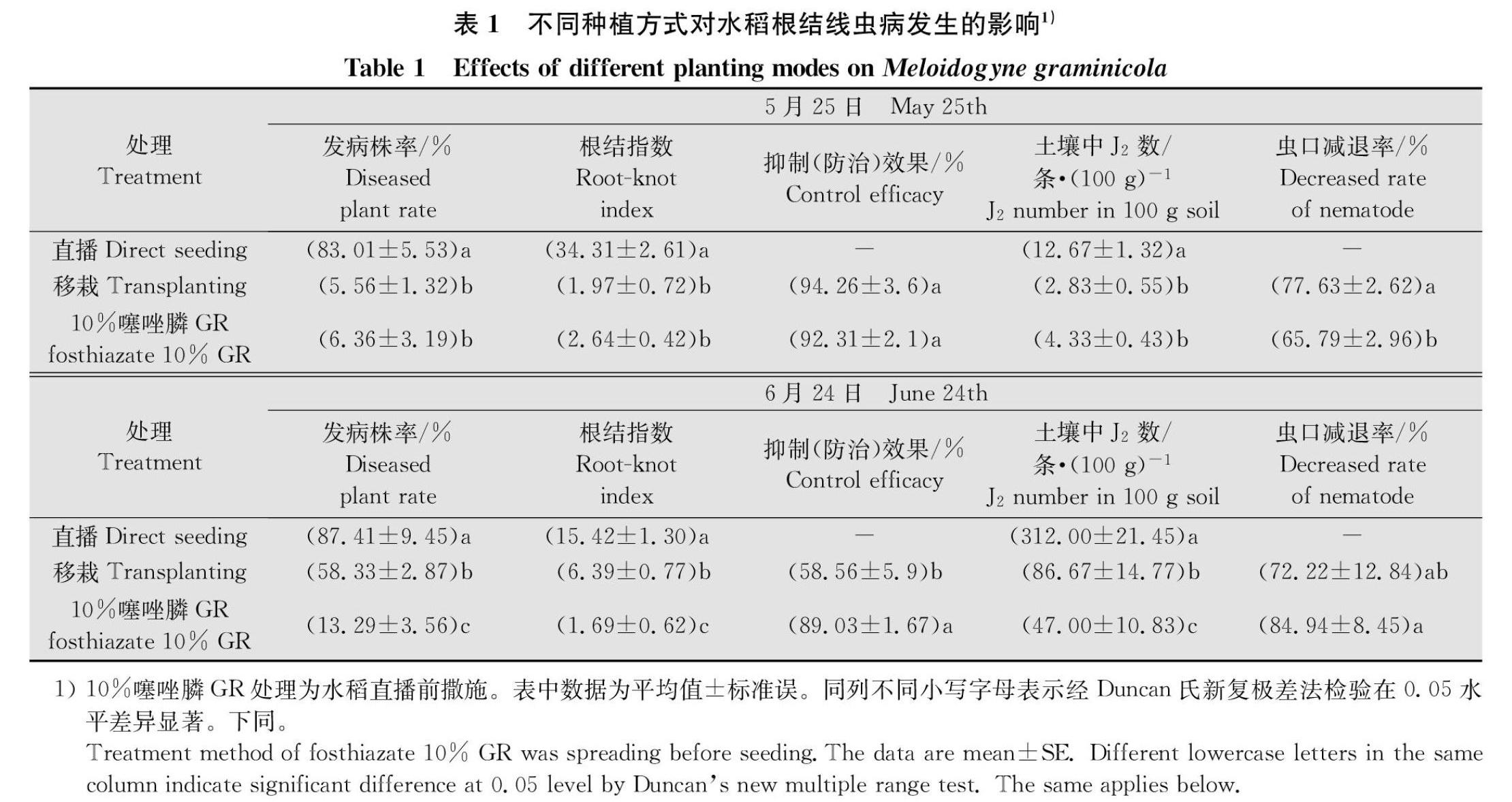
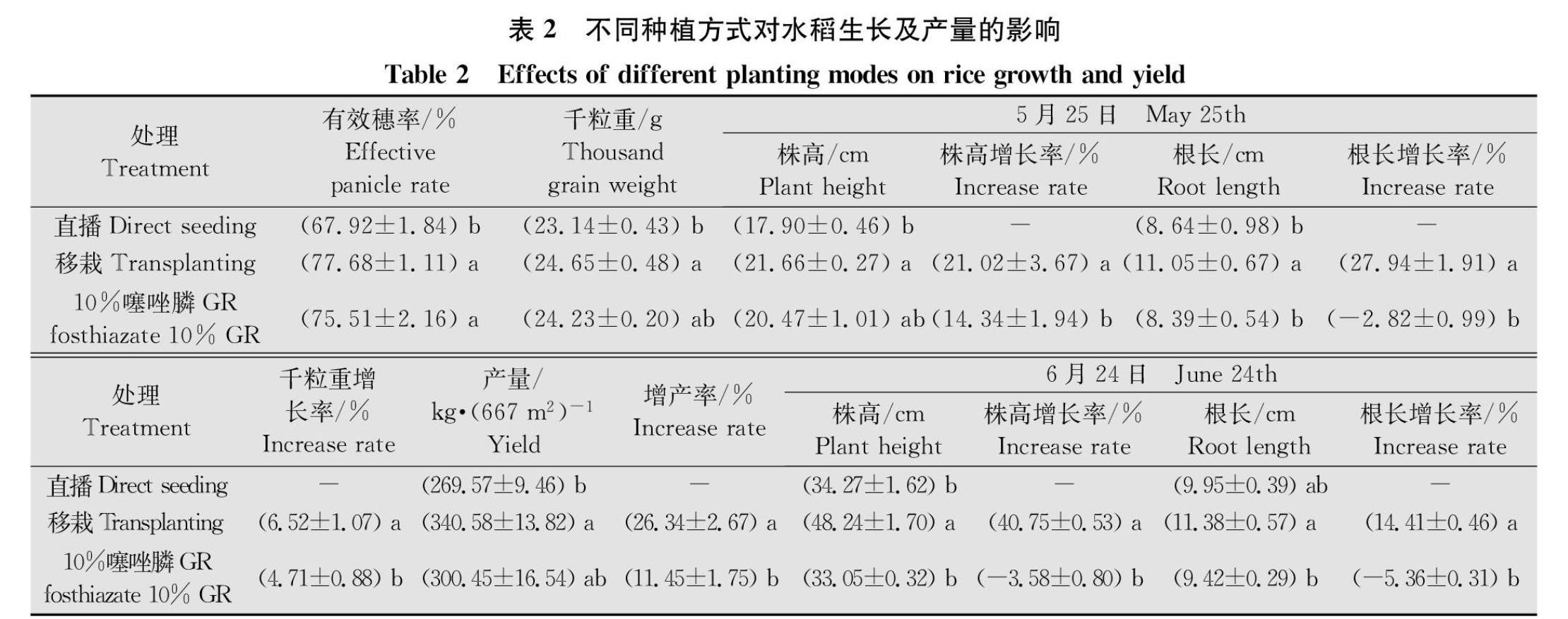
摘要 :水稻根結线虫病是严重危害水稻生产的主要病害之一,目前尚无成本低且安全有效的防控方法。本研究通过田间小区试验评价了直播、移栽和直播前撒施0.2 kg/667 m2 10%噻唑膦颗粒剂(GR) 3种种植方式下水稻根结线虫病发生及危害情况。结果表明,与直播相比,移栽田移栽后25 d水稻根结线虫的抑制率达到94.26%,根结指数为1.97,与直播前撒施0.2 kg/667 m2 10%噻唑膦GR化学药剂处理组无显著差异;移栽后55 d水稻根结线虫的抑制率为58.56%。同时,移栽田移栽后25 d和55 d 根结线虫2龄幼虫虫口减退率分别达到77.63%和72.22%。此外,移栽田水稻株高与根长均高于直播处理组及直播前撒施10%噻唑膦GR处理组;产量比直播处理组增加26.34%,直播处理组产量和直播前撒施10%噻唑膦GR处理组没有显著差异。因此,在水稻根结线虫病发生严重的田块采用移栽方式种植,可显著抑制根结线虫的发生为害,是一种安全、有效的防控措施。
关键词 :水稻根结线虫病; 拟禾本科根结线虫; 移栽方式; 直播方式; 防控效果
中图分类号: S 435.111
文献标识码: A
DOI: 10.16688/j.zwbh.2019624
Effects of different planting modes on occurrence of rice rootknot nematode disease
TANG Bei1,2, WANG Dongwei2, WANG Jian3, HE Qingcong1,2, LIU Yong1,2,
ZHANG Deyong1,2*, CHENG Feixue1,2*
(1. Longping Branch, Graduate School of Hunan University, Changsha 410125, China;
2. Key Laboratory of Integrated Management of the Pests and Diseases on Horticultural Crops in Hunan Province,
Institute of Plant Protection, Hunan Academy of Agricultural Sciences, Changsha 410125, China;
3. Institute of Agricultural Economy and Agricultural Regionalization, Hunan
Academy of Agricultural Sciences, Changsha 410125, China)
Abstract :Rice rootknot nematode disease is a major threat to rice production. There is no lowcost, safe and effective method to control this disease up to now. In this study, the effects of three different cultivation modes, including direct seeding, transplanting and spreading 0.2 kg/667 m2 fosthiazate 10% GR over the field before seeding, on the occurrence of rice rootknot nematode disease were evaluated. The results showed that compared to the direct seeding mode, the control efficacy of transplanting on rice rootknot nematode disease reached 94.26% and the rootknot index of rice was 1.97 25 days after transplanting, showed no significant difference with the mode of spreading fosthiazate 10% GR of 0.2 kg/667 m2 before seeding. The control efficacy of transplanting on rice rootknot nematode was still up to 58.56% 55 days after transplanting. The secondstage juvenile (J2) density of Meloidogyne graminicola in soil was reduced by 77.63% and 72.22% in transplanting field 25 days and 55 days after transplanting, respectively. In addition, the plant height and root length of transplanting rice were higher than rice in direct seeding field and field treated by fosthiazate 10% GR before seeding, and the yields of transplanting rice were significantly increased by 26.34% compared to those of direct seeding rice. There was no significant difference between the yields in mode of direct seeding and the yields in the mode of spreading fosthiazate 10% GR before seeding. Therefore, the transplanting mode is a safe and effective measure for the control of the rootknot nematode disease in rice field.
Key words :rice rootknot nematode disease; Meloidogyne graminicola; transplanting mode; direct seeding mode; control effect
水稻根结线虫病是严重危害水稻生产的重要病害,其主要病原物为拟禾本科根结线虫Meloidogyne graminicola[1]。该线虫主要分布在中国、美国、印度以及缅甸、老挝等热带和亚热带地区[2],我国最早在海南岛的水稻上发现了拟禾本科根结线虫[3]。近年来,随着水稻种植方式的改变,水稻根结线虫病在海南、广东、广西、福建、云南、湖南、江西、江苏、四川等多个省(自治区)大面积严重发生[48],导致产量损失11%~73%,甚至绝收[910]。……