肺癌患者根治术后谵妄的危险因素分析
2021-01-28许海阳刘红应笑丽邹伟伟龚柳阳
许海阳 刘红 应笑丽 邹伟伟 龚柳阳
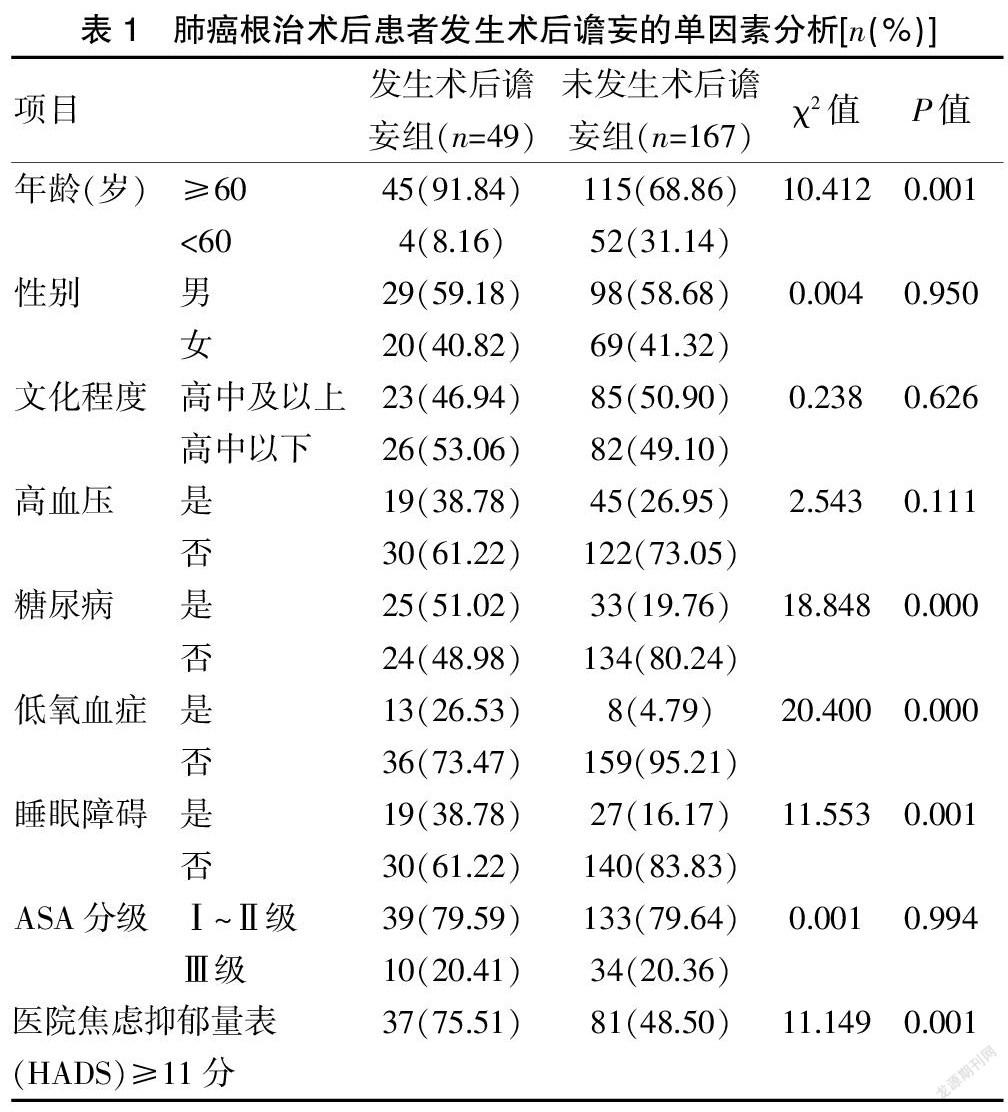

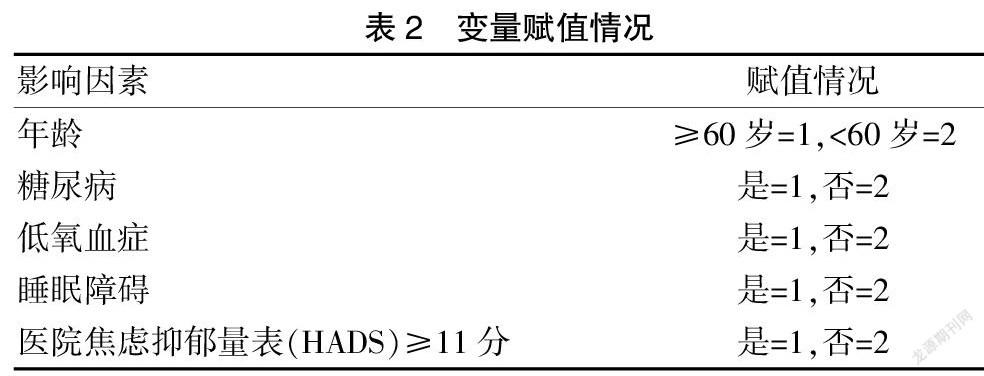
[摘要] 目的 研究肺癌患者根治術后发生谵妄的危险因素,为预防术后谵妄的发生提供依据。 方法 采用简单随机抽样方法选取我院2019年1—12月收治的肺癌根治术患者216例作为本研究样本,通过采用自制调查表进行相关数据的收集,先进行术后谵妄的单因素分析,再进一步进行多因素Logistic回归分析术后谵妄发生的危险因素。 结果 肺癌根治术后患者谵妄发生率为22.69%。年龄≥60岁OR(95%置信区间)为 2.41(1.808~3.229)(P=0.042);糖尿病OR(95%置信区间)为12.81(9.608~17.165)(P=0.012);低氧血症OR(95%置信区间)为9.16(6.875~12.284)(P=0.022);睡眠障碍OR(95%置信区间)为 2.79(2.093~3.739)(P=0.043);医院焦虑抑郁量表(HADS)≥11分OR(95%置信区间)为7.31(5.483~9.795)(P=0.023)。 结论 年龄≥60岁、糖尿病、低氧血症、睡眠障碍及医院焦虑抑郁量表(HADS)≥11分为肺癌根治术后患者发生谵妄的独立危险因素,对于高龄及伴随糖尿病的患者应重点监测并积极预防术后谵妄,同时应积极改善患者的血气指标,减少低氧血症的发生,改善患者的睡眠质量,对患者进行心理干预,改善患者的焦虑及抑郁状况,积极预防肺癌根治术后患者的谵妄发生。
[关键词] 肺癌根治术;谵妄;危险因素;认知功能
[中图分类号] R734.2 [文献标识码] B [文章编号] 1673-9701(2021)33-0102-03
[Abstract] Objective To study the risk factors for delirium in patients with radical surgery for lung cancer, so as to provide a basis for the prevention of postoperative delirium. Methods A total of 216 patients with radical surgery for lung cancer admitted to our hospital from January to December 2019 were selected as the sample of this study by a simple random sampling method. The relevant data were collected by using a self-made questionnaire, and the risk factors for postoperative delirium were analyzed through a single-factor analysis, followed by a multi-factor logistic regression analysis. Results The incidence of delirium in patients with radical surgery for lung cancer was 22.69%. The odds ratio (OR) [95% confidence interval (CI)] of age ≥60 years was 2.41 (1.808-3.229) (P=0.042). The OR (95%CI) of diabetes was 12.81 (9.608-17.165) (P=0.012). The OR (95%CI) of hypoxemia was 9.16 (6.875-12.284) (P=0.022). The OR (95%CI) of sleep disorders was 2.79 (2.093-3.739) (P=0.043). The OR (95%CI) for Hospital Anxiety and Depression Scale (HADS) score≥11 points was 7.31 (5.483-9.795) (P=0.023). Conclusion Age ≥60 years, diabetes, hypoxemia, sleep disorders, and HADS score≥11 points are independent risk factors for delirium in patients with radical surgery for lung cancer. Elderly patients with diabetes should be monitored tightly, and corresponding measures should be actively taken to prevent them from postoperative delirium. Meanwhile, the blood gas indexes of patients should be improved to reduce the occurrence of hypoxemia. In addition, it is also necessary to improve sleep quality, and conduct psychological interventions to improve the anxiety and depression state of patients, thus preventing the delirium after radical surgery for lung cancer.
[Key words] Radical surgery for lung cancer; Delirium; Risk factors; Cognitive function
目前临床上肺癌根治术为早期、中期肺癌治疗的主要方式,且随着医疗技术的进步其手术适应证范围越广,采用该手术治疗的患者越来越多[1-2]。而肺癌根治术后容易发生各种并发症。术后谵妄即为神经系统并发症之一。术后谵妄是以出现思维混乱,认知能力,注意力及不同程度意识障碍等可逆性精神障碍,表现为急性发病。……