精神专科医院与综合医院精神科新入院精神分裂症临床特征及治疗分析
2021-01-05慕永刚许珂张素贞宓为峰张鸿燕
慕永刚 许珂 张素贞 宓为峰 张鸿燕
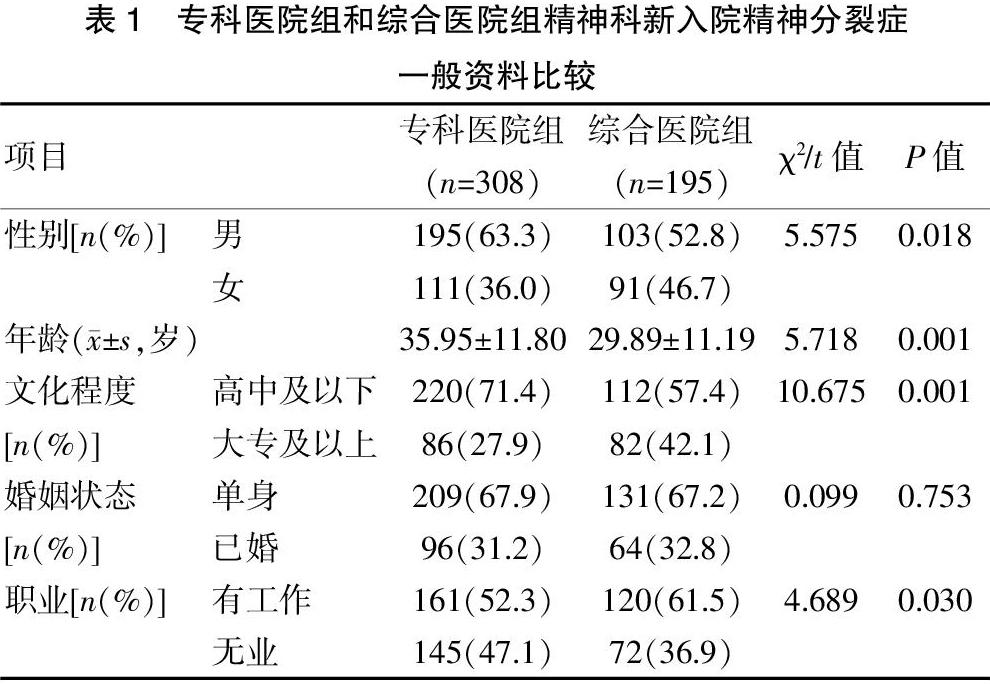

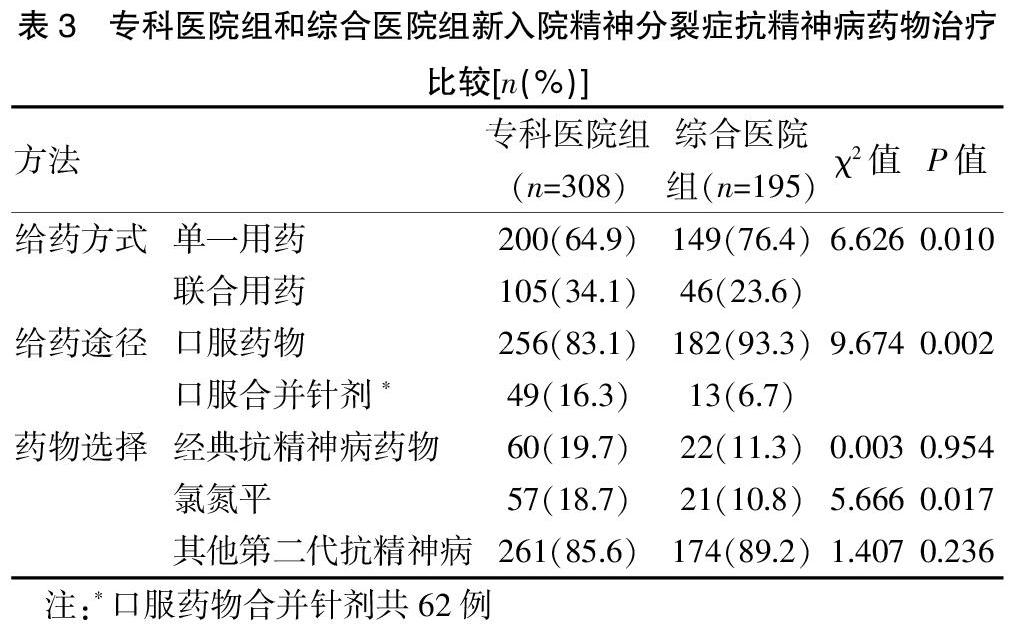
[摘要] 目的 比較精神专科医院与以综合科系为主的综合医院精神科新入院精神分裂症患者临床特征和临床干预手段的异同。 方法 本研究为多中心、横断面、非干预性研究。选取2014年9—11月国内5家三级医疗卫生机构(3家精神专科医院和2家综合科系为主的综合医院精神科)503例新入院精神分裂患者,收集患者一般资料,评定患者CGI-S、BARS、PANSS-EC、MOAS量表并收集实际治疗情况。 结果 ①一般资料:精神专科医院组年龄高于综合医院精神科组,差异有统计学意义(P<0.01),而综合医院精神科组女性、大专及以上文化程度、有工作比例均高于精神专科医院组,差异有统计学意义(P<0.05);②临床特征:精神专科医院组既往住院≥4次、非自愿住院、CGI-S≥6、MOAS≥4分、PANSS-EC总分、兴奋激越比例均明显高于综合医院精神科组,差异均有统计学意义(P<0.01);③临床干预手段:精神专科医院组经典抗精神病药物联合用药、口服合并针剂、氯氮平比例高于综合医院组,差异均有统计学意义(P<0.05)。两组选用经典抗精神病药物与其他第二代抗精神病药比较,差异均无统计学意义(P>0.05)。 结论 与综合医院精神科相比,精神专科医院新入院精神分裂患者临床表现具有病情重、攻击暴力风险高的特点,两组医院临床干预手段均以抗精神病药物单一治疗和口服药物治疗为主。
[关键词] 专科医院;综合医院;精神分裂症;临床特征;干预
[中图分类号] R749.3 [文献标识码] A [文章编号] 1673-9701(2021)31-0023-04
[Abstract] Objective To compare the similarities and differences in clinical features and clinical interventions for newly admitted schizophrenic patients in the psychiatric department of psychiatric hospitals and general hospitals with comprehensive departments as the mainstay. Methods This was a multicenter, cross-sectional, non-interventional study. A total of 503 newly admitted schizophrenic patients in 5 tertiary medical institutions (the psychiatric department of 3 psychiatric hospitals and 2 general hospitals with comprehensive departments as the mainstay) in China from September to November 2014 were selected as the study subjects. The general data of these patients were collected, the Clinical Global Impression Scale(CGI-S), Behaviorally Anchored Rating Scale (BARS), Positive and Negative Syndrome Scale-Chinese version (PANSS-EC) and Modified Overt Aggression Scales (MOAS) were scored, and the actual treatment situation was summarized. Results (1)In terms of general data, patients in the psychiatric hospital group was older than those in the general hospital psychiatric group (P<0.01). The proportions of females,college and above education level,and having a job in the general hospital psychiatric group were higher than those in the psychiatric hospital group,with statistically significant differences (P<0.05). (2)In terms of clinical features,the number of patients with ≥4 previous hospitalizations,the number of involuntary hospitalizations,the proportion of CGI-S≥6 points and MOAS≥4 points,total PANSS-EC score,and the proportion of excited agitation in the psychiatric hospital group were significantly higher than those in the general hospital psychiatric group,all with statistically significant differences (all P<0.01). (3)In terms of clinical interventions,the proportions of antipsychotic drug combinations,combination of oral medication and injections, use of clozapine were higher in the psychiatric hospital group than in the general hospital psychiatric group,all with statistically significant differences (P<0.05). There was no statistical difference between the two groups in the selection of classical antipsychotics and other second-generation antipsychotics(P>0.05). Conclusion Compared with psychiatric departments in general hospitals,the clinical manifestations of newly admitted schizophrenic patients in psychiatric hospitals are characterized by severer illness and higher risk of aggressive violence. The clinical interventions in both kinds of hospitals are mainly antipsychotic monotherapy and oral medication.
[Key words] Specialty hospitals; General hospitals; Schizophrenia; Clinical features; Intervention
精神分裂癥(Schizophrenia,SCH)是临床最常见的一类严重性精神疾病,该病多起病于青壮年,具有高复发率、高致残率的特点,严重影响患者的生活质量[1]。……