新生儿呼吸窘迫综合征治疗中经鼻间歇正压通气的应用临床效果
2020-11-10王太艮
王太艮

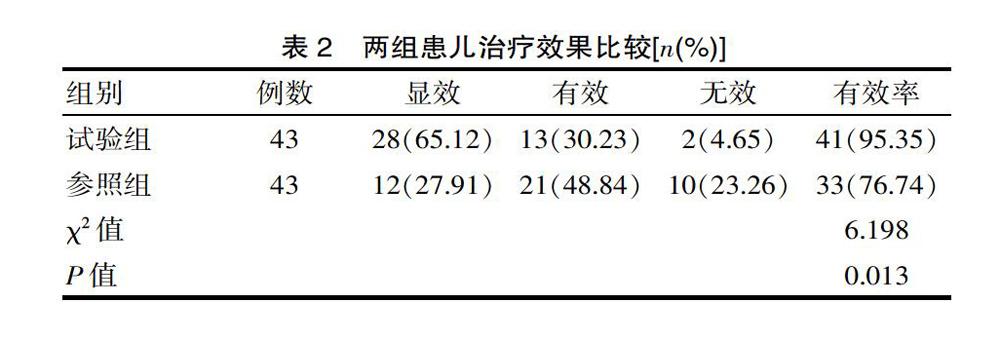
[摘要] 目的 探究经鼻间歇正压通气应用于新生儿呼吸窘迫综合征的临床效果。方法 随机选取该院自2018年8月—2019年10月期间收治的86例新生儿呼吸窘迫综合征患儿采取抽签法随机分为试验组(n=43)与参照组(n=43),参照组患儿实施经鼻持续气道正压通气,试验组患儿实施经鼻间歇正压通气,对比两组患儿动脉血气指标及治療效果。结果 试验组患儿PaCO2为(37.81±6.13)mmHg低于参照组的(45.41±7.26)mmHg(t=5.245,P=0.000),PaO2为(74.38±11.54)mmHg高于参照组的(65.86±10.83)mmHg(t=3.530,P=0.001),pH值为(7.36±0.27)高于参照组的(7.19±0.21)(t=3.259,P=0.002),试验组患儿治疗有效率为95.35%明显高于参照组的76.74%(χ2=6.198,P=0.013<0.05)。结论 经鼻间歇正压通气应用于新生儿呼吸窘迫综合征可有效改善动脉血气指标,提高治疗效果,安全性较高。
[关键词] 新生儿呼吸窘迫综合征;经鼻间歇正压通气;临床效果
[中图分类号] R5 [文献标识码] A [文章编号] 1674-0742(2020)08(c)-0017-03
[Abstract] Objective To explore the clinical effect of intermittent positive pressure ventilation applied to neonatal respiratory distress syndrome. Methods Random selection 86 children with neonatal respiratory distress syndrome admitted to the hospital from August 2018 to October 2019 were randomly divided into experimental group (n=43) and reference group(n=43) by lottery. Children in the reference group received continuous positive airway pressure through the nose, and children in the test group received intermittent positive airway pressure through the nose. The arterial blood gas indexes and treatment effects of the two groups were compared. Results The PaCO2 of the children in the experimental group was (37.81±6.13)mmHg lower than the (45.41±7.26)mmHg of the reference group (t=5.245, P=0.000), and the PaO2 of (74.38±11.54)mmHg was higher than the (65.86±10.83)mmHg of the reference group (t=3.530, P=0.001), the pH value of (7.36±0.27) was higher than (7.19±0.21) of the reference group (t=3.259, P=0.002), and the treatment effective rate of children in the experimental group was 95.35% significantly higher than that of the reference group 76.74% (χ2=6.198, P=0.013<0.05). Conclusion The application of nasal intermittent positive pressure ventilation in neonatal respiratory distress syndrome can effectively improve arterial blood gas indicators and improve the therapeutic effect. It is safe of promotion.
[Key words] Neonatal respiratory distress syndrome; Nasal intermittent positive pressure ventilation; Clinical effect
新生儿呼吸窘迫综合征是常见的新生儿呼吸系统疾病,多发病于早产儿,发病主要原因是患儿肺结构未完全发育成熟,肺泡表面缺乏活性物质导致[1],临床表现为发绀、呼吸困难、呻吟等,若不及时救治易引发呼吸衰竭,严重威胁患儿生命安全[2]。为了避免引发其他并发症,需要尽快对患儿施救,通过科学的治疗方式改善临床症状,由于患儿无法进行言语表达,医护人员务必密切观察患儿血气指标及生命体征[3-4]。随着医疗水平逐渐成熟,呼吸机氧疗被广泛应用,临床通常采取经鼻间歇或经鼻持续气道正压通气治疗[5],该文将该院2018年8月—2019年10月期间收治的86例新生儿呼吸窘迫综合征患儿作为研究对象,探究经鼻间歇正压通气的应用效果,现报道如下。
1 资料与方法
1.1 一般资料
随机选取该院收治的86例新生儿呼吸窘迫综合征患儿,采取抽签法分成试验组(n=43)和参照组(n=43)。……
