银杏内酯注射液对比丁苯酞注射液治疗大动脉粥样硬化性缺血性脑卒中的最小成本分析
2020-10-20周黎项予良郭昭婷胡明杨男
周黎 项予良 郭昭婷 胡明 杨男
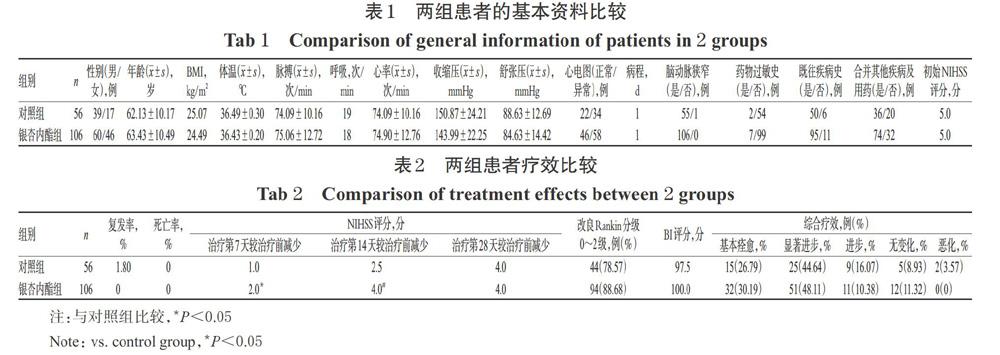
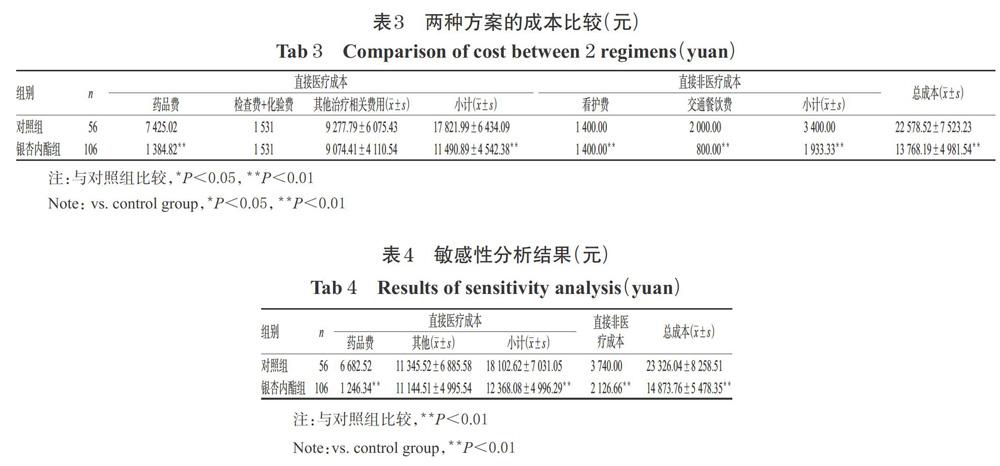
摘 要 目的:評价银杏内酯注射液对比丁苯酞注射液治疗大动脉粥样硬化性缺血性脑卒中的疗效、安全性和经济性。方法:从一项银杏内酯注射液治疗大动脉粥样硬化性缺血性脑卒中的多中心、随机、双盲、对照临床试验中,选取原试验组中使用了银杏内酯注射液+阿司匹林肠溶片而未使用任何剂型的丁苯酞的106例患者作为银杏内酯组,原安慰剂组中使用了丁苯酞注射液+阿司匹林肠溶片的56例患者作为对照组,比较两种方案的治疗效果、安全性和经济性。疗效指标包括复发率、死亡率、美国国立卫生研究院卒中量表(NIHSS)评分、残障程度分级(改良 Rankin分级)、日常生活能力(BI)评分、综合疗效,安全性指标包括治疗过程中出血事件及不良事件发生率;采用最小成本分析法进行经济学评价。结果:治疗后第28天,两组复发率、死亡率、NIHSS评分、改良Rankin分级0~2级的患者比例、BI评分、综合疗效、不良事件发生率比较,差异均无统计学差异(P>0.05);而治疗后第7、14天银杏内酯组患者NIHSS评分的改善情况显著优于对照组(P<0.05)。最小成本分析结果表明,试验组患者治疗14 d的总成本为(13 768.19±4 981.54)元,显著低于对照组的(22 578.52±7 523.23)元(P<0.01);敏感性分析结果提示最小成本分析结果稳定。结论:对于大动脉粥样硬化性缺血性脑卒中患者的治疗,银杏内酯+阿司匹林的方案与丁苯酞+阿司匹林方案在改善患者28 d的临床疗效和安全性方面效果相当,但前者改善患者神经功能缺损的短期效果更优,短期经济性也更佳。
关键词 缺血性脑卒中;银杏内酯注射液;丁苯酞注射液;疗效;安全性;最小成本分析
中图分类号 R969;R743 文献标志码 A 文章编号 1001-0408(2020)18-2235-05
DOI 10.6039/j.issn.1001-0408.2020.18.11
ABSTRACT OBJECTIVE: To evaluate therapeutic efficacy,safety and economical efficiency of Ginkgolide injection versus Butylphthalide injection in the treatment of ischemic stroke. METHODS:Among the GISAA of Ginkgolide injection in the treatment of ischemic stroke of large-artery atherosclerosis, 106 patients who were given Ginkgolide injection+Asprin enteric-coated tablets but did not use butylphthalide in any dosage in previous trial group were selected as ginkgolide group;56 patients who were given Butylphthalide injection+Ginkgolide injection+Asprin enteric-coated tablets in previous placebo group were selected as control group. The effects, safety and economical efficiency were compared between 2 groups. Effect indexes included recurrence rate, mortality, NIHSS score, modified Rankin score (mRS),Barthel index and comprehensive efficacy. The safety indexes included incidence of bleeding event and adverse event during treatment. Cost-minimization analysis was used for economic evaluation. RESULTS: There was no statistical difference in recurrence rate, mortality, NIHSS score, the proportion of subjects with mRS 0-2, Barthel index, comprehensive efficacy and the incidence of adverse event between 2 groups on 28th day after treatment (P>0.05). NIHSS score of ginkgolide group was better than that of control group on 7th and 14th day (P<0.05). Results of cost-minimization analysis showed that total cost of ginkgdide group was (13 768.19±4 981.54) yuan on 14th day of treatment, which was significantly lower than (22 578.52±7 523.23) yuan of control group (P<0.01). The results of sensivity analysis indicated that the minimum lost analysis was stable. CONCLUSIONS: For the treatment of ischemic stroke, ginkgolide+aspirin is similar to butylphthalide+aspirin in improving clinical outcome and safety of 28 days, but is better than it in short-term efficacy of improving neurological deficit, and better short-term economical efficiency.
KEYWORDS Ischemic stroke; Ginkgolide injection; Butylphthalide injection; Efficacy; Safety; Cost-minimization analysis
脑卒中是指因脑部血液循环障碍,缺血、缺氧所致的局限性脑组织的缺血性坏死或软化而出现相应的神经系统功能缺损[1],具有发病率高、死亡率高、致残率高和复发率高的特点[2-3]。2013年基于我国多个省份的一项调查研究显示,脑卒中已成为我国第一大致死疾病[4]。按病……