地西他滨单药治疗骨髓增生异常综合征疗效和安全性的Meta分析
2020-10-20郑丽宫一凡孙雪林张卫娜赵妍
郑丽 宫一凡 孙雪林 张卫娜 赵妍
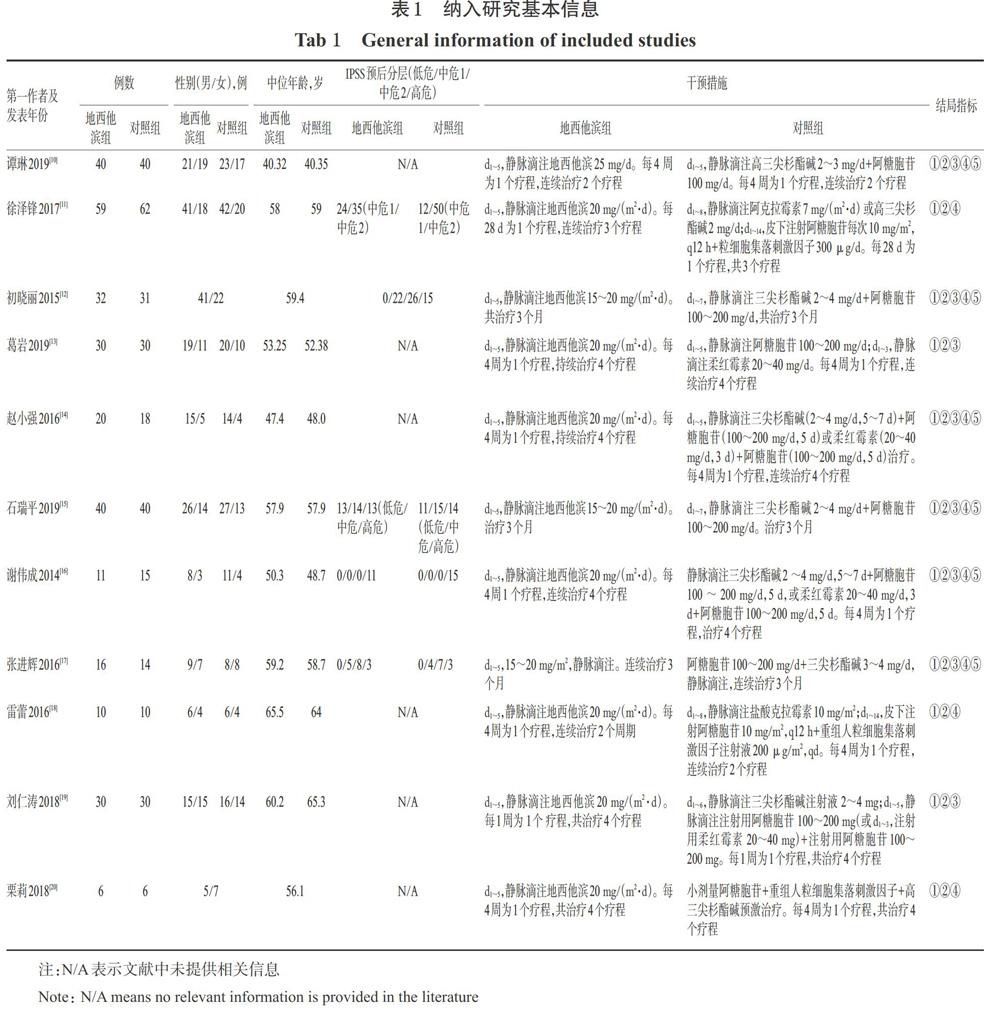
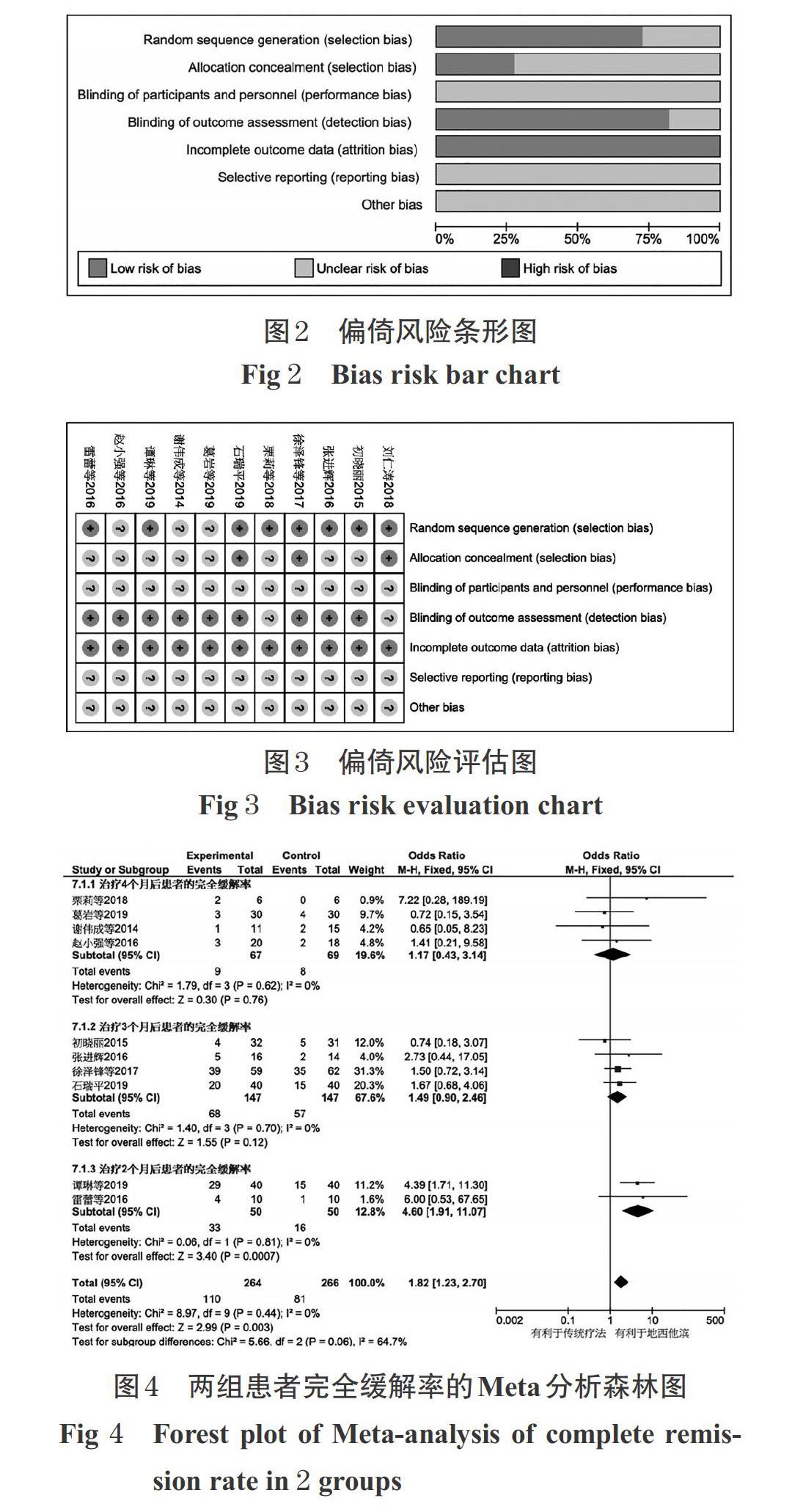
摘 要 目的:系統评价地西他滨单药治疗骨髓增生异常综合征(MDS)的疗效和安全性,为临床提供循证参考。方法:计算机检索Embase、Cochrane图书馆、PubMed、Medline、Clinical Key、Google学术、中国知网、中国生物医学文献数据库及万方数据等中英文数据库,检索时限均为建库起至2020年6月26日,收集地西他滨(地西他滨组)对比传统联合化疗方案(对照组)治疗MDS患者的随机对照试验(RCT)。筛选文献,提取资料并采用Cochrane系统评价员手册5.2.2推荐的偏倚风险评估工具评价纳入文献质量后,采用Rev Man 5.3软件进行Meta分析。结果:共纳入11项RCT,共计590例患者。Meta分析结果显示,地西他滨组患者的完全缓解率[OR=1.82,95%CI(1.23,2.70),P=0.003]和总有效率[OR=1.54,95%CI(1.05,2.27),P=0.03]均显著高于对照组,不良反应发生率[OR=0.26,95%CI(0.16,0.40),P<0.000 01]、感染发生率[OR=0.48,95%CI(0.27,0.85),P=0.01]和骨髓抑制发生率[OR=0.37,95%CI(0.17,0.81),P=0.01]均显著低于对照组。按疗程进行的亚组分析结果显示,在疗程为3、4个月的方案中,两组患者的完全缓解率和总有效率比较差异均无统计学意义(P>0.05);在疗程为1、2个月的方案中,地西他滨组患者的完全缓解率和总有效率均显著高于对照组(P<0.05)。结论:地西他滨单药治疗MDS患者的疗效和安全性均较好,且当治疗时长≤2个月时,地西他滨治疗MDS患者的完全缓解率及总有效率更优。
关键词 地西他滨;骨髓增生异常综合征;疗效;安全性;Meta分析
中图分类号 R551.3;R969 文献标志码 A 文章编号 1001-0408(2020)18-2269-06
DOI 10.6039/j.issn.1001-0408.2020.18.17
ABSTRACT OBJECTIVE: To systematically evaluate the efficacy and safety of decitabine monotherapy in the treatment of myelodysplastic syndrome (MDS), and to provide evidence-based reference to the clinic. METHODS: Retrieved from Embase, Cochrane Library, PubMed, Medline, Clinical Key, Google Scholar, CNKI, CBM and Wanfang data, during the inception to Jun. 26th, 2020, randomized controlled trials (RCTs) about decitabine (decitabine group) versus traditional combined chemotherapy (control group) in the treatment of MDS were collected. After literature screening and data extraction, literature quality evaluation with bias risk evaluation tool recommended by Cochrane systematic evaluator manual 5.2.2, Meta-analysis was performed by using Rev Man 5.3 software. RESULTS: A total of 590 patients with 11 RCTs were included. Meta-analysis results showed that complete remission rate [OR=1.82, 95% CI(1.23,2.70), P=0.003] and total response rate [OR=1.54,95% CI(1.05,2.27),P=0.03] of decitabine group were significantly higher than those of control group; the incidence of ADR [OR=0.26, 95% CI(0.16,0.40), P<0.000 01], the incidence of infection [OR=0.48, 95% CI(0.27,0.85), P=0.01] and the incidence of myelosuppression [OR=0.37, 95% CI(0.17,0.81), P=0.01] in decitabine group were significantly lower than control group. The results of subgroup analysis according to the course of treatment showed that there was no significant difference in the complete remission rate and total response rate between 2 groups in the treatment course of 3 and 4 months (P>0.05); but there was significant difference in the treatment course of 1 month or 2 months, the decitabine group was significantly higher than control group (P<0.05). CONCLUSIONS: Decitabine has good efficacy and safety in the treatment of MDS patients, and when the treatment time is less than or equal to 2 months, the complete remission rate and total response rate of decitabine in MDS patients are better.
KEYWORDS Decitabine; Myelodysplastic syndrome; Efficacy; Safety; Meta-analysis
骨髓增生异常综合征(Myelodysplastic syndrome,MDS)是一种起源于造血干细胞的恶性克隆性疾病,具有高度异质性,表现为无效造血、难治性血细胞减少、造血功能衰竭,并以高风险向急性髓系白血病(Acute myelod leukemia,AML)转化为特征[1]。临床一般采用CAG(阿糖胞苷+阿克拉霉素+粒细胞集落刺激因子)[2]或HAG(高三尖杉酯碱+阿糖胞苷+粒细胞集落刺激因子)[3]等预激方案治疗MDS,然而上述方案的有效性和安全性尚有待进一步提高[4]。研究证实,DNA甲基化异常特别是抑癌基因甲基化异常与MDS和AML的发生密切相关,抑制DNA甲基化异常可改善部分MDS患者的病情,延迟向AML转化,甚至延长生存期[5-6]。……