浅析临床医学检验中血液细胞检验质量控制的策略
2020-10-13张宏

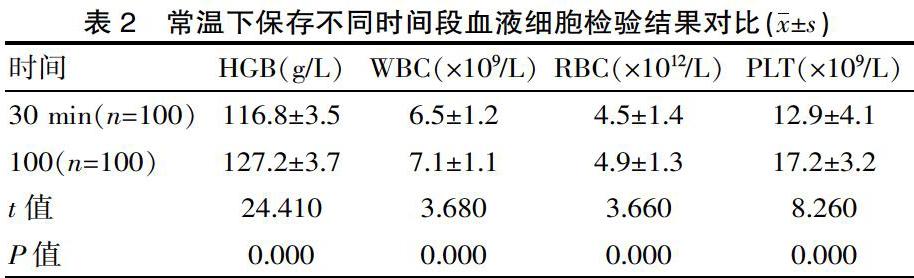

[摘要] 目的 分析临床医学检验中血液细胞检验质量控制的策略。方法 随机选取2018年10月—2019年9月到该院进行血液细胞检验的100份患者血液样本作为该次研究的观察对象,按照影响血液样本质量的因素对样本进行科学处理,比较了抗凝配比不同、常温下保存不同时间段和低温下保存不同时间段对血液细胞检验结果造成的差异。 结果 抗凝比对血液细胞检验结果的影响较大,1∶5 000的HGB、WBC、RBC、PLT分比為(106.3±6.3)g/L、(6.2±0.3)×109/L、(4.0±0.6)×1012/L、(137.3±6.7)×109/L,对比1∶10 000比例的(132.1±8.7)g/L、(10.8±0.2)×109/L、(5.3±0.6)×1012/L、(183.8±8.8)×109/L,差异有统计学意义(t=24.010、127.580、15.320、42.040,P<0.05);常温下保存不同时间段血液细胞检验结果差异较大,30 min的HGB、WBC、RBC、PLT分比为(116.8±3.5)g/L、(6.5±1.2)×109/L、(4.5±1.4)×1012/L、(12.9±4.1)×109/L,3 h的HGB、WBC、RBC和PLT值为(127.2±3.7)g/L、(7.1±1.1)×109/L、(4.9±1.3)×1012/L和(17.2±3.2)×109/L,差异有统计学意义(t=24.410、3.680、3.660、8.260,P<0.05);低温下保存不同时间段血液细胞检验结果差异较大,30 min的HGB、WBC、RBC、PLT分比为(119.8±2.5)g/L、(13.5±1.2)×109/L、(14.5±1.3)×1012/L、(183.9±4.1)×109/L,3 h的HGB、WBC、RBC和PLT值为(126.2±2.7)g/L、(15.1±1.2)×109/L、(15.7±0.2)×1012/L、(187.2±3.2)×109/L,差异有统计学意义(t=17.390、9.420、9.120、6.340,P<0.05)。 结论 为了检验的质量控制,要严格按照科学抗凝配比,做好温度监测和时间把握,充分保证血液细胞检验结果的科学性和准确性。
[关键词] 医学检验;质量控制;抗凝剂;血液细胞检验
[中图分类号] R446.1 [文献标识码] A [文章编号] 1674-0742(2020)08(a)-0193-03
Analysis on the Strategy of Quality Control of Blood Cell Test in Clinical Medical Test
ZHAN Hong
Department of Laboratory Medicine, Central Hospital of Zibo Mining Group Co., Ltd. Zibo, Shandong Province, 255120 China
[Abstract] Objective To analyze the quality control strategy of blood cell test in clinical medical examination. Methods 100 blood samples of patients who went to the hospital for blood cell test from October 2018 to September 2019 were random selected as the observation objects of this study. The samples were scientifically processed according to factors affecting the quality of blood samples, and the anticoagulation ratio was compared. Differences in blood cell test results caused by storage at different temperatures at different temperatures for different periods of time and at low temperatures. Results Different anticoagulation ratios have a greater impact on blood cell test results. The HGB, WBC, RBC, and PLT score ratios of 1∶5 000 are (106.3±6.3)g/L, (6.2±0.3)×109/L, (4.0±0.6)×1012/L, (137.3±6.7)×109/L, compared with (132.1±8.7)g/L, (10.8±0.2)×109/L, (5.3±0.6)×1012/L, (183.8±8.8)×109/L of 1∶10 000 ratio(t=24.010,127.580,15.320,42.040,P<0.05). It is statistically significant; the results of blood cell tests at different time periods at room temperature are quite different. The scores of HGB, WBC, RBC, and PLT at 30 minutes are (116.8±3.5)g/L, (6.5±1.2)×109/L, (4.5±1.4)×1012/L, (12.9±4.1)×109/L, the HGB, WBC, RBC and PLT values for 3h are (127.2±3.7)g/L, (7.1±1.1)×109/L, (4.9±1.3)×1012/L and (17.2±3.2)×109/L,(t=24.410,3.68,3.660,8.260,P<0.05)is statistically significant; the results of blood cell tests at different time periods under low temperature storage are quite different. The scores of HGB, WBC, RBC, and PLT at 30 minutes are (119.8±2.5)g/L(13.5±1.2)×109/L, (14.5±1.3)×1012/L, (183.9±4.1)×109/L, 3h HGB, WBC, RBC and PLT values are (126.2±2.7)g/L, (15.1±1.2)×109/L, (15.7±0.2)×1012/L, (187.2±3.2)×109/L(t=17.390,9.420,9.120,6.340,P<0.05)are statistically significant. Conclusion In order to control the quality of the test, we should strictly follow the scientific anticoagulation ratio, monitor the temperature and time, and ensure the scientific and accurate results of the blood cell test.
[Key words] Medical examination; Quality control; Anticoagulation; Blood cell test
血液细胞检验也即是生活中常说的血常规检验,是临床医学检验中最重要的项目内容之一。血液细胞检验通过相关具体的生化指标能够直观展示患者身体的异常情况,对于临床病情的诊断和及时治疗提供了可靠的依據[1]。临床的血液细胞检验主要主要通过对患者的白细胞、红细胞、血红蛋白以及血小板等进行检验以对患者的病情做出诊断,通过这些检验,对患者的临床治疗有着重要的辅助作用[2]。但是在临床的血液细胞检验工作中,也有着一定的问题,即检验的准确性,有研究指出检验会受到诸多因素的影响,如抗凝配比不同和常温和低温保存不同时间段都会对检验的结果造成影响[3]。临床检验的准确性对治疗才有积极作用,因此要采取质量控制避免影响因素对检验结果的影响,这是检验人员在临床的血液细胞检验中尤其需要注意的问题[4]。……