川红和祁红香气特征分析及成分比较
2020-09-02张翔王聪明聂枞宁李顺宇徐一帆谢安然杜晓
张翔 王聪明 聂枞宁 李顺宇 徐一帆 谢安然 杜晓
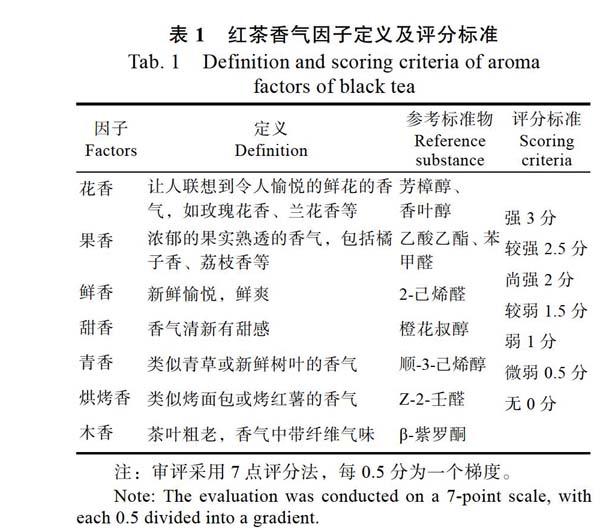


摘 要:为探讨川红(CH)和祁红(QH)香气特征及成分差异,以两个地区的红茶样品为材料,运用感官因子審评法结合静态顶空–固相微萃取/气相色谱–质谱联用法(SHS-SPME/GC-MS)对CH和QH典型样品的香气特征及香气化合物进行分析,依据各物质相对含量与相对香气活度值(ROAV)评估呈香贡献率。结果表明:‘川红1号(CH1)呈现出以果香、甜香和烘烤香浓郁,花香适中,木香和鲜香较淡,有微弱清香的特点;‘川红2号(CH2)则以花香和甜香为主,果香、清香和烘烤香较突出,鲜香和木香微弱的特征;QH呈现出甜香和果香明显,其余香型均较突出的特点。ROAV分析结合香气特征性描述表明,3种红茶共有的主要香气贡献物质为芳樟醇和香叶醇;CH1的主要香气贡献物质还有2-己烯醛、柠檬烯和糠醛,其ROAV分别为362.59、6.74和1.05;CH2的主要香气贡献物质是芳樟醇氧化物、苯乙醛、顺-3-己烯醇和苯甲醇,ROAV分别为1472.33、462.22、383.92和4.42;QH的主要香气贡献物质是芳樟醇氧化物、正己醛、苯乙醛、正壬醛、顺-3-己烯醇和2-戊基呋喃,ROAV均大于100。此外,3种红茶中共有的12种香气物质,包括芳樟醇、苯乙醛、正己醛、香叶醇、芳樟醇氧化物、正壬醛、2-戊基呋喃、顺-3-己烯醇、水杨酸甲酯、正庚醛、柠檬烯和苯乙醇,可能是红茶香气的物质基础。
关键词:川红;祁红;香气特征;香气成分中图分类号:S571.1;TS272.5 文献标识码:A
Comparison of Volatile Components and Aroma Characterization in Sichuan Black Tea and Qimen Black Tea
ZHANG Xiang1, WANG Congming1, NIE Congning1, LI Shunyu1, XU Yifan1, XIE Anran1, DU Xiao1,2*
1. College of Horticulture, Sichuan Agriculture University, Chengdu, Sichuan 611130, China; 2. Provincial Key Laboratory of Tea Science and Engineering, Sichuan Agricultural University, Chengdu 611130, China
Abstract: In order to determine the differences of the aroma characterization and components in Sichuan Black Tea (CH) and Qimen Black Tea (QH), the black tea in the two regions were sampled as the research objects. The aroma characterization and volatile components of three typical tea samples were analyzed by sensory the analysis method and static headspace-solid phase microextraction / gas chromatography-mass spectrometry (SHS-SPME/GC-MS). The contribution rates were evaluated according to the relative content of each component and relative odour activity value (ROAV). CH1 presented strong fruit, sweet and roasted aroma with moderate flowery aroma, faint woody and fresh aroma coupled with light green aroma. CH2 also showed strong flowery and sweet aroma with moderate fruit, green and roasted aroma added light fresh and woody aroma. QH presented strong sweet and fruit aroma, with other prominent aroma characterization. The ROAV analysis combined with a characterization description of aroma showed that the common main aroma contributors of the three tea samples were linalool and geraniol. CH1 had 2-hexenal, cinene and furfural, with ROAVs of 362.59, 6.74 and 1.05, respectively. CH2 showed the presence of linalool oxide, phenylacetaldehyde, cis-3-hexenol and benzyl alcohol, with ROAVs reached 1472.33, 462.22, 383.92 and 4.42, respectively. QH also showed the presence of linalool, linalool oxide, geraniol, n-hexanal, phenylacetaldehyde, 1-nonanal, cis-3-hexenol and 2-pentylfuran, with all having a ROAVs of more than 100. In addition, 12 kinds of aroma components in three kinds of black tea, including linalool, phenylacetaldehyde, n-hexanal, geraniol, linalool oxide, n-nonanal, 2-pentylfuran, cis-3-hexenol, methyl salicylate, n-heptanal, limonene and phenethyl alcohol may be the material basis of black tea-based aroma.
Keywords: Sichuan black tea; Qimen black tea; aroma characterization; aroma components
DOI: 10.3969/j.issn.1000-2561.2020.07.022
紅茶属于全发酵茶,是目前世界上消费区域最广、生产量最多、国际总贸易量最大的茶类[1]。香气作为茶叶的主要品质成分,其内含物数量和配比的动态变化及组成规律是目前研究的热点。……
