学习能力、社会化服务与农户生态农业技术采纳行为
2020-08-31杨兴杰齐振宏陈雪婷
杨兴杰 齐振宏 陈雪婷
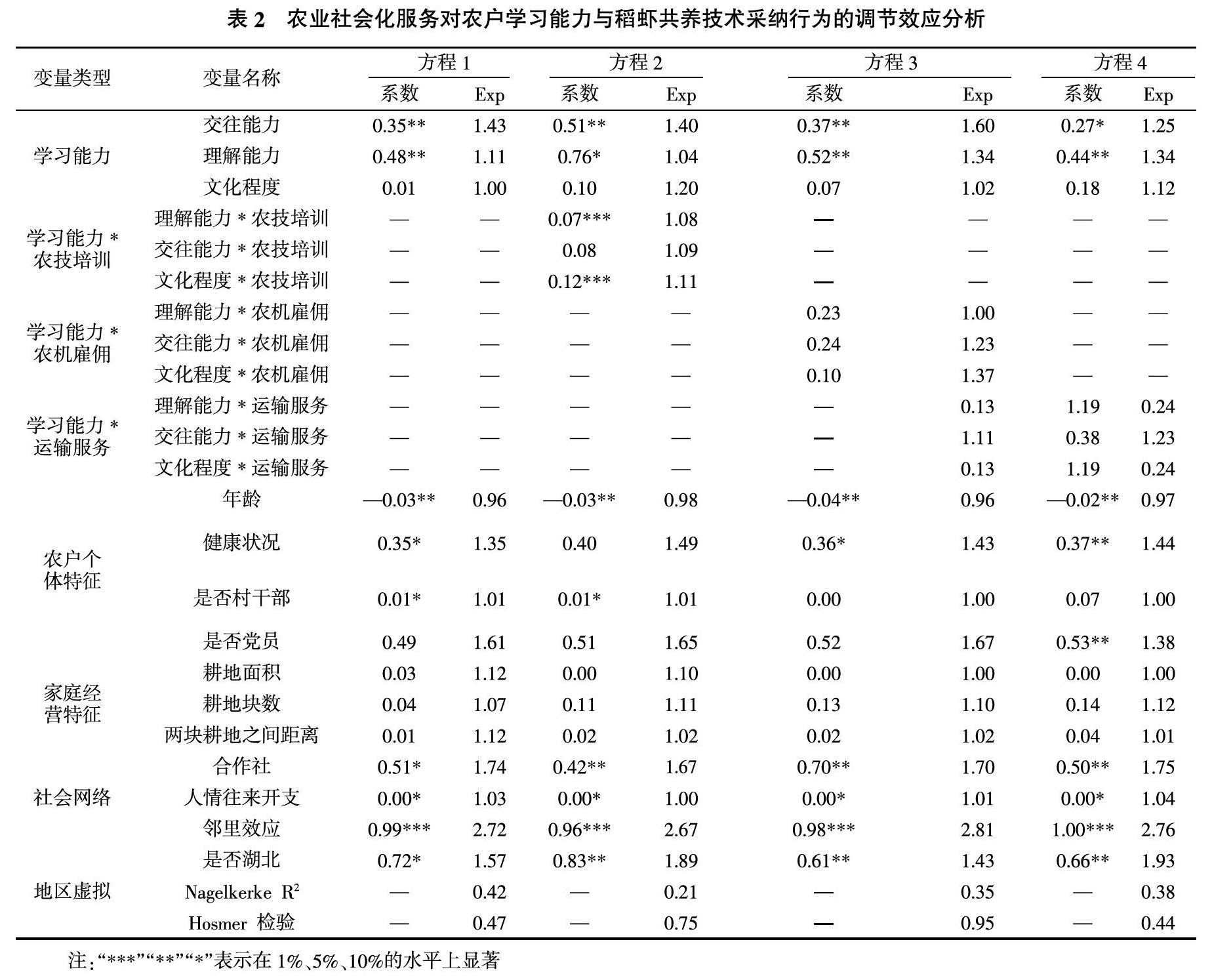
摘要:基于江苏省和湖北省共612份农户的微观调研数据,运用二元Logistic模型,实证分析了农户学习能力对其稻虾共养技术采纳行为的影响,并在此基础上探究了农业社会化服务的调节作用。研究发现,农户理解能力、交往能力显著正向影响其采纳稻虾共养技术,而其文化程度的影响程度不显著;政府农技培训仅显著正向调节农户理解能力和交往能力与稻虾共养技术采纳行为;农机雇佣服务、运输服务对农户学习能力与稻虾共养技术采纳行为的调节作用不显著。
关键词:农户;学习能力;稻虾共养;农业社会化服务
中图分类号:F323.3 文献标识码:A
文章编号:0439-8114(2020)10-0199-07
DOI:10.14088/j.cnki.issn0439-8114.2020.10.045 开放科学(资源服务)标识码(OSID):
Abstract: Based on a total of 612 microscopic survey data of farmers in Jiangsu province and Hubei province, the binary logistic model was used to empirically analyze the impact of farmers' learning ability on the adoption of rice and shrimp co-culture technology. On this basis, the regulatory role of agricultural socialization service was explored. The study found that farmers' ability to understand and communicate significantly positively affected their adoption of rice and shrimp co-culture technology, while their education level had no significant effect on their adoption of rice and shrimp co-culture technology. Government agricultural technology training only significantly positively regulates farmers' ability to understand and interact with rice and shrimp co-culture technology adoption behavior. Agricultural machinery employment service and transportation service have no significant role in regulating the learning ability of farmers and the adoption of rice and shrimp co-culture technology.
Key words: farmers; learning ability; rice and shrimp co-culture; agricultural socialization service
發展和推广生态农业技术,不仅可以减轻环境污染、生态破坏,还可以提高农户的务农收益,带来正的外部效益[1]。为此,国家出台了《关于打好农业面源污染防治攻坚战的实施意见》和《全国农业可持续发展规划(2015-2030)年》等政策,旨在降低农业生产污染,有效推动生态农业技术快速发展。由此可见,促进生态农业技术推广是今后农业发展的必然要求。但是,农户采纳生态农业技术的积极性还有待进一步提高[2],以稻虾共养技术为例,该技术在促进生态环境健康发展的同时,实现“一田双收,一水双用”,具有很好的生态效益和社会效益[3]。农户作为基本的农业生产主体,是农业新技术的需求者和最终采用者,且对新技术采用具有独立的决策权[4]。其中,农户对生态农业技术的观察能力、学习能力在一定程度上影响其采纳行为。……
