MHR与急性ST段抬高型心肌梗死短期预后的相关性分析
2020-08-21鲁谦徐慧琳刘志辉
鲁谦 徐慧琳 刘志辉

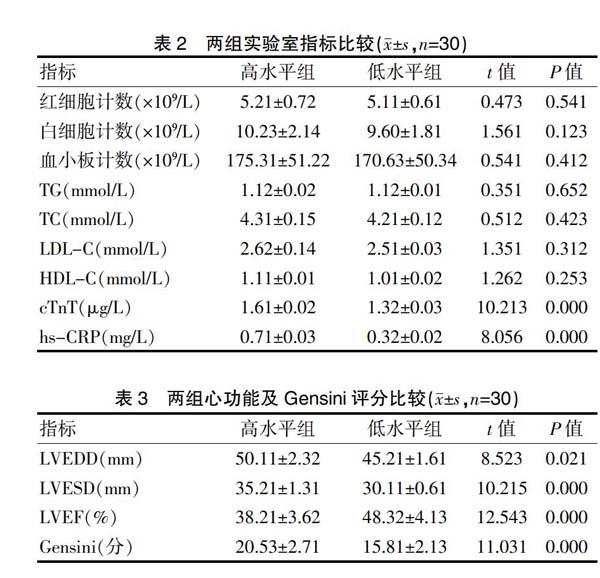
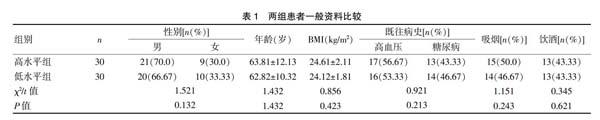
[摘要] 目的 分析單核细胞与高密度脂蛋白胆固醇比值(MHR)与急性ST段抬高型心肌梗死(STEMI)患者短期预后的关系。 方法 筛选2018年6月~2019年6月于景德镇市第一人民医院就诊的60例STEMI患者为研究对象,以MHR值0.46为分组线,≤0.46的为低水平组,>0.46为高水平组,各30例。比较两组的临床资料、实验室检查指标、心功能指标等,随访6个月,统计并比较两组的心血管不良事件(MACE)发生率,并应用Logistic进行单因素分析。 结果 两组患者的性别、年龄、体质量指数(BMI)比较,差异无统计学意义(P>0.05);两组血脂相关指标甘油三酯(TG)、总胆固醇(TC)、低密度脂蛋白C(LDL-C)、高密度脂蛋白C(HDL-C)比较,差异无统计学意义(P>0.05);低水平组肌钙蛋白(cTnT)、左室舒张末期内径(LVEDD)、左室收缩末期内径(LVESD)低于高水平组,而低水平组左心室射血分数(LVEF)高于高水平组,两组比较差异有统计学意义(P<0.05);高水平组Gensini评分及MACE发生率高于低水平组,差异有统计学意义(P<0.05)。采用Pearson相关分析进行相关性分析,MHR与MACE呈正关系(r=0.215,P=0.011)。 结论 MHR值与MACE、心功能、Gensini评分密切相关,对STEMI患者短期预后具有一定的预判作用。
[关键词] MHR;STEMI;MACE;预后
[中图分类号] R541.4 [文献标识码] A [文章编号] 1673-9701(2020)18-0019-04
Correlation analysis between MHR and short-term prognosis of acute ST-segment elevation myocardial infarction
LU Qian XU Huilin LIU Zhihui
Department of Cardiology, the First People's Hospital of Jingdezhen City in Jiangxi Province, Jingdezhen 333000, China
[Abstract] Objective To analyze the relationship between the ratio of monocytes to high density lipoprotein cholesterol (MHR) and short-term prognosis of patients with acute ST-segment elevation myocardial infarction(STEMI). Methods Sixty STEMI patients who were treated at the First People's Hospital of Jingdezhen from June 2018 to June 2019 were screened as the research subjects, with MHR value 0.46 as the grouping line. Patients with MHR≤0.46 were included in the low-level group, and patients with MHR > 0.46 were included in the high-level group, with 30 cases in each group. The clinical data, laboratory test indexes, and cardiac function indexes between the two groups were compared. The patients were followed up for 6 months, and the incidence of cardiovascular adverse events(MACE) was analyzed and compared between the two groups by using Logistic univariate analysis. Results There were no statistically significant differences in gender, age and body mass index(BMI) between the two groups(P>0.05). The differences in blood lipid-related indicators [triglyceride(TG), total cholesterol(TC), low-density lipoprotein C(LDL-C), high-density lipoprotein(HDL-C) were not significant(P>0.05). The troponin(cTnT), left ventricular end-diastolic diameter(LVEDD) and left ventricular end-systolic diameter(LVESD) in the low-level group were lower than those of the high-level group, while the left ventricular ejection fraction(LVEF) in the low-level group was higher than that of the high level group, with statistically significant difference(P<0.05). The Gensini score and MACE incidence of high-level group were higher than those of the low-level group, and the difference between the two groups was statistically significant(P<0.05). Correlation analysis by Pearson correlation analysis showed that MHR was positively related to MACE(r=0.215, P=0.011). Conclusion MHR value is closely related to MACE, cardiac function and Gensini score. And it has a certain predictive effect on the short-term prognosis of STEMI patients.
[Key words] MHR; STEMI; MACE; Prognosis
急性ST段抬高型心肌梗死(ST-segment elevation myocardial infarction,STEMI)是一种常见的危重心血管疾病,经皮冠状动脉介入术(Percutaneous coronary intervention,PCI)因可迅速改善心肌缺血状态,已成为治疗STEMI首选的再灌注方法[1]。但有关资料表明,此类患者5年内的病死率约为19%,其中32%左右的死亡发生于心功能不全泵衰竭[2]。因此,如何有效评估STEMI行PCI术后的并发症,从而及时调整治疗方案、改善治疗效果,逐渐成为研究热点。已有的研究表明单核细胞与高密度脂蛋白胆固醇的比值(Monocyte to high density lipoprotein cholesterol ratio,MHR)可以反映系统炎症水平,且与动脉粥样硬化密切相关[3]。另有研究指出,MHR与STEMI介入术后慢血流或无复流等心血管不良事件(Major adverse cardiovascular events,MACE)的发生有关[4],认为MHR可作为STEMI预后的指标。我国对于MH……