信息化靶向行为干预模式在初诊中青年糖尿病中的应用效果
2020-08-10刘良红郑晓佳陈日秋季晓珍陈敏华丁莉
刘良红 郑晓佳 陈日秋 季晓珍 陈敏华 丁莉
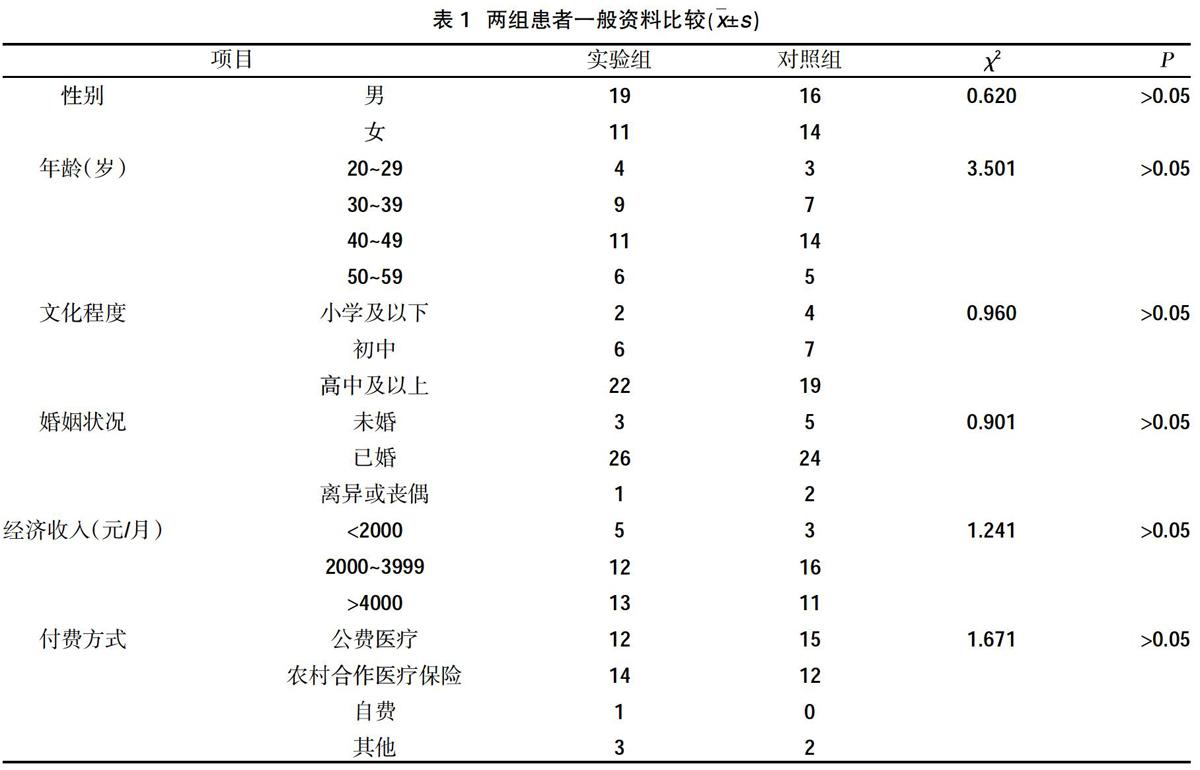
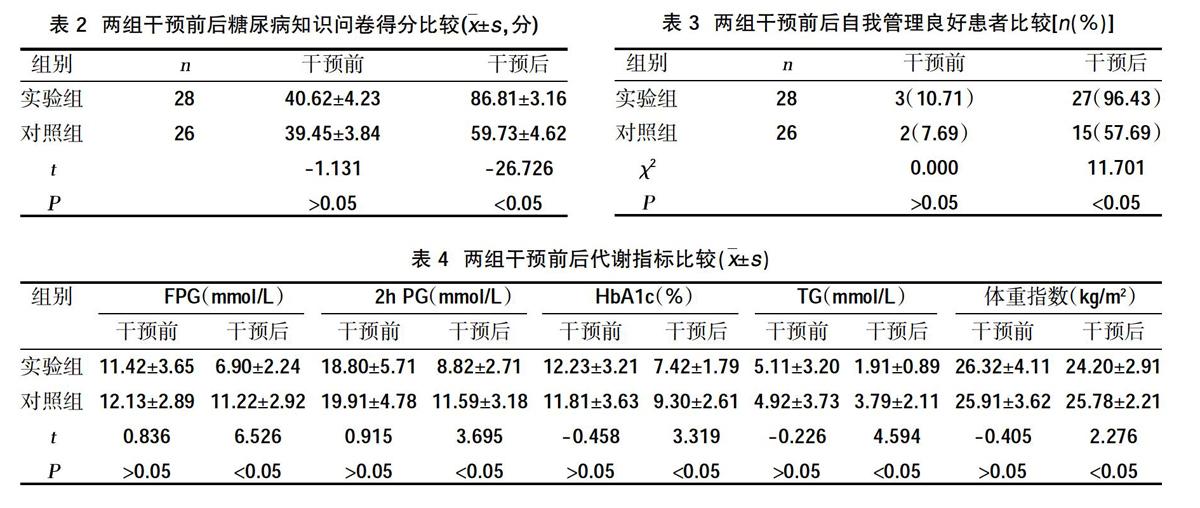
摘要:目的 探討信息化靶向行为干预模式在初诊中青年糖尿病患者中的应用效果。方法 选择我院2016年5~12月首次确诊的中青年糖尿病患者60例作为研究对象,随机分为试验组和对照组,各30例,试验组实施基于信息化平台的靶向行为干预模式,对照组实施基线测评和常规糖尿病健康教育,干预前及干预后6个月采用《糖尿病知识问卷》《糖尿病自我管理行为量表(SDSCA)》对两组患者进行测评,比较两组干预前、干预后6个月的空腹血糖(FPG)、餐后2h血糖(2h PG)、血脂(TG)、糖化血红蛋白(HbA1c)及体重指数。结果 两组患者干预前糖尿病知识问卷得分、自我管理良好患者比较,差异无统计学意义(P>0.05);干预后6个月后,实验组糖尿病知识问卷得分为(86.81±3.16)分,高于对照组的(59.73±4.62)分,差异有统计学意义(P<0.05);实验组自我管理良好患者(96.43%)多于对照组(57.69%),差异有统计学意义(P<0.05);实验组FPG、2h PG、HbA1c、TG、体重指数均优于对照组,差异有统计学意义(P<0.05)。结论 信息化靶向行为干预模式能提升初诊中青年糖尿病患者的糖尿病知识水平,进而改善其自我管理依从性,有助于患者糖代谢及血脂、血压等代谢指标的控制。
关键词:信息化;靶向行为干预;中青年;糖尿病
中图分类号:R473.5 文献标识码:A DOI:10.3969/j.issn.1006-1959.2020.14.024
文章编号:1006-1959(2020)14-0085-04
Application Effect of Information-based Targeted Behavior Intervention Model
in Newly Diagnosed Young and Middle-aged Diabetes
LIU Liang-hong,ZHENG Xiao-jia,CHEN Ri-qiu,JI Xiao-zhen,CHEN Min-hua,DING Li
(Department of Endocrinology,Lishui Peoples Hospital,Lishui 323000,Zhejiang,China)
Abstract:Objective To explore the application effect of information-based targeted behavior intervention model in newly diagnosed middle-aged and young diabetic patients.Methods 60 young and middle-aged diabetic patients diagnosed for the first time in our hospital from May to December 2016 were selected as the research object, and randomly divided into a test group and a control group, 30 cases each. The test group implemented a targeted behavioral intervention model based on an information platform. The control group implemented baseline assessment and routine diabetes health education. Before and 6 months after the intervention, the two groups of patients were evaluated using the Diabetes Knowledge Questionnaire and the Diabetes Self-Management Behavior Scale (SDSCA) to compare the two groups before and after intervention. After 6 months, fasting blood glucose (FPG), 2h postprandial blood glucose (2h PG), blood lipid (TG), glycated hemoglobin (HbA1c) and body mass index.Results There was no statistically significant difference between the two groups of patients before diabetes intervention questionnaire score and self-managed patients(P>0.05); 6 months after the intervention, the experimental group diabetes knowledge questionnaire score was (86.81±3.16) points, higher than the control group (59.73±4.62), the difference was statistically significant (P<0.05); the self-managed patients in the experimental group (96.43%) were more than the control group (57.69%), the difference was statistically significant (P<0.05) ; The experimental group FPG, 2h PG, HbA1c, TG, body mass index were better than the control group, the difference was statistically significant(P<0.05).Conclusion The information-based targeted behavioral intervention model can improve the diabetes knowledge level of young and middle-aged diabetic patients, and then improve their self-management compliance, which can help patients with glucose metabolism and control of metabolic indicators such as blood lipids and blood pressure.
2.2两组干预前后自我管理良好患者比较 干预前,两组自我管理良好者例数比较,差异无统计学意义(P>0.05);干预后,两组患者自我管理良好例数比较,差异有统计学意义(P<0.05),见表3。
2.3两组干预前后代谢指标比较 干预前,两组FPG、2h PG、HbA1c、TG、体重指数比较,差异无统计学意义(P>0.05);干预后,实验组FPG、2h PG、HbA1c、TG、体重指数均优于对照组,差异有统计学意义(P<0.05),见表4。
3讨论
3.1自我管理行为是血糖控制的关键因素 研究表明[5],自我管理行为各维度值与糖化血红蛋白的水平呈负相关,帮助患者建立有效的自我管理行为是当前糖尿病教育和行为干预管理的最佳模式之一[6]。中青年人……
