呼气末二氧化碳分压监测用于心脏骤停患者对心肺复苏质量和预后的临床评价意义
2020-08-06陈苗妙潘柳华李坤旺
陈苗妙 潘柳华 李坤旺
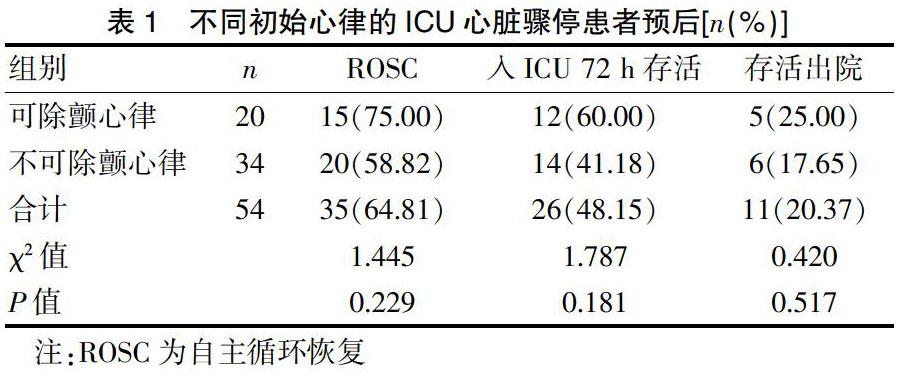
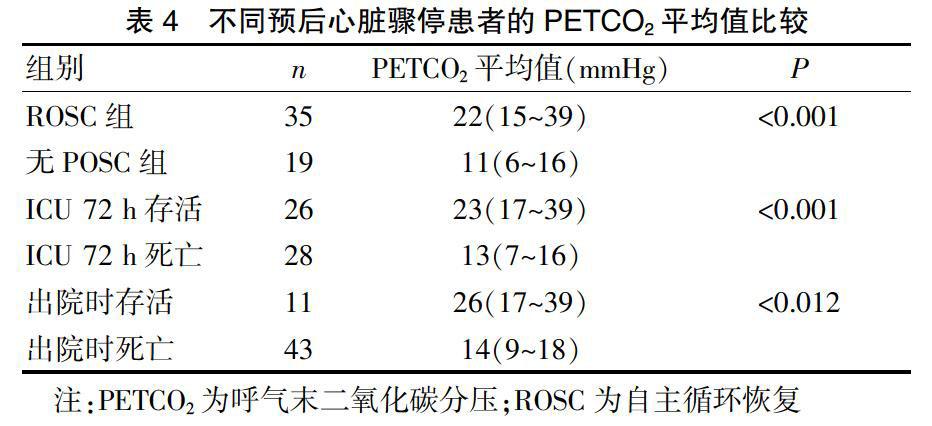
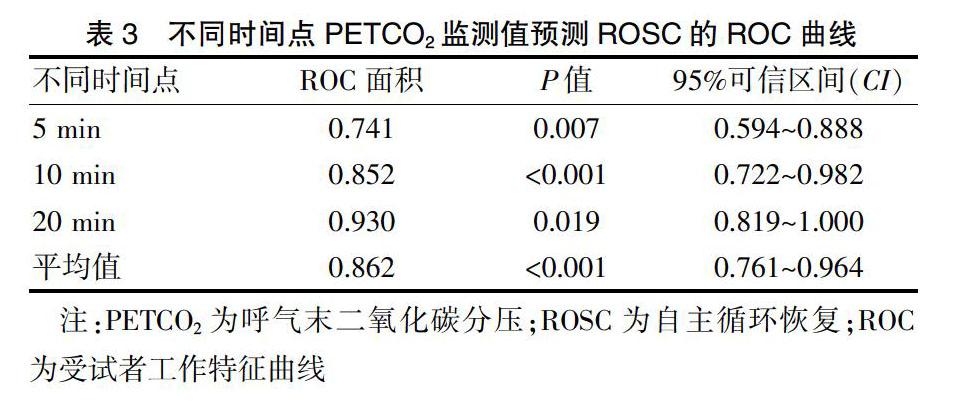
[摘要] 目的 探討呼气末二氧化碳分压(PETCO2)监测用于心脏骤停患者评估心肺复苏质量和预后的临床价值。 方法 纳入2018年6月~2020年1月丽水市人民医院重症医学科(ICU)心脏骤停且年龄在18~75岁之间的患者54例,实施标准心肺复苏(CPR)并行动态PETCO2监测。根据是否自主循环恢复(ROSC)分为ROSC组(35例)和非ROSC组(19例),比较两组复苏过程中PETCO2连续监测的结果,应用受试者工作特征曲线(ROC)评价不同时间点PETCO2预测CPR效果的效能。记录可除颤心律患者除颤前1 min内的PETCO2,并在除颤成功与失败患者间比较PETCO2 除颤前1 min;同时按照是否 ROSC、入住ICU 72 h生存和死亡、出院时存活和死亡分组,分别比较各组患者的平均PETCO2。 结果 ROSC组患者在CPR开始5 min、10 min、20 min PETCO2及平均PETCO2方面均高于非ROSC组(P<0.05);但CPR开始1 min PETCO2在两组间无明显差异(P>0.05)。除颤成功患者的除颤前1 min PETCO2明显高于除颤失败患者,差异有统计学意义(P=0.002)。ROC曲线显示,PETCO2 20 min预测复苏成功的曲线下面积(AUC)[AUC=0.930,95%可信区间(CI):0.819~1.000]大于平均PETCO2(AUC=0.862,95%CI:0.761~0.964)、PETCO2 10 min(AUC=0.852,95%CI 0.722~0.982)、PETCO2 5 min(AUC=0.741,95%CI:0.594~0.888);PETCO2 20 min预测CPR成功的最佳节点为20.5 mmHg,此时其特异性为94.7%、敏感性为66.7%。ROSC组、入住ICU 72 h存活组及存活出院组的平均PETCO2值均高于无ROSC组、入住ICU 72 h死亡组及出院时死亡组(P<0.05)。 结论 动态监测PETCO2可有效评估心脏骤停患者CPR的质量和预后,包括预测可除颤心律心脏骤停患者的除颤效果,其中 CPR 20 min 时的 PETCO2≤20.5 mmHg可作为预后不良的评价指标。
[关键词] 呼气末二氧化碳分压;心脏骤停;心肺复苏;自主循环恢复
[中图分类号] R459.7 [文献标识码] B [文章编号] 1673-9701(2020)16-0083-05
Clinical value of end-expiratory carbon dioxide partial pressure monitoring for the evaluation of cardiopulmonary resuscitation quality and prognosis in patients with cardiac arrest
CHEN Miaomiao1 PAN Liuhua1 LI Kunwang2
1.Department of Intensive Medicine, Lishui People's Hospital in Zhejiang Province, Lishui 323000, China; 2.Department of Anesthesiology, Lishui People's Hospital in Zhejiang Province, Lishui 323000, China
[Abstract] Objective To explore the clinical value of end-expiratory carbon dioxide partial pressure(PETCO2) monitoring for the evaluation of cardiopulmonary resuscitation quality and prognosis in patients with cardiac arrest. Methods 54 cardiac arrest patients aged 18 to 75 years from the Department of Intensive Medicine(ICU) of Lishui People's Hospital from June 2018 to January 2020 were included, and standard CPR was performed in parallel with dynamic PETCO2 monitoring. According to whether or not the patients had the recovery of spontaneous circulation(ROSC), they were divided into ROSC group(35 cases) and non-ROSC group(19 cases). The results of continuous monitoring of PETCO2 during the recovery process were compared between the two groups. The effectiveness of PETCO2 at different time points in predicting the effect of CPR was evaluated by the receiver operating characteristic curve(ROC). PETCO2 within 1 minute before defibrillation of patients with defibrillation rhythm was recorded. PETCO2 between successful and failed defibrillation patients was compared 1min before defibrillation. At the same time, they were grouped according to whether or not ROSC, stay in ICU 72 h survival and death, survival and death at discharge. The average PETCO2 of patients in each group was compared. Results The patients in the ROSC group had higher PETCO2 and mean PETCO2 than the non-ROSC group at 5 min, 10 min, and 20 min after CPR(P<0.05). There was no significant difference in PETCO2 between the two groups at 1 min after CPR(P>0.05). The PETCO2 of patients with successful defibrillation was significantly higher than that of patients with failed defibrillation at 1 min before defibrillation, and the difference was statistically significant(P=0.002). The ROC curve showed that the area under the curve(AUC)[AUC=0.930, 95% confidence interval(CI): 0.819~1.000] of PETCO2 predicting successful recovery at 20 min was greater than the average PETCO2(AUC=0.862, 95%CI: 0.761~0.964), PETCO2 10 min (AUC=0.852, 95% CI: 0.722~0.982), PETCO2 5 min(AUC=0.741, 95% CI: 0.594~0.888). The best node of PETCO2 20 min to predict CPR success was 20.5 mmHg, with the specificity of 94.7% and the sensitivity of 66.7%. The average PETCO2 values of the ROSC group, the ICU 72-hour survival group and the survival discharge group were higher than those of the non-ROSC group, the ICU 72-hour death group and the death discharge group(P<0.05). Conclusion Dynamic monitoring of PETCO2 can effectively assess the quality and prognosis of CPR in patients with cardiac arrest, including predicting the defibrillation effect in patients with defibrillablecardiac arrest, and PETCO2≤20.5 mmHg at 20 minutes of CPR can be used as an evaluation indicator for poor prognosis.
[Key words] End-expiratory carbon dioxide partial pressure; Cardiac arrest; Cardiopulmonary resuscitation; Recovery of spontaneous circulation
据报道,我国有超过2.3亿人患有心血管疾病,每年有55万人出现心脏骤停,心脏骤停的存活率低于1%[1],当前急需提高心脏骤停患者的抢救成功率,心肺复苏(Cardiopulmonary resuscitation,CPR)作为心脏骤停的标准治疗,是提高心脏骤停抢救成功率的重中之重。因此,如何准确监测CPR质量以指导CPR至关重要。呼气末二氧化碳分……