苓桂术甘汤治疗后循环缺血性眩晕的临床效果分析
2020-06-12刘民胜陈迅何海威
刘民胜 陈迅 何海威
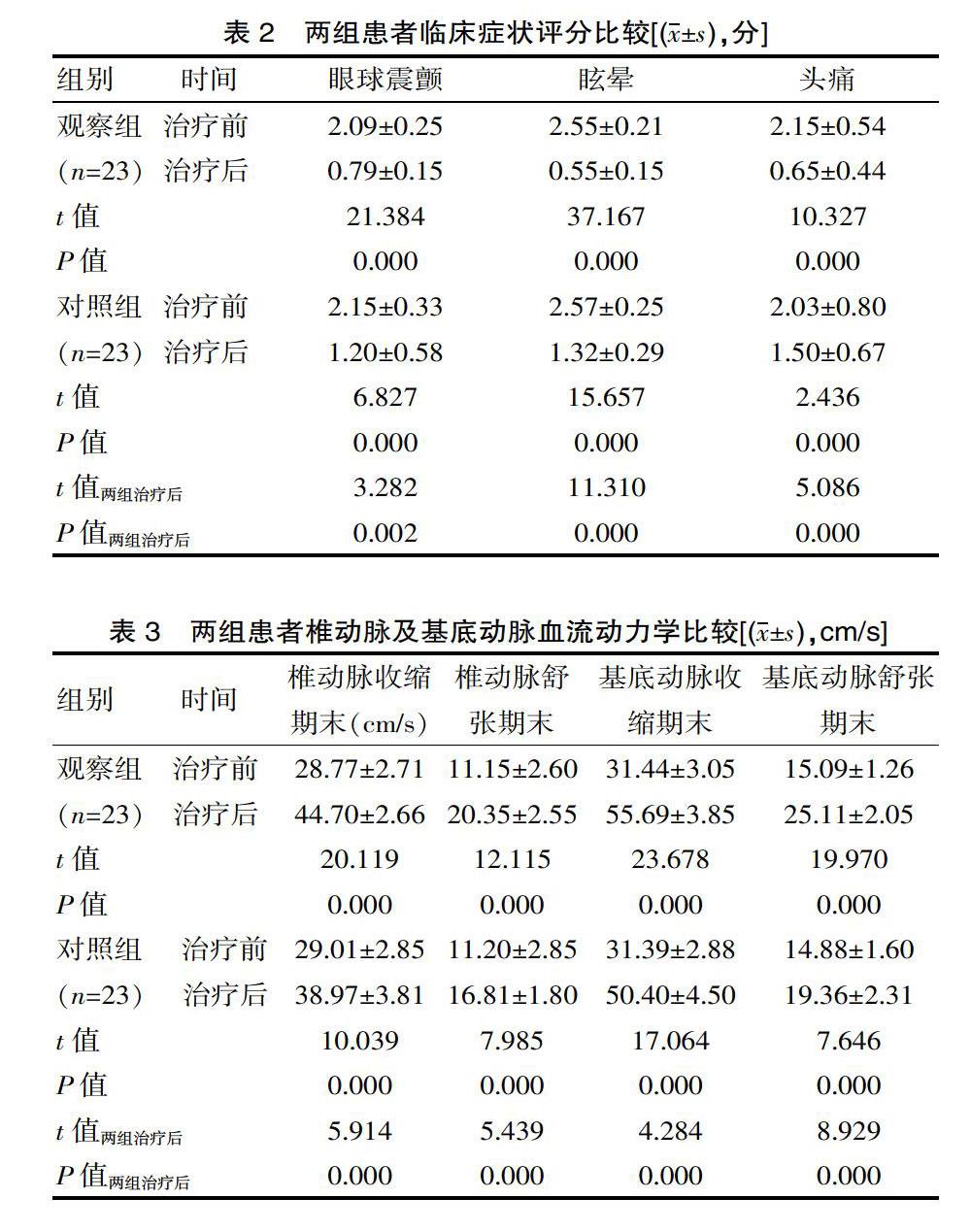
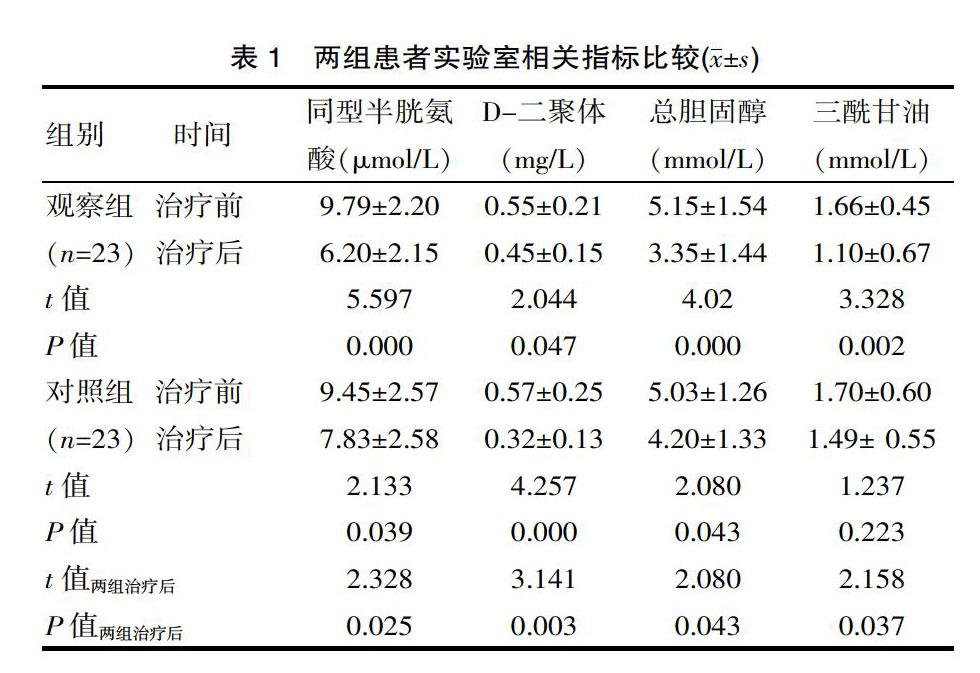
[摘要] 目的 分析后循环缺血性眩晕采用苓桂术甘汤治疗效果。 方法 方便选取46例该院(2017年12月—2019年7月)收治的后循环缺血性眩晕患者开展该次研究,随机分为对照组、观察组。对照组(23例)用常规治疗,基于此,观察组(23例)用苓桂术甘汤治疗,对比实验室相关指标、临床症状评分、椎动脉及基底动脉血流动力学、治疗总有效率、不良反应发生率。结果 与对照组比较实验室相关指标,观察组较优(P<0.05);与对照组比较临床症状评分,观察组较低(P<0.05);与对照组比较椎动脉及基底动脉血流动力学,观察组较高(P<0.05);治疗总有效率观察组95.75%高于对照组69.6%(χ2=5.447,P<0.05)。两组均出现腹泻、呕吐等不良反应,组间对比差异无统计学意义(P>0.05)。 结论 在后循环缺血性眩晕治疗中,采用苓桂术甘汤治疗,不仅可以改善实验室相关指标、缓解临床症状,又能降低椎动脉及基底动脉血流动力学、提高治疗效果。
[关键词] 后循环缺血性眩晕;苓桂术甘汤;治疗效果
[Abstract] Objective To analyze the effect of Lingguizhugan Decoction on post-circulatory ischemic vertigo. Methods 46 patients with post-circulatory ischemic vertigo treated in the hospital(December 2017 to July 2019) were convenient selected for this study and randomly divided into control group and observation group. The control group (23 cases) was treated with conventional treatment. Based on this, the observation group (23 cases) was treated with Linggui Zhugan Decoction. The laboratory-related indicators, clinical symptom scores, vertebral and basilar artery hemodynamics, and total effective rate of treatment, the incidence of adverse reactions were compared. Results Compared with the control group, laboratory-related indicators were better in the observation group (P<0.05); compared with the control group, the clinical symptom score was lower in the observation group (P<0.05); compared with the control group, the vertebral artery and basilar artery blood flow were compared, the study group was higher in the observation group (P<0.05); the total effective rate in the observation group was 95.75% higher than that in the control group 69.6%(χ2=5.447, P<0.05). Adverse reactions such as diarrhea and vomiting occurred in both groups, and there was no difference between the groups,statistically significant(P>0.05). Conclusion6 In the treatment of posterior circulation ischemic vertigo, Linggui Zhugan Decoction can not only improve laboratory related indicators and relieve clinical symptoms, but also reduce the vertebral and basilar artery hemodynamics and improve the treatment effect.
[Key words] Posterior circulation ischemic vertigo; Linggui Zhugan Decoction; Therapeutic effect
后循環缺血性眩晕是临床最常见的一种脑血管疾病,临床统计,此病症在缺血性脑卒中占据20%[1]。后循环缺血性眩晕发作时,患者会出现眼球震颤、眩晕、头痛等,如治疗不及时,不仅会加重病症,还会随着病情的进展,引发后循环性脑梗死,增加死亡率[2]。研究发现,后循环缺血性眩晕的出现,多因椎基底动脉系统管腔出现痉挛、狭窄、闭塞,导致小脑、脑干、丘脑、枕叶等出现梗死,或是出现暂时性缺血,此病症好发于中老年人,并以眩晕为主要症状[3]。随着中医学的进步,中医描述,后循环缺血性眩晕多因阴阳失衡、脑窍阻滞、脏腑失养、痰瘀互结等所致,治愈难度较大,且复发率较高[3]。故在治疗中,需从发病原因入手,从根本上开展治疗,以此来提高治疗效果。……
