三种不同术式治疗股骨近端骨折的随机对照研究
2020-05-08梁健陈国政邓训训刘立华陈瑜梁增章梁群芳
梁健 陈国政 邓训训 刘立华 陈瑜 梁增章 梁群芳
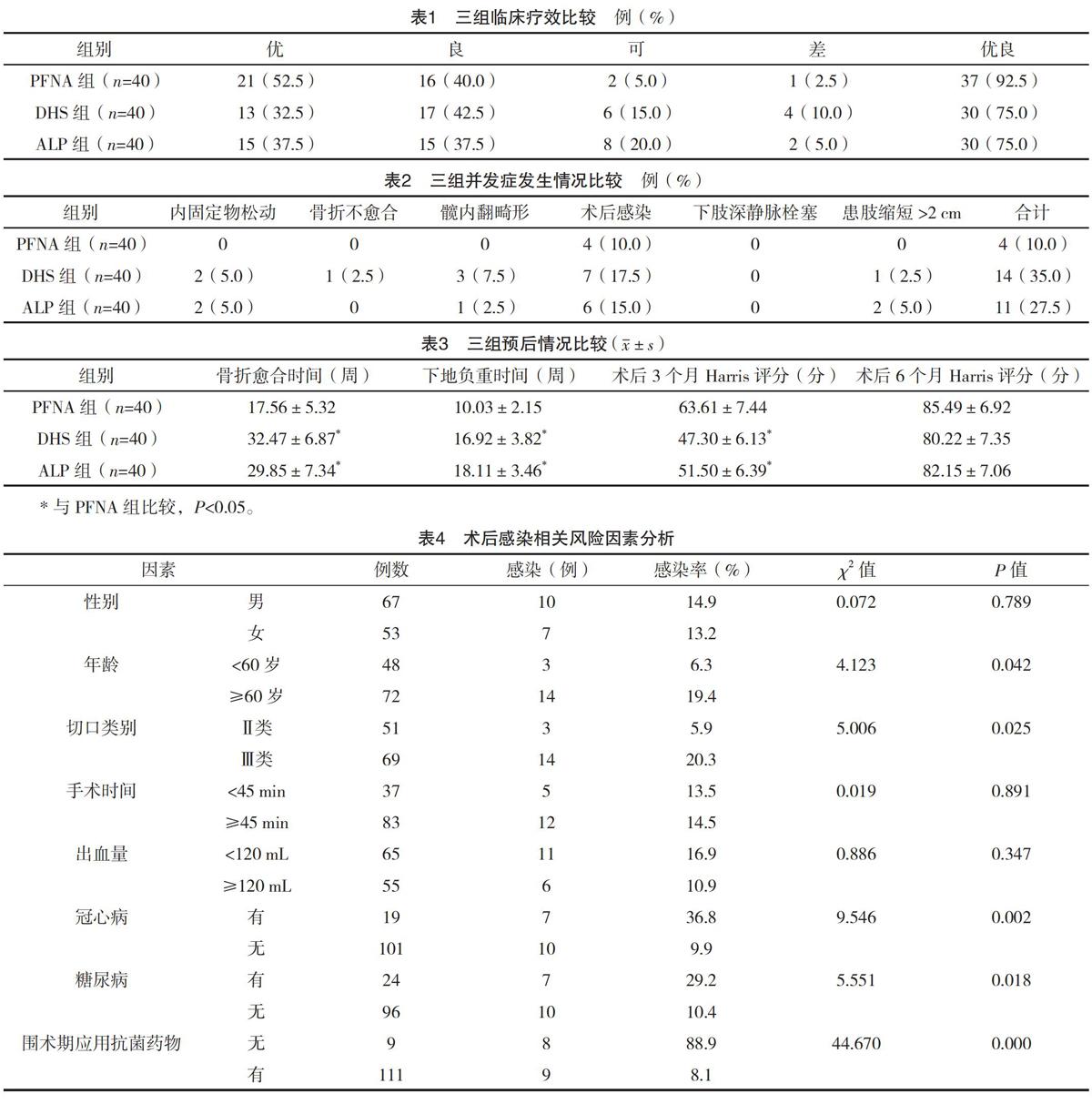
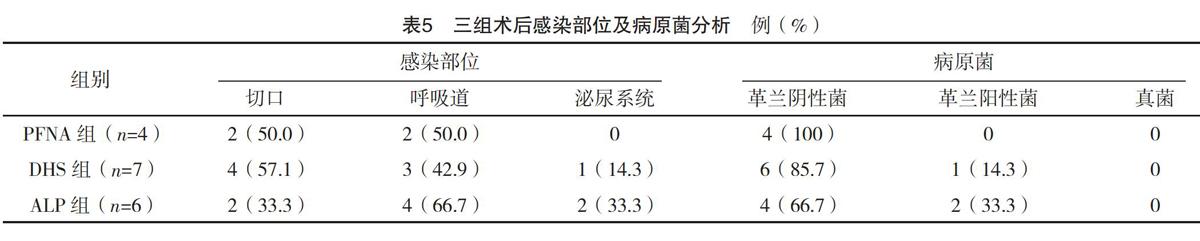
【摘要】 目的:探討股骨近端防旋髓内钉(PFNA)、动力髋螺钉(DHS)和股骨近端解剖锁定钢板(ALP)治疗股骨近端骨折的临床效果及术后感染风险因素。方法:选取2017年4月-2019年3月本院收治的股骨近端骨折患者120例,根据随机数字表法分为PFNA组(n=40)、DHS组(n=40)和ALP组(n=40)。PFNA组采用PFNA治疗,DHS组采用DHS治疗,ALP组采用ALP治疗。比较三组临床疗效、预后情况及并发症发生情况,并分析术后感染相关风险因素、术后常见感染部位及病原菌。结果:PFNA组治疗优良率高于DHS组和ALP组(P<0.05),PFNA组并发症发生率低于ALP组与DHS组(P<0.05),PFNA组骨折愈合时间与下地负重时间均短于DHS组和ALP组(P<0.05)。术后3个月,PFNA组Harris评分均高于DHS组和ALP组(P<0.05)。年龄≥60岁、Ⅲ类切口、冠心病、糖尿病及围术期未应用抗菌药物均为诱发患者术后感染的风险因素(P<0.05);术后感染病原菌以革兰阴性菌为主。结论:与DHS、ALP治疗相比,PFNA治疗股骨近端骨折效果显著,有利于提高临床疗效,降低术后并发症的发生,改善患者预后。同时手术治疗后诱发感染的因素较多,应当采取针对性措施以降低术后感染的发生。
【关键词】 股骨近端骨折 股骨近端防旋髓内钉 动力髋螺钉 股骨近端解剖锁定钢板
A Randomized Controlled Study of Three Different Operative Methods in the Treatment of Proximal Femoral Fracture/LIANG Jian, CHEN Guozheng, DENG Xunxun, LIU Lihua, CHEN Yu, LIANG Zengzhang, LIANG Qunfang. //Medical Innovation of China, 2020, 17(10): 0-053
[Abstract] Objective: To investigate the clinical effect of proximal femoral nail antirotation (PFNA), dynamic hip screw (DHS) and proximal femoral anatomical locking plate (ALP) in the treatment of proximal femoral fracture and the risk factors of postoperative infection. Method: A total of 120 patients with proximal femoral fracture admitted to our hospital from April 2017 to March 2019 were selected. They were divided into PFNA group (n=40), DHS group (n=40) and ALP group (n=40) according to the random number table method. The PFNA group was treated with PFNA, the DHS group was treated with DHS and the ALP group was treated with ALP. The clinical efficacy, prognosis and complications of the three groups were compared. The risk factors of postoperative infection, common postoperative infection sites and pathogens were analyzed. Result: The excellent and good rate of PFNA group was higher than that of DHS group and ALP group (P<0.05). The complication rate of PFNA group was lower than that of ALP group and DHS group (P<0.05). The fracture healing time and the ground load time in the PFNA group were lower than those in the DHS group and ALP group (P<0.05). Three months after the operation, Harris scores of the PFNA group were higher than those of the DHS group and the ALP group (P<0.05). ≥60 years old, Ⅲ incision, coronary heart disease, diabetes mellitus and perioperative without use antibacterial drugs were risk factors for postoperative infection (P<0.05). The main pathogens of postoperative infection was Gram-negative bacteria. Conclusion: Compared with DHS and ALP treatment, PFNA treatment of proximal femoral fracture has a significant effect, which is conducive to improving the clinical efficacy, reducing the occurrence of postoperative complications and improving the prognosis of patients. At the same time, there are many factors inducing infection after surgical treatment, so targeted measures should be taken to reduce the occurrence of postoperative infection.
[Key words] Proximal femoral fracture PFNA DHS ALP
First-authors address: Lianjiang Peoples Hospital of Guangdong Province, Lianjiang 524400, China
doi:10.3969/j.issn.1674-4985.2020.10.012
21世紀以来,随着我国社会老龄化人口的快速发展,同时因生活环境、交通事故、意外坠落等因素影响,股骨近端骨折的发病率呈现逐渐攀升趋势[1]。股骨近端骨折属于常见的骨折类型,指的是股骨粗隆部位至股骨干狭窄部位的骨折,往往给患者生活质量、身心健康带来严重的影响。股骨近端防旋髓内钉(PFNA)、动力髋螺钉(DHS)和股骨近端解剖锁定钢板(ALP)是临床上治疗股骨近端骨折常用的方法,取得了理想的效果,且预后较好[2-3]。值得注意的是,术后感染是股骨近端骨折手术治疗常见的并发症,可恶化术区内环境,严重影响患者术后骨折愈合,严重者可能因此而截肢[4]。基于此,本研究对2017年4月-2019年3月本院收治的120例股骨近端骨折患者分别进行PFNA、DHS与ALP治疗,观察此三种术式治疗股骨近端骨折的效果并分析术后感染的相关因素,现报道如下。……
