拮抗放线菌菌株FS-4发酵工艺筛选
2020-03-23段雅婕梅志刚孙德权李伟明庞振才胡会刚
段雅婕 梅志刚 孙德权 李伟明 庞振才 胡会刚
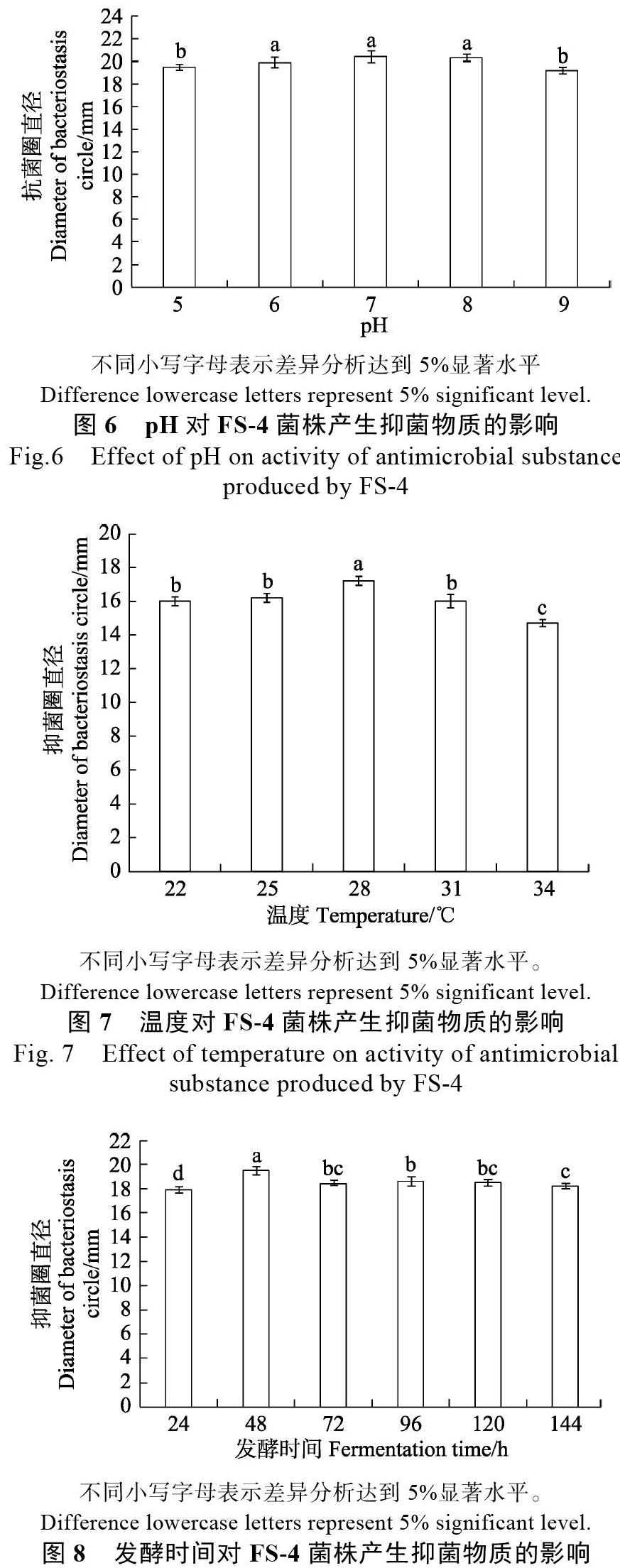
摘 要:FS-4是1株对香蕉枯萎病菌有较好拮抗作用的放线菌。以高氏一号培养基为基础,通过单因素和响应面实验进行了相关优化,对FS-4菌株的发酵工艺进行筛选。结果表明:0.5%蛋白胨,2.4%蔗糖,0.05%的磷酸氢二钾、氯化钠和硫酸镁,发酵温度28 ℃,初始pH为7为最佳培养基配方及最优发酵条件。发酵62 h后,发酵液中抑菌物质活性达到最高水平,对香蕉枯萎病菌的抑菌圈直径达到27.1 mm。
关键词:放线菌菌株FS-4;发酵工艺;响应面法
中图分类号:Q949.748.5 文献标识码:A
Abstract: The screening of antagonistic bacteria from soil microorganisms in the areas with banana Fusarium wilt is of great practical significance for controlling this disease. In this report, a strain, designated FS-4, was isolated from healthy banana rhizosphere soil in the area affected by Fusarium wilt. Based on Gauses No. 1 synthetic medium, the optimization of medium, single factor experiments and response surface experiments were conducted to maximize the production of the antibacterial substances of actinomycete FS-4. The best fermentation medium and fermentation conditions were as follows: sucrose 2.4%, peptone 0.5%, K2HPO4 0.05%, NaCl 0.05%, MgSO4 0.05%, fermentation temperature 28 ℃, initial pH 7. Under the conditions, the inhibition zone diameter of actinomycete FS-4 fermentation filtrate reached 27.1 mm on the test plates of Bacillus subtilis after 62 h incubation
Keywords: actinomycetes FS-4; fermentation conditions; response surface method
由尖孢鐮刀菌(Fusarium oxysporum f. sp. cubense)侵染引起的枯萎病是香蕉种植中的毁灭性病害,对相关产业的健康发展具有重要影响[1]。抗病育种、化学农药、轮作等方法在对香蕉枯萎病的防治中均存在不同的缺陷,难以规模化推广应用。利用包括拮抗微生物在内的生物防治方法具有安全、环保、经济效益高等优点,是当前该类病害防治研究中的热点[2]。FS-4是本团队从香蕉枯萎病发病田土壤中分离筛选出的1株放线菌,其对香蕉枯萎病菌具有较好拮抗作用[3-4]。
本团队采用16S rDNA 序列分析其放线菌为曼尼普尔链霉菌(Streptomyces manipurensis),命名为曼尼普尔链霉菌FS-4(Streptomyces manipurensis FS-4)[3-4]。采用国际链霉菌规划中的标准培养基(1976),28 ℃培养7~21 d,观察FS-4菌株培养特征。结果发现:FS-4菌株能使硝酸盐还原,淀粉水解,能产生H2S、黑色素、尿素酶和酪氨酸酶,但不能使明胶液化、牛奶胨化与凝固。生长pH范围为5.0~10.0,最适生长pH为7.0。最适生长温度为28~32 ℃,不能生长在NaCl含量大于3%的培养基。FS-4菌株对香蕉枯萎病1号(Foc 1)和4号(Foc 4)小种均有拮抗作用,对香蕉枯萎病菌1号小种的拮抗性较弱,显著低于香蕉枯萎病菌4号小种,2者的抑菌带宽度分别为12.07和15.12 mm。……
