循证护理在急性心肌梗死并发心律失常护理中的应用效果观察
2020-03-02张蓓蓓
张蓓蓓
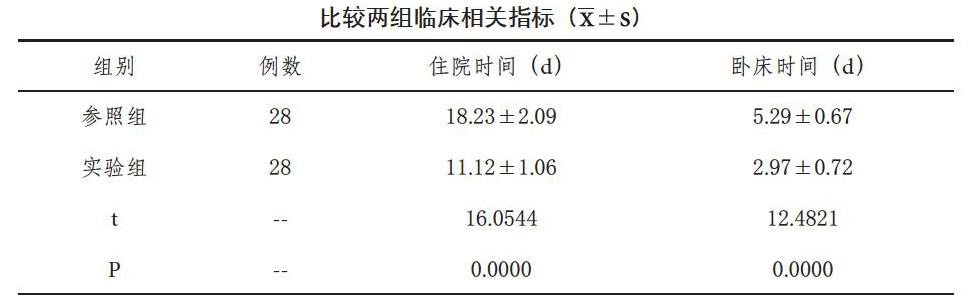
【摘 要】目的:观察在急性心肌梗死合并心律失常的护理中应用循证护理的临床效果。方法:选取2017年8月到2018年8月间本院收治的56例伴有急性心肌梗死合并心律失常症状的患者进行研究,采取分别抽样法将其分为参照组(n=28)和实验组(n=28),参照组应用常规护理,实验组行循证护理,对两组患者的护理效果行统计分析。结果:实验组住院时间、卧床时间与参照组相比明显较优,P<0.05;实验组心律失常发生率较参照组显著降低,P<0.05。结论:在急性心肌梗死合并心律失常的护理中应用循证护理效果良好。
【关键词】急性心肌梗死;心律失常;循证护理;临床指标;效果
Abstract:Objective To observe the clinical effect of applying evidence-based nursing in the nursing of patients with acute myocardial infarction complicated with arrhythmia. METHODS: Fifty-six patients with symptoms of acute myocardial infarction and arrhythmia admitted to our hospital from August 2017 to August 2018 were enrolled in the study. The sampling method was used to divide them into reference groups (n=28) and experiments. Group (n=28), the reference group used routine nursing, the experimental group performed evidence-based nursing, and the nursing effect of the two groups of patients was statistically analyzed. Results: The hospitalization time and bed time of the experimental group were significantly better than the reference group, P<0.05. The incidence of arrhythmia in the experimental group was significantly lower than that of the reference group, P<0.05. Conclusion: The application of evidence-based nursing in the treatment of acute myocardial infarction complicated with arrhythmia is effective.
Key words: acute myocardial infarction; arrhythmia; evidence-based nursing; clinical indicators; effect
【中图分类号】R541.4【文献标识码】A【文章编号】1005-0019(2020)01--01
急性心肌梗死是多发病,是由冠动脉长时间闭塞诱发的局部心肌组织缺血性变性引起,常常合并心律失常症状。有报道指出[1],急性心肌梗死患者中伴有心律失常的概率高达75%,并且在1h死亡的概率高达50%,故有效的护理措施显得十分重要。
现代医学的发展,促使循证护理应用范围越来越广,且应用后患者并发症显著减少。为进一步探究循证护理的应用效果,本院对28例患者实施循证护理,并将效果与参照组之间进行比较,现作如下汇报。
1 资料与方法
1.1 一般资料
选取2017年8月到2018年8月间本院收治的56例伴有急性心肌梗死合并心律失常症状的患者进行研究。纳入标准:发病特征符合急性心肌梗死;患者同意且知情。
排除标准:既往存有心血管病史;遵医行为较差者。
采取分别抽样法将其分为参照组(n=28)和实验组(n=28),参照组的男女比为15:13;
年齡47-80岁,平均年龄是(62.4±8.6)岁;实验组的男女比为16:12;年龄48-82岁,平均年龄为(64.5±8.6)岁。……