经济增长与能源消费动态关系研究
2020-02-14陈黎明严露谌方圆胡荣才
陈黎明 严露 谌方圆 胡荣才
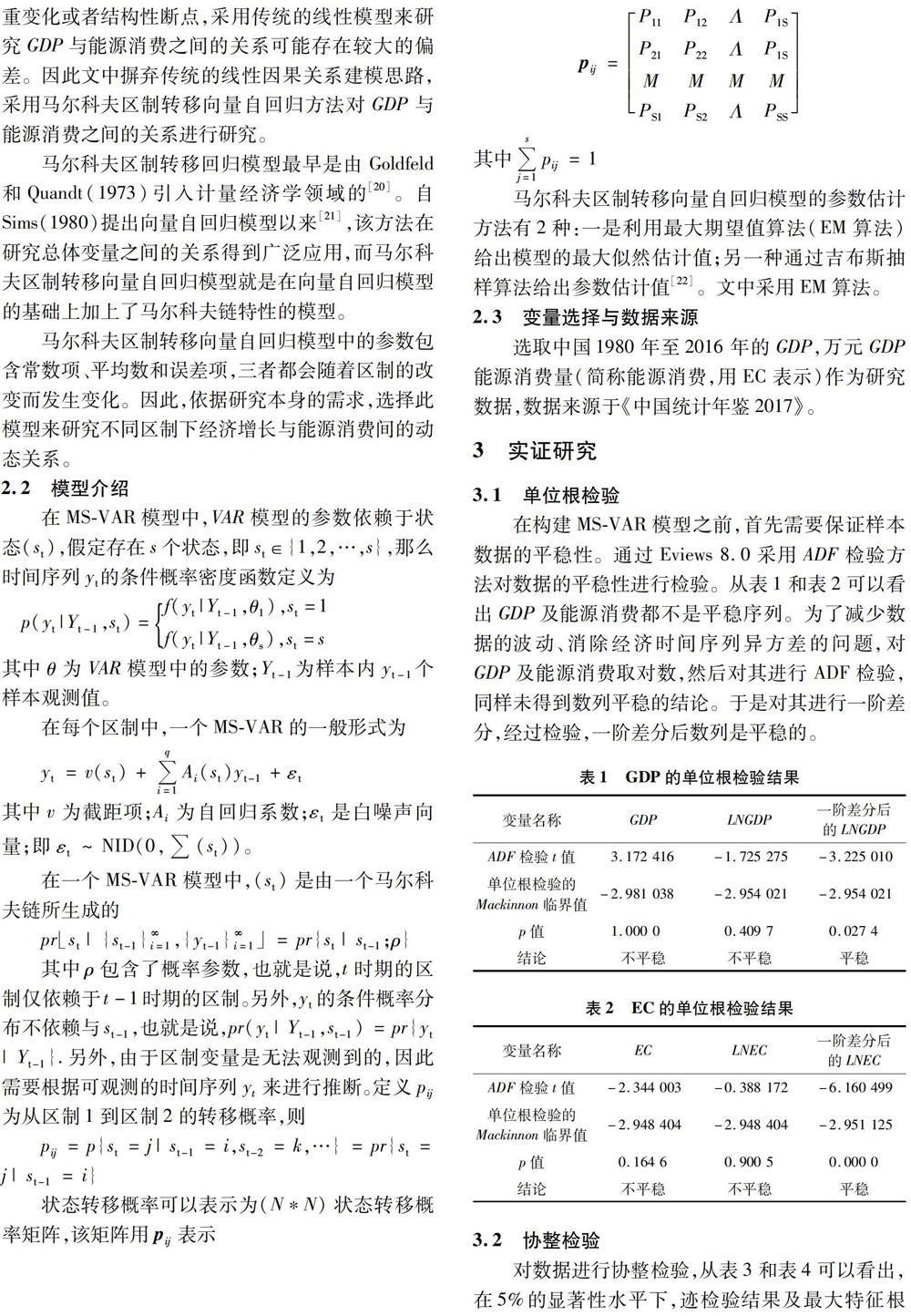
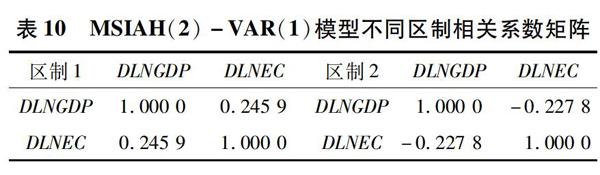
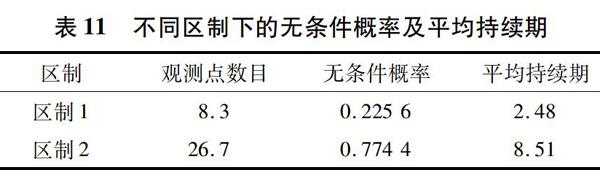
摘 要:能源是社會经济发展的重要基础资源,解决好能源的可持续发展战略问题,是实现中国社会经济可持续发展的重要环节。基于1980—2016年GDP及万元GDP能源消费量数据,运用马尔科夫区制转移向量自回归(MS-VAR)模型,研究能源消费及其变化对经济增长的影响。研究表明,经济增长与能源消费之间的关系存在显著的两区制性质,发展趋势存在明显的非对称性。具体体现在周期阶段的转换概率不同以及周期阶段的持续期不同。尤其是2010—2016年间,随着中国经济的增速逐步放缓,产业结构和能源结构不断发生变化,经济增长与能源消费出现了逐步脱钩的趋势,经济增长对能源消费的依赖显著减弱。
关键词:经济增长;能源消费;可持续发展;MS-VAR
中图分类号:F 062.2
文献标识码:A 文章编号:1672-7312(2020)01-0075-08
A Study on the Dynamic Relationship between
Economic Growth and Energy Consumption
CHEN Li-ming,YAN Lu,CHEN Fang-yuan,HU Rong-cai
(College of Finance and Statistics,Hunan University,
Changsha 410079,China)
Abstract:Energy is an important basic resource for social
and economic development.Solving the problem of sustainable
development strategy of energy is an important link for
realizing Chinas social and economic sustainable
development.Drawing on the annual GDP data from 1980 to 2016
and the corresponding energy consumption data per ten
thousand Yuan GDP,the influence of energy consumption and
its changes on economic growth was studied by using the
Markov Zone Transfer Vector Autoregression (MS-VAR) model.It
is found that the relationship between economic growth and
energy consumption has a significant two-regime feature,and
there is a significant asymmetry in the development
trend.This is specifically reflected in the different
transition probabilities in the cycle phase and the duration
of the cycle phase.Especially from 2010 to 2016,with the
gradual slowdown of Chinas economic growth,the industrial
structure and energy structure continued to change,economic
growth and energy consumption gradually decoupled,and the
dependence of economic growth on energy consumption weakened
significantly.
Key words:economic growth;energy consumption;sustainable
development;MS-VAR
0 引言近年来,随着经济发展进入新常态,中国能源消费强度大幅下降,但能源消费总量居高不下,结构优化任重道远。2017年,中国经济稳定发展,能源消费稳中有升,能源生产总体平稳,全年能源消费总量为44.9亿t标准煤,同比增长2.9%,增速较2016年提高1.5个百分点。能源消费结构不断优化,煤炭消费量占比为60.4%,同比下降1.6个百分点。清洁能源消费占比达到20.8%,同比上升1.3个百分点[1]。随着社会发展的需要,中国能源需求仍将持续增长。但是,中国能源资源总量仅为世界的10%,而单位GDP能源消耗却是世界水平的1.9倍,并且能源效率远远落后于发达国家[2-3]。假如继续大量增加使用量,能源紧张问题将日益突出,势必制约经济的健康稳定发展。……