超早期康复护理干预对脑梗死患者情绪改善及功能恢复的影响
2019-04-21叶洁晶
叶洁晶
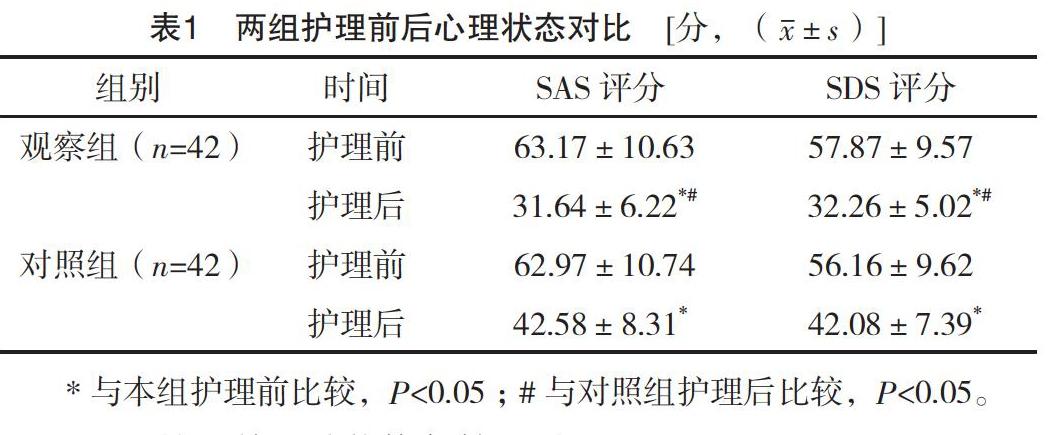
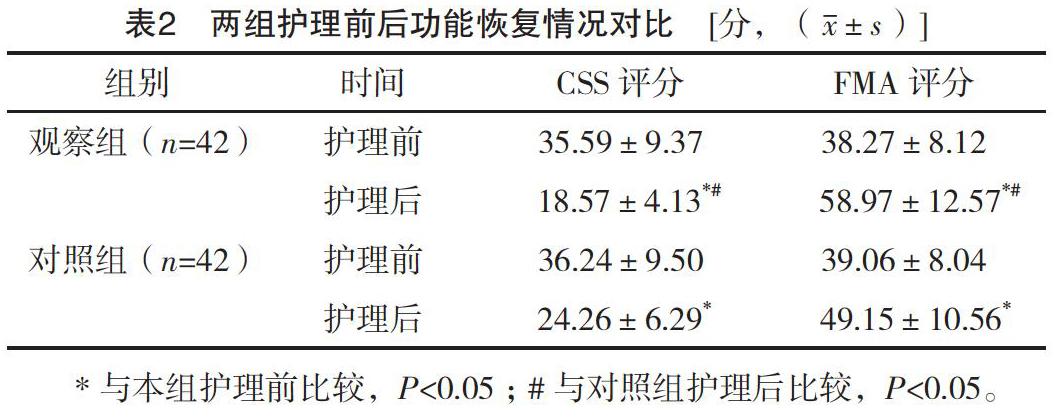
【摘要】 目的:探讨脑梗死患者应用超早期康复护理干预在改善患者情绪及功能恢复的临床效果。方法:选取笔者所在医院2017年5月-2018年5月收治的84例脑梗死患者,将其随机分为观察组与对照组,各42例。对照组应用常规护理方法,观察组实施超早期康复护理干预。比较两组护理效果。结果:护理后观察组SAS评分、SDS评分均明显低于对照组,差异有统计学意义(P<0.05)。护理后观察组CSS评分、FMA评分均优于对照组,差异有统计学意义(P<0.05)。结论:脑梗死患者应用超早期康复护理干预,可有效缓解患者负性情绪,促使患者运动功能、神经功能恢复,有推广应用价值。
【关键词】 超早期 康复护理干预 脑梗死 负性情绪 神经功能 运动功能
doi:10.14033/j.cnki.cfmr.2019.28.043 文献标识码 B 文章编号 1674-6805(2019)28-0-03
Effect of Super Early Rehabilitation Nursing Intervention on Emotional Improvement and Functional Recovery of Patients with Cerebral Infarction/YE Jiejing. //Chinese and Foreign Medical Research, 2019, 17(28): -106
[Abstract] Objective: To explore the clinical effect of super early rehabilitation nursing intervention in improving the emotional and functional recovery in patients with cerebral infarction. Method: A total of 84 patients with cerebral infarction admitted in our hospital from May 2017 to May 2018 were selected and randomly divided into the observation group and the control group, with 42 cases in each group. The control group used routine nursing methods, and the observation group implement super early rehabilitation nursing intervention. The nursing effect of the two groups was compared. Result: After nursing, the scores of SAS and SDS were significantly lower than those of the control group, and the differences were statistically significant (P<0.05). After nursing, the scores of CSS and FMA in the observation group were better than those in the control group, and the differences were statistically significant (P<0.05). Conclusion: The application of super early rehabilitation nursing intervention in patients with cerebral infarction can effectively alleviate the negative emotions of patients, and promote the recovery of patients motor function and neurological function, which has the value of popularization and application.
[Key words] Super early Rehabilitation nursing intervention Cerebral infarction Negative emotion Neurological function Motor function
First-authors address: The First Hospital of Fuzhou, Fuzhou 350009, China
腦梗死在临床中比较常见,因脑组织缺氧缺血引起,患者通常病情危急,需及时进行治疗,绝大多数患者治疗后运动功能、神经功能均存在受损情况,导致患者负性情绪增加,不利于疾病的康复[1-2]。有研究显示,脑梗死在我国每年发病人数达到200万以上,且致残、致死率极高,致死率可达10%~15%,严重威胁患者健康[3-4]。为使脑梗死患者治疗效果进一步提升,在急性脑梗死患者早期治疗中,除给予相应的药物治疗外,应用超早期康复护理干预,对缓解患者负性情绪,促进患者功能恢复有重要作用[4-5]。本研究针对笔者所在医院84例脑梗死患者进行研究,对超早期康复护理干预应用的效果进行观察,现报道如下。
1 资料与方法
1.1 一般资料
选取笔者所在医院2017年5月-2018年5月收治的84例脑梗死患者,所有患者均符合全国第四届脑血管病学会制定脑梗死临床诊断标准[6],且经MRI或CT诊断确诊。排除智力障碍者、精神疾病者、大面积脑梗死者及合并外周神经疾病者。……