急性脑梗死昏迷患者的循证护理要点及护理效果评价
2019-04-21高红卫
高红卫

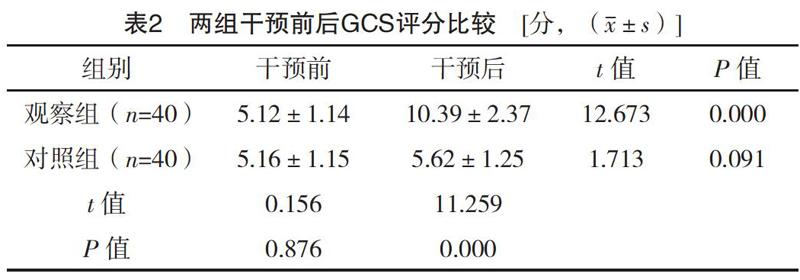

【摘要】 目的:探讨循证护理在急性脑梗死昏迷患者中的应用要点及效果。方法:选择80例2016年1月-2018年1月于笔者所在医院住院治疗的急性脑梗死昏迷患者作为研究对象,随机分为观察组与对照组,每组40例。对照组予常规护理干预,观察组在对照组基础上予循证护理干预。比较两组护理干预效果并分析循证护理要点。结果:观察组干预后GCS评分改善幅度、护理满意度及并发症发生率均明显优于对照组(P<0.05)。结论:通过对急性脑梗死昏迷患者采取循证护理干预,有利于促进患者清醒,改善预后,并且可以提高护理满意度,减少并发症的发生。
【关键词】 急性脑梗死 昏迷 循证护理
doi:10.14033/j.cnki.cfmr.2019.29.053 文献标识码 B 文章编号 1674-6805(2019)29-0-03
[Abstract] Objective: To explore the application points and effects of evidence-based nursing in patients with acute cerebral infarction. Method: Eighty patients with acute cerebral infarction who were hospitalized in our hospital from January 2016 to January 2018 were selected as the study subjects, and were randomly divided into the observation group and the control group, 40 cases in each group. The control group was given routine nursing intervention, and the observation group was given evidence-based nursing intervention on the basis of the control group. The effect of nursing intervention were compared between the two groups and the evidence-based nursing points were analyzed. Result: After the intervention, the improvement of GCS score, nursing satisfaction and complications rate in the observation group were significantly better than those of the control group (P<0.05). Conclusion: Evidence-based nursing intervention for coma patients with acute cerebral infarction is beneficial to promote patients wakefulness, improve prognosis, improve nursing satisfaction and reduce the occurrence of complications.
[Key words] Acute cerebral infarction Coma Evidence-based nursing
First-authors address: Seventh Medical Center, General Hospital of the Peoples Liberation Army, Beijing 100700, China
急性腦梗死是由脑动脉供血不足所引起,对人们的生命健康安全已造成严重危害[1]。相关研究结果显示,通过对急性脑梗死昏迷患者进行优质的护理干预,可使患者生活质量得到明显改善,还可明显改善预后情况[2]。循证护理(evidence-based nursing,EBN)是根据循证医学所提出来的一种护理学理念,目前已成为临床上一种新型的护理理念与方法,且应用越来越广泛[3]。通过循证护理干预可明显缩短昏迷患者的昏迷时间,减少并发症的发生。本研究通过对急性脑梗死昏迷患者进行循证护理干预,疗效满意,报道如下。
1 资料与方法
1.1 一般资料
选择80例2016年1月-2018年1月于笔者所在医院住院治疗的急性脑梗死昏迷患者作为研究对象。纳入标准:均存在不同程度的昏迷。排除标准:(1)严重肝肾功能不全;(2)精神行为异常,不能配合。随机分为观察组与对照组,每组40例。两组性别、年龄、昏迷程度比较,差异均无统计学意义(P>0.05),具有可比性,见表1。本……