QCC护理对病毒性脑炎患儿生存质量的影响
2019-04-21张秀梅祝文金
张秀梅 祝文金
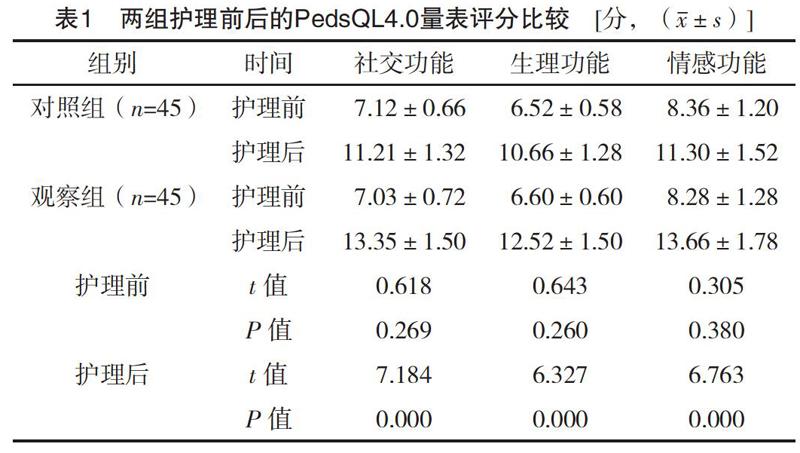
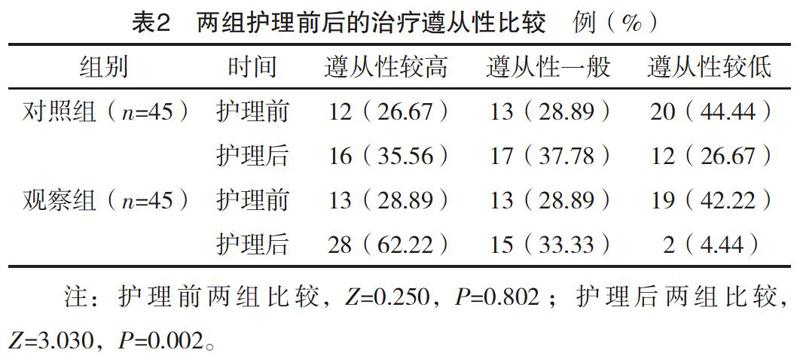
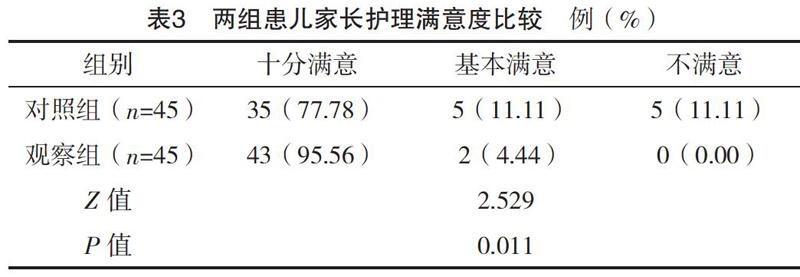
【摘要】 目的:研究与分析QCC护理对病毒性脑炎患儿生存质量的影响。方法:选取2017年1月-2019年7月90例病毒性脑炎患儿为研究对象,根据护理方式的不同分为对照组(常规病毒性脑炎护理组)45例和观察组(QCC护理组)45例。比较两组患儿护理前后的生存质量(PedsQL4.0量表),以及治疗遵从性、患儿家长护理满意度。结果:护理前两组的PedsQL4.0量表评分及治疗遵从性比较,差异无统计学意义(P>0.05),护理后观察组的PedsQL4.0量表评分及治疗遵从性优于对照组,患儿家长护理满意度高于对照组,差异均有统计学意义(P<0.05)。结论:QCC护理对病毒性脑炎患儿生存质量的影响较好,在本类患儿中具有较高的应用价值。
【关键词】 QCC护理模式 病毒性脑炎 生存质量
doi:10.14033/j.cnki.cfmr.2019.29.038 文献标识码 B 文章编号 1674-6805(2019)29-00-03
[Abstract] Objective: To study and analyze the influence of QCC nursing mode for the life quality of children with viral encephalitis. Method: From January 2017 to July 2019, 90 children with viral encephalitis were chosen for the study,and they were divided into the control group (routine nursing of viral encephalitis group)45 cases and the observation group (QCC nursing group) 45 cases according to the difference of nursing mode. Then the life quality (PedsQL4.0 scale) and treatment compliance before and after the nursing, satisfaction degree of parents for nursing of two groups were compared. Result: The PedsQL4.0 scale and treatment compliance of two groups before the nursing were compared, there were no statistically significant differences (P>0.05). The PedsQL4.0 scale and treatment compliance of the observation group after the nursing were better than those of the control group, the satisfaction degree of parents for nursing of the observation group was higher than that of control group, there were statistically significant differences(P<0.05). Conclusion: The influence of QCC nursing mode for the life quality of children with viral encephalitis is better, and its application value in the children is higher.
[Key words] QCC nursing mode Viral encephalitis Life quality
First-authors address: First Affiliated Hospital of Xiamen University, Xiamen 361001, China
病毒性腦炎的临床危害极大,其中较多为小儿患者,可对患儿的神经系统造成较大损害,严重者导致死亡。临床中与病毒性脑炎患儿相关的研究显示,除积极有效的治疗外,较佳的护理模式对患儿的影响也相对突出,而生存质量作为患儿综合状态反应的有效评估指标,其在护理模式的评估中具有较高的价值[1-2]。本研究就QCC护理对病毒性脑炎患儿生存质量的影响进行研究与分析,结果报道如下。
1 资料与方法
1.1 一般资料
选取2017年1月-2019年7月的90例病毒性脑炎患儿为研究对象,纳入标准:符合病毒性脑炎诊断标准;清醒患儿。排除标准:家长为文盲者;合并其他器官系统疾病者;合并其他感染。根据护理方式的不同分为对照组(常规病毒性脑炎护理组)45例和观察组(QCC护理组)45例。对照组中包括男童32例,女童13例;年龄2.0~13.8岁,平均(6.5±0.8)岁;病程7.5~27.5 d,平均(13.3±2.7)d;轻中度者40例,重度者5例。观察……