护理干预对医院感染患者治疗依从性的影响
2019-04-21郑丹熊艳群
郑丹 熊艳群
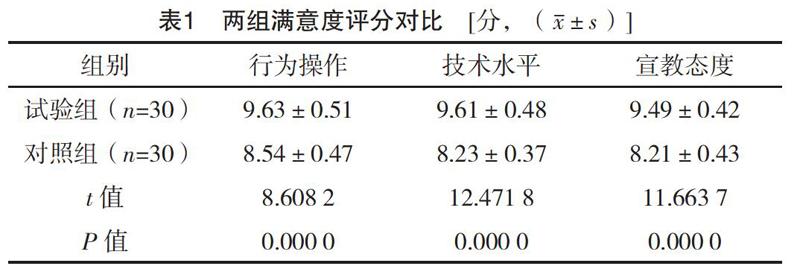
【摘要】 目的:探讨护理干预对医院感染患者治疗依从性的影响。方法:以2017年2月-2018年8月筆者所在医院接诊的医院感染患者60例为研究对象,将其随机分为对照组和试验组,每组30例。试验组在抗感染治疗的同时应用护理干预措施,而对照组则应用常规护理措施。比较两组治疗依从性及护理满意度。结果:试验组日常服药遵医、合理饮食、科学运动锻炼依从率均高于对照组,差异有统计学意义(P<0.05)。试验组对护士行为操作、技术水平和宣教态度的满意度评分均优于对照组,差异均有统计学意义(P<0.05)。结论:采取护理干预措施对医院感染患者进行护理,能够显著改善其治疗依从性,并有助于提高临床护理质量,提高患者对护士工作的满意度。
【关键词】 医院感染 干预作用 治疗依从性 护理干预
doi:10.14033/j.cnki.cfmr.2019.29.035 文献标识码 B 文章编号 1674-6805(2019)29-00-02
[Abstract] Objective: To explore the effect of nursing intervention on treatment compliance of patients with nosocomial infection. Method: A total of 60 patients with nosocomial infection admitted in our hospital from February 2017 to August 2018 were selected as the study subjects. They were randomly divided into the control group and the experimental group, with 30 patients in each group. The experimental group was treated with anti-infection and nursing intervention, while the control group was treated with routine nursing intervention. The treatment compliance and nursing satisfaction of the two groups was compared. Result: The compliance rate of daily medication compliance, reasonable diet and scientific exercise of the experimental group were all higher than those of the control group, the differences were statistically significant (P<0.05). The satisfaction scores of nurses behavioral operation, technical level and education attitude in the experimental group were better than those in the control group, the differences were statistically significant (P<0.05). Conclusion: Nursing intervention measures for patients with nosocomial infection can significantly improve their treatment compliance, improve the quality of clinical nursing, and improve patients atisfaction with the work of nurses.
[Key words] Nosocomial infection Intervention effect Treatment compliance Nursing intervention
First-authors address: Daye Peoples Hospital, Daye 435110, China
现阶段,医院感染在我国临床上比较常见,该病的发生给患者造成了痛苦,同时还会加重其病情,影响治疗效果[1-2]。为此,有必要加强对医院感染进行预防及控制力度,尽可能地减少患者发生医院感染的风险。笔者以60例医院感染患者为研究对象,着重分析医院感染应用护理干预措施对提高患者治疗依从性的干预价值,现报道如下。
1 资料与方法
1.1 一般资料
选取2017年2月-2018年8月笔者所在医院接诊的医院感染患者60例,患者在医院中获得感染,并经临床检查明确诊断为医院感染。采用计算机随机双盲法分为试验组和对照组,每组30例。试验组男女比例为17∶13;年龄25~77岁,平均(43.26±10.39)岁;住院时间7~23 d,平均(11.31±2.68)d;神经科5例,肿瘤外科9例,普外科12例,其他科4例。对照组男女比例16∶14;年龄24~78岁,平均(43.59±10.16)岁;住院时间7~22 d,平均(11.28±2.31)d;神经科3例,肿瘤外科8例,普外科15例,其他科3例。两组一般资料比较差异无统计学意义(P>0.05),有可比性。
1.2 方法
两组抗感染等对症治疗期间均接受常规护理,具体如下:遵医嘱指导患者用药;注意观察患者病情变化,若发现异常立即处理;将疾病相关知识详细告知患者,并对患者提出的问题做出及时的解答。试……