补阳还五汤加减治疗腰椎间盘突出症术后残留神经综合征的临床观察
2019-04-21洪友谊赖展龙王汉龙吴志强柯晓斌
洪友谊 赖展龙 王汉龙 吴志强 柯晓斌
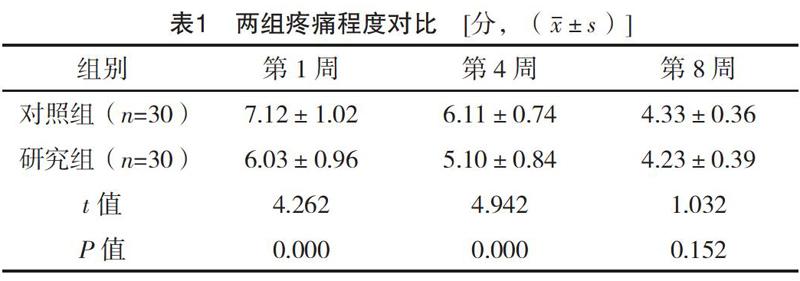
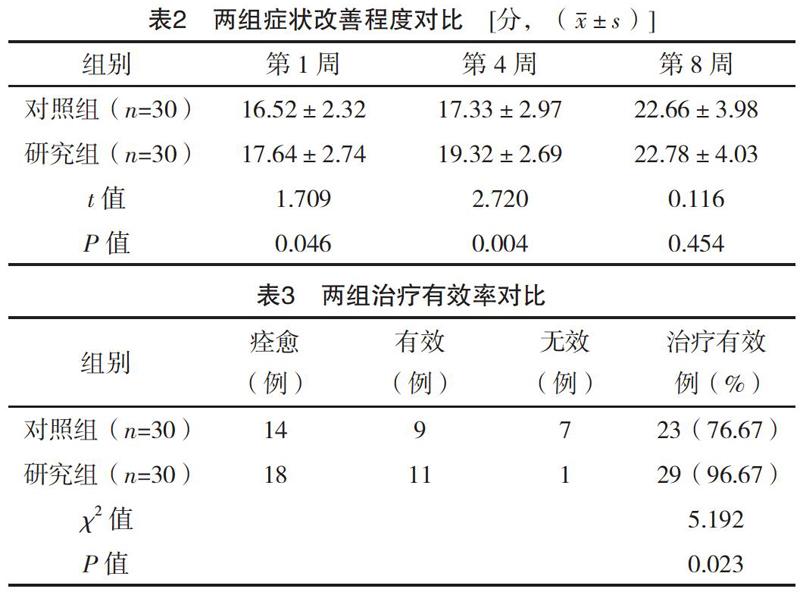
【摘要】 目的:对比不同方式治疗腰椎间盘突出症术后残留神经综合征的效果,论证补阳还五汤加减在腰椎间盘突出症术后残留神经综合征治疗中的疗效,并探讨其作用机制。方法:选取2018年1月-2019年1月至笔者所在医院就诊的腰椎间盘突出症患者60例作为此次研究对象。患者均通过手术治疗,且术后出现残留神经综合征。通过抽签的方式将患者分为对照组(n=30,患者术后通过抗感染、护胃、脱水、伤口处理及西药等常规治疗)和研究组(n=30,患者术后在常规治疗的基础上结合补阳还五汤加减治疗),以VAS评分标准对患者疼痛程度进行评估,以JOA评分标准评估症状改善程度,比较手术后第1、4及8周患者的疼痛程度及症状改善程度,并对两组治疗效果进行比较。结果:研究组患者第1、4周的疼痛程度、症状改善程度与对照组相比更优,差异有统计学意义(P<0.05)。第8周两组的疼痛程度、症状改善程度差异无统计学意义(P>0.05)。对照组治疗有效率为76.67%,研究组治疗有效率为96.67%,组间对比差异有统计学意义(P<0.05)。结论:在腰椎间盘突出症术后残留神经综合征治疗中,在常规医药治疗的基础上给予补阳还五汤加减治疗比单一的常规治疗方式更有优势,不仅能缓解患者术后疼痛感,还能更有效改善症状,治疗效果更佳,值得临床推广。
【关键词】 腰椎间盘突出癥 术后残留神经综合征 补阳还五汤加减
doi:10.14033/j.cnki.cfmr.2019.29.002 文献标识码 A 文章编号 1674-6805(2019)29-000-03
[Abstract] Objective: To compare the effects of different ways of treating residual nerve syndrome after lumbar disc herniation, to demonstrate the efficacy of Buyang Huanwu Decoction addition and reduction in treating residual nerve syndrome after lumbar disc herniation and to explore its mechanism. Method: A total of 60 patients with lumbar disc herniation who visited our hospital from January 2018 to January 2019 were selected as the subjects of this study. All patients were treated by surgery, and residual nerve syndrome occurred after surgery. By lottery divided the patients into the control group (n=30, postoperative patients treated by anti-infection, protecting stomach, dehydration, the wound treatment and western routine therapy) and the study group (n=30, postoperative patients treated with Buyang Huanwu Decoction addition and reduction on the basis of conventional treatment), VAS score standard to evaluate patients pain degree, JOA score standard to evaluate degree of symptoms improvement,and the level of pain and degree of symptoms improvement in the first week, the fourth and the eighth week after the operation, and to compare the effect of two groups. Result: The pain degree and symptom improvement degree in the first week and fourth week of the study group were better than those in the control group, and the differences were significant (P<0.05). There was no statistically significant difference in pain degree and symptom improvement degree between the two groups at the eighth week (P>0.05). The effective rate was 76.67% in the control group and 96.67% in the research group, and the difference between the two groups was statistically significant (P<0.05). Conclusion: In the treatment of residual nerve syndrome after lumbar disc herniation, Buyang Huanwu Decoction addition and reduction on the basis of conventional medical treatment is more advantageous than single conventional treatment, which can not only relieve patients postoperative pain, but also improve symptoms more effectively, with better treatment effect, and is worthy of clinical promotion.
[Key words] Lumbar disc herniation Postoperative residual nerve syndrome Buyang Huanwu Decoction addition and reduction
First-authors address: Quanzhou Bone-setting Hospital Affiliated to Fujian University of Traditional Chinese Medicine, Quanzhou 362000, China
腰椎间盘突出症是骨科常见的疾病之一,发病原因为腰间盘的纤维环被破坏或者发生退行性变及髓核突出,因此而刺激和压迫相邻组织,影响患者的日常生活和工作。有研究数据显示,腰椎间盘突出症在男性中的发病率大约为5.2%,在女性中的发病率大约为3.6%,并且大多数患者仅经过保守治疗即可控制病情,但是复发率较高,且易出现疼痛和神经功能损伤[1-2]。……