明日叶叶斑病病原菌的生物学特性及室内药效试验
2019-01-13周洁郭凤领符家平肖颖徐绳武吴金平
周洁 郭凤领 符家平 肖颖 徐绳武 吴金平


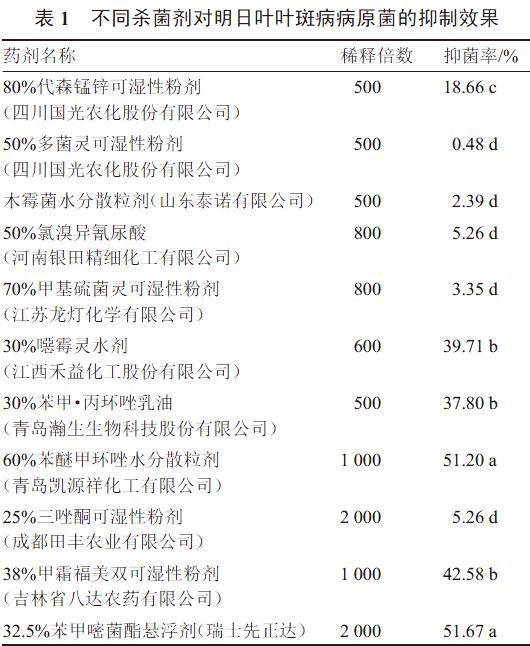
摘 要:为了明确明日叶(Angelica keiskei)叶斑病病原菌链格孢(Alternaria alternata)的生物学特性而进行了室内药劑筛选,为该病的防治提供理论依据。以蔬菜种质创新与遗传改良湖北重点实验室保存的明日叶叶斑病病原菌为材料,对病原菌的生物学特性进行测定,并在室内对11种药剂进行筛选。链格孢(Alternaria alternata)菌丝生长致死温度为55 ℃;适宜pH范围为8~10;最佳氮源为酵母浸出物,最佳碳源为甘露醇;稀释1 000倍的60%苯醚甲环唑水分散粒剂和稀释2 000倍的32.5%苯甲嘧菌酯悬浮剂对该病原菌抑制率达50%以上。综合以上结果,明日叶叶斑病病原菌适宜在弱碱性和富含有机营养的环境下生长,可选用苯醚甲环唑和苯甲嘧菌酯作为田间防治药剂。
关键词:明日叶;叶斑病;链格孢;生物学特性;药剂筛选
Pathogen biological characteristics and fungicide-screening for leaf spot disease of Angelica keiskei
ZHOU Jie1, GUO Fengling1, FU Jiaping1, XIAO Ying1, XU Shengwu2, WU Jinping1
(1. Hubei Key Laboratory of Vegetable Germplasm Enhancement and Genetic Improvement / Institute of Economic Crops, Hubei Academy of Agricultural Sciences, Wuhan 430064, Hubei, China; 2. Xianning Academy of Agricultural Sciences, Xianning 437000, Hubei, China)
Abstract: The experiment was conducted to clarify the biological characteristics and fungicide-screening of Alternaria alternata, the pathogen of leaf spot disease of Angelica keiskei, to provide a theoretical basis for the controlling of the disease. The biological characteristics of A.alternata were determined, and 11 kinds of fungicides on pathogens was screened. The lethal temperature of mycelium growth was 55 ℃; the optimal pH range was 8 to 10; the best nitrogen source was yeast extract, the best carbon source was mannitol; 1 000 times solution of 60% difenoconazole water dispersible granules and 2 000 times solution of 32.5% azoxystrobin suspension showed best inhibition effect, and the mycelial growth inhibition rate exceeded 50%.The pathogen of leaf spot disease of A. keiskei is suitable for growth in a weak alkaline and organic-rich environment. Difenoconazole and azoxystrobin can be used as control agents in field.
Key words: Angelica keiskei; Leaf spot; Alternaria alternata; Biological characteristics; Fungicide-screening
明日叶(Angelica keiskei),又名明日草、八丈草、长寿草等,是多年生草本植物,属伞形科当归属的药食两用蔬菜,有“21世纪健康食品”和“神奇植物”的美称[1]。明日叶原产于日本八丈岛,含有人体所需的多种维生素、氨基酸、矿物质和微量元素等,同时还含有查尔酮、类黄酮及香豆素等天然活性成分,利于人体健康[2- 3]。此外,有研究发现,明日叶所含的膳食纤维也可为食品工业提供丰富的纤维功能成分来源[4]。随着明日叶功能的不断挖掘,明日叶被引进中国,并被推广规模化种植。未曾关注的病害问题也日渐显现,如由链格孢(Alternaria alternata)引起的叶斑病[5],导致产量损失近40%,制约了明日叶产业的健康发展。因此,明确该病病原菌的生物学特性及室内药剂的筛选,可为明日叶叶斑病的防治提供理论依据。……