低温胁迫下油菜素内酯对黄瓜种子萌发及幼苗生长的影响
2019-01-13张爱敏周国顺付丽军李娟陆晴任瑞星
张爱敏 周国顺 付丽军 李娟 陆晴 任瑞星
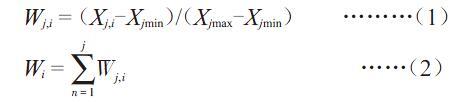
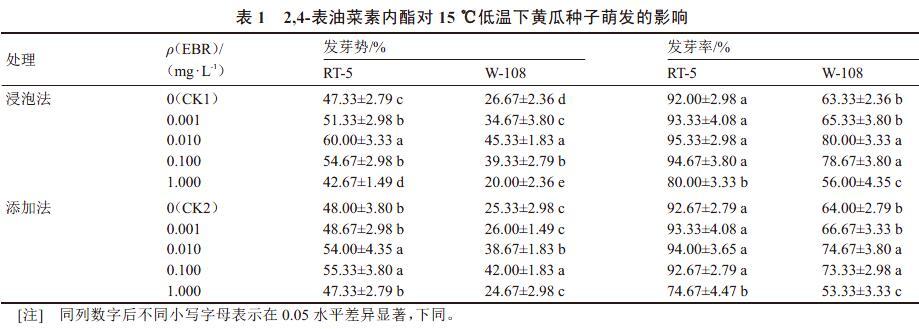
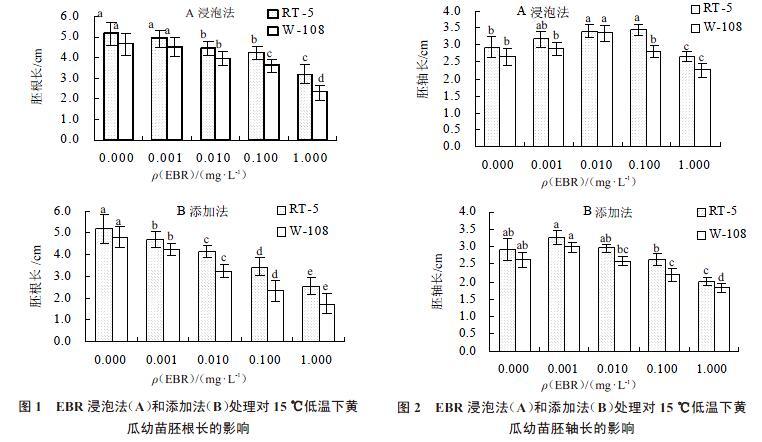
摘 要:以耐冷型黄瓜品种‘RT-5和冷敏型黄瓜品种‘W-108种子为试验材料,采用2,4-表油菜素内酯(EBR)浸泡法和添加法处理,研究了15 ℃低温胁迫下不同质量浓度(0.001、0.010、0.100、1.000 mg·L-1)EBR对黄瓜种子萌发及幼苗生长的影响。结果表明,适当质量浓度的(0.001~0.100 mg·L-1)EBR处理可以提高黄瓜种子的发芽势、发芽率、胚轴长、轴根比和侧根数,减轻种子萌发和幼苗受到的低温伤害,且冷敏品种‘W-108的低温缓解效应大于耐冷品种‘RT-5。高质量浓度(1.000 mg·L-1)EBR则显著抑制黄瓜种子萌发和幼苗生长。各浓度EBR处理均不同程度降低了黄瓜幼苗的胚根长,随EBR浓度升高,抑制作用加强。运用隶属函数法对EBR各处理进行综合评价,结果表明EBR浸泡法处理效果优于添加法,其中以浸泡法0.010 mg·L-1 EBR处理对低温胁迫下黄瓜种子萌发及幼苗生长的促进效果最好。
关键词:黄瓜;油菜素内酯;低温胁迫;种子萌发;幼苗生长
Effects of brassinosteroids on seed germination and seedling growth of cucumber under low temperature stress
ZHANG Aimin, ZHOU Guoshun, FU Lijun, LI Juan, LU Qing, REN Ruixing
(Tangshan Research Institute of Agricultural Sciences, Tangshan 063001, Hebei, China)
Abstract: Two cucumber seed of different varieties were used as experimental materials, one was cold-resistant varieties ‘RT-5 and the other was cold-sensitive varieties ‘W-108. The experiment was designed to study the effects of different concentrations of 2, 4- Epibrassinolide (EBR) (0.000、0.001、0.010、0.100、1.000 mg·L-1)on seed germination and seedling growth of cucumbe under 15 ℃ low temperature stress by EBR immersion. The results showed that in a certain range of concentration of EBR, the treatment could improve the germination potential, germination rate, root length, hypocotyl ratio and the number of lateral roots of cucumber, reduce the risk of low temperature on seed germination and seedling, and the effect on cold sensitive cultivar ‘W-108 was greater than the cold resistant variety ‘RT-5. High concentration EBR (1.000 mg·L-1) significantly inhibited cucumber seed germination and seedling growth. The length of cucumber seedlings was reduced in all concentrations of EBR treatment. With the increasing of concentration of EBR, the inhibition was strengthened. The membership function method was used to evaluate the treatment of EBR. The results showed that EBR soaking method was better than adding method, and 0.010 mg·L-1 EBR soaking treatment had the best effect on seed germination and seedling growth of cucumber under low temperature stress.
Key words: Cucumber; Brassinolide; Low temperature stress; Seed germination; Seedling growth
低温胁迫是常见的非生物胁迫之一,是限制作物产量和品质的重要因素[1]。黄瓜(Cucumis sativus L.)起源于亚热带地区,属喜温作物,对低温反应敏感[2] ,生长期间特别是种子发芽期间对温度要求较高。研究表明,黄瓜种子萌发适宜温度为25~32 ℃,低于15 ℃发芽率显著降低[3-4],低于10~12 ℃幼苗生長缓慢或停止发育[5] 。然而在我国冬季和早春保护地栽培中,黄瓜常遭受0~15 ℃低温伤害,低温逆境下黄瓜种子萌发受阻、幼苗生长停滞、叶片萎蔫黄化,严重时可导致整株死亡[6]。如何提高低温下黄瓜种子萌发和幼苗期耐冷性,对解决冬春季黄瓜生产有着重要的现实意义。……