治疗性内镜逆行性胰胆管造影术后胰腺炎的危险因素分析
2017-11-14曹世长黄坤于久飞
曹世长 黄坤 于久飞
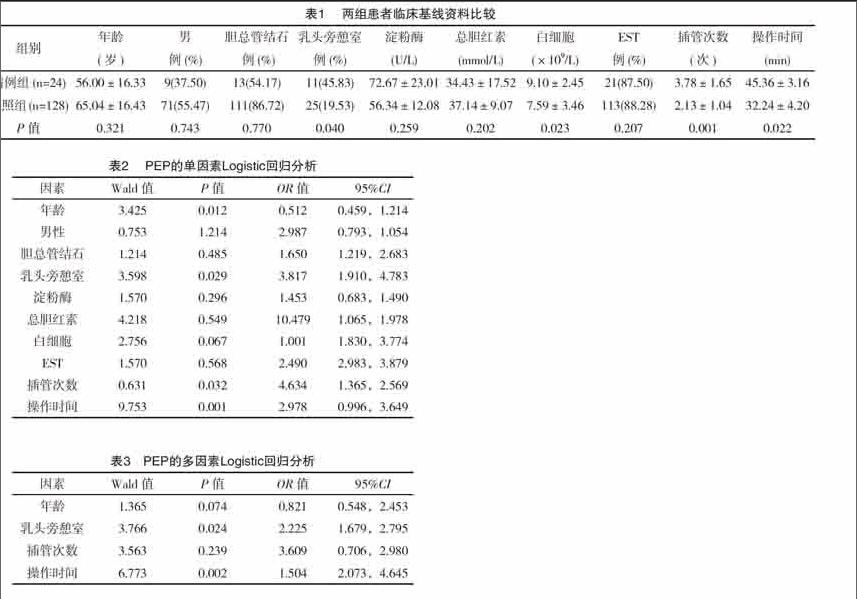
【摘要】 目的:探讨影响治疗性内镜逆行性胰胆管造影(ERCP)术后胰腺炎(PEP)的危险因素。方法:回顾性分析2011年1月-2016年7月于笔者所在医院消化内科行治疗性ERCP操作的152例患者,对其年龄、性别、原发疾病(胆总管结石或恶性肿瘤胆总管梗阻)、有无乳头旁憩室、术前化验(淀粉酶、总胆红素、白细胞)、操作情况(是否行内镜十二指肠乳头切开术、插管次数、操作时间)进行分析,根据术后有无发生PEP将患者分为对照组(128例)和病例组(24例),采用Logistic多因素分析评估影响PEP的危险因素。结果:152例患者术后发生急性胰腺炎共24例,发生率为15.79%。Logistic多因素分析显示十二指肠乳头旁憩室、ERCP操作时间长是影响PEP的独立危险因素。结论:存在十二指肠乳头旁憩室及操作时间长的ERCP患者更易发生PEP,对此类患者可予针对性预防措施。
【关键词】 内镜逆行性胰胆管造影; 急性胰腺炎; 危险因素
doi:10.14033/j.cnki.cfmr.2017.19.015 文献标识码 B 文章编号 1674-6805(2017)19-0031-03
Analysis of the Risk Factors of Therapeutic Post-ERCP Pancreatitis/CAO Shi-chang,HUANG Kun,YU Jiu-fei.//Chinese and Foreign Medical Research,2017,15(19):31-33
【Abstract】 Objective:To analyze the risk factors for pancreatitis after endoscopic retrograde cholangio pancreatography(ERCP).Method:152 patients who underwent ERCP in Department of Gastroenterology during January 2011 to July 2016 were enrolled in this retrospective study.Clinical datas,including age,gender,disease(bile duct stone or malignant obstruction),juxta-papilary duodenal diverticulum,amylase,total bilirubin,white blood cell and the details of ERCP (including endoscopic sphincterotomy, multiple cannulation attempts and operating time) were collected and analyzed.Case group contains 24 patients with PEP while control group contains 128 patients.Multivariate logistic regression was performed to detect the potential risk factors related to PEP.Result:24 patients had PEP in all 152 patients with a prevalence rate of 15.79%.Juxta-papilary duodenal diverticulum and long operating time of ERCP were independent risk factors of PEP.Conclusion:PEP occurs more often in patients with juxta-papilary duodenal diverticulum and long operating time of ERCP.
【Key words】 Endoscopic retrograde cholangiopancreatography; Acute panreatitis; Risk factors
First-authors address:Civil Aviation General Hospital,Beijing 100123,China
內镜逆行性胰胆管造影(Endoscopic retrograde cholangio pancreatography,ERCP)是诊断和治疗肝胆胰疾病的重要手段,在临床上广泛应用。但ERCP术后可引起较多并发症,如出血、穿孔、急性胰腺炎、急性胆管炎,其中术后胰腺炎(Post-ERCP pancreatitis, PEP)发生率最高,且治疗性ERCP较诊断性ERCP并发症发生率高[1],不仅限制了ERCP的广泛应用,而且增加了患者的痛苦及医疗成本。如何降低ERCP术后胰腺炎的发生率,早期识别ERCP术后胰腺炎的高危患者,及早采取预防措施,一直是临床医生研究的热点。本研究通过对笔者所在医院接受ERCP治疗患者的回顾性分析,探讨PEP的危险因素,为预防PEP提供参考。……