心理护理对尿毒症血液透析患者自我管理行为及生活质量影响研究
2017-11-13张佳慧谭春梅许文华
张佳慧 谭春梅 许文华

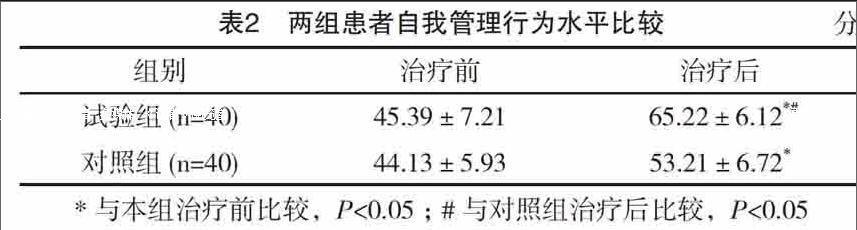
【摘要】 目的:探讨心理护理对尿毒症血液透析患者自我管理行为及生活质量影响。方法:选取笔者所在医院就诊的80例血液透析患者,随机分为试验组和对照组,各40例。对照组患者给予基础护理,试验组患者在对照组基础上给予心理护理干预。观察并比较两组患者治疗前后的自我管理行为评分及生活质量评分情况。结果:与治疗前相比,治疗后两组患者的躯体功能、社会功能、心理功能、物质生活状态及自我管理行为水平评分均升高,差异有统计学意义(P<0.05),与对照组相比,试验组患者治疗后的躯体功能、社会功能、心理功能、物质生活状态、自我管理行为水平方面评分较高,差异有统计学意义(P<0.05)。结论:心理护理能够改善尿毒症血液透析患者的自我管理行为及生活质量水平,临床效果较好。
【关键词】 心理护理; 尿毒症; 血液透析; 自我管理行为; 生活质量
doi:10.14033/j.cnki.cfmr.2017.18.032 文献标识码 B 文章编号 1674-6805(2017)18-0062-03
Effect of Psychological Nursing on Self-management Behavior and Quality of Life of Patients with Uremia Hemodialysis/ZHANG Jia-hui,TAN Chun-mei,XU Wen-hua.//Chinese and Foreign Medical Research,2017,15(18):62-64
【Abstract】 Objective:To explore the effect of psychological nursing on self-management behavior and quality of life in patients with uremia hemodialysis.Method:80 cases of hemodialysis patients in our hospital were selected and randomly divided into experimental group and control group,40 cases in each group.The patients in the control group were given basic nursing,the experimental group was given psychological nursing intervention on the basis of the control group.Observed and compared the self-management behavior scores and quality of life scores among the patients in the two groups,before and after the treatment.Result:Compared with before treatment,the physical function,social function,psychological function,material life and self management behavior level score of the two groups were increased after treatment,the differences were statistically significant(P<0.05);compared with the control group,the physical function,social function,psychological function,material life state,self management behavior level scores in the experimental group were higher after treatment,the differences were statistically significant(P<0.05).Conclusion:Psychological nursing can improve the self-management behavior and quality of life of uremic hemodialysis patients,and the clinical effect is better.
【Key words】 Psychological nursing; Uremia; Hemodialysis; Self-management behavior; Quality of life
First-authors address:The Fifth Hospital Affiliated to Zhongshan University,Zhuhai 519000,China
尿毒癥患者在不能得到肾源进行肾移植的情况下,将会持续进行血液透析。血液透析能够延长患者的生存期,是治疗尿毒症晚期患者的重要方式[1]。在透析过程中患者会出现一系列的不良反应,且透析所需的费用较高,患者的负担较重,增加了患者的身心负担,从而出现焦虑、抑郁等许多负性心理问题,影响患者的生存质量和心理健康,对患者的健康造成严重的影响,不利于患者的临床治疗,且在极端情况下还可能导致患者的自杀[2]。随着医学的进步,医疗模式已发生了根本的转变,以人为本的理念已经得到了深入的贯彻,心理护理干预的目的不仅要延长患者的生存期,还应对患者的生活质量进行提高[3]。生活质量是反应患者治疗效果的指标,是通过患者的躯体、心理、社会、物质生活等方面的量化,从而对治疗和护理的效果进行评价[4]。……