基于稀疏表示的体域网节点休眠策略
2017-09-08陈家顺周岳斌王涛
陈家顺+周岳斌+王涛

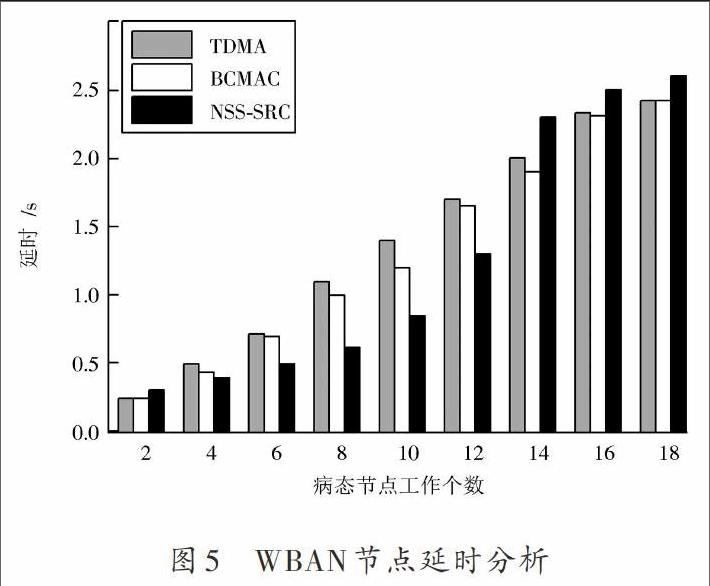
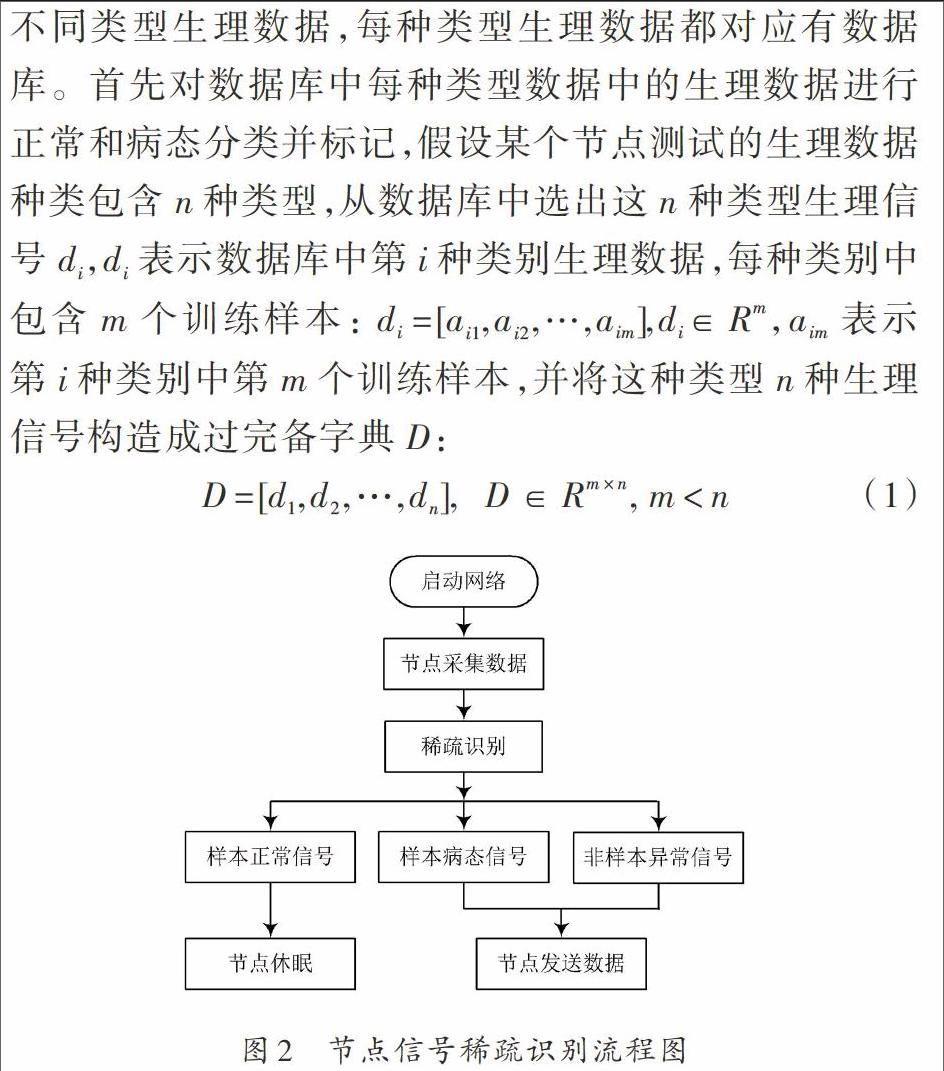
摘 要: 针对无线体域网(WBAN)节点电池能量有限和不易更换电源的问题,提出一种基于稀释表示分类算法的节点休眠策略(NSS?SRC)。当WBAN节点采集的人体生理信号处于正常范围时,采用稀疏表示理论对测试样本信号进行识别,根据识别结果滤除不需要传送的正常信号,将WBAN节点转换为休眠状态,并延长节点休眠时间,从而减少节点数据传输量。通过NS2软件对节点延时和能耗进行仿真分析,结果表明,在生理信号通常处于稳定范围的WBAN中,与传统TDMA,BCMAC相比,NSS?SRC策略能有效降低能耗和延时。
关键词: WBAN; 休眠策略; 稀疏表示; 节能
中图分类号: TN914?34 文献标识码: A 文章编号: 1004?373X(2017)17?0015?05
Body area network node sleep strategy based on sparse representation
CHEN Jiashun1, 3, ZHOU Yuebin2, 3, WANG Tao1
(1. School of Machinery and Automation, Wuhan University of Science and Technology, Wuhan 430081, China;
2. School of Mechanical & Auto Engineering, Hubei University of Arts & Science, Xiangyang 441053, China;
3. The Collaborative Innovation Center of Hubei Province for Auto Parts Manufacturing Equipment Digitization, Xiangyang 441053, China)
Abstract: Since the battery energy of wireless body area network (WBAN) node is limited, and its power supply is hard to replace, a node sleep strategy based on sparse representation classification (NSS?SRC) algorithm is proposed. While the human?body physiological signal collected by WBAN nodes stays in the normal range, the sparse representation theory is used to identify the test sample signals. According to the identification results, the normal signals which needn′t to be sent are filtered out, and the state of WBAN node is converted into the sleep state. The node sleep time is prolonged to reduce the transmission quantity of node data. The node delay and energy consumption are simulated and analyzed with NS2 software. The results show that, in comparison with the traditional TDMA and BCMAC algorithms, the NSS?SRC strategy can reduce the energy consumption and time delay effectively while the physiological signal is in WBAN with stable range.
Keywords: WBAN; sleep strategy; sparse representation; energy saving
0 引 言
无线体域网(Wireless Body Area Network, WBAN)是在人体表或体内安置传感器节点,通过节点采集人体温度、血压、心率、脑电图等各部位生理信息的数据网络。WBAN现已被广泛应用于远程医疗诊断、疾病监控和预防、家庭看护等方面。WBAN节点一般采用电池供电,能量有限,对植入人体内部节点更加不易频繁更换,因此研究WBAN节点的节能方法具有重要的现实意义[1?4]。
2009年Wright等人首次将稀疏表示理论用于分类,提出稀疏表示分类算法(Sparse Representation?Based Classifier,SRC),将模式识别问题转化为信号稀疏表示问题,为基于信号识别提供了理论基础[5]。与传统模式识别方法相比,如最近邻NN、最近子空间NS、支持向量机SVM等,稀疏表示算法具有较高的识别精度和鲁棒性[6]。随着科技进步,在医疗器械检测中,通过对各类病人的测量统计,建立了各类生理信号数据库,为稀疏表示……