阅读的历史与未来
2017-08-16ByPaulLaFarge
By+Paul+La+Farge
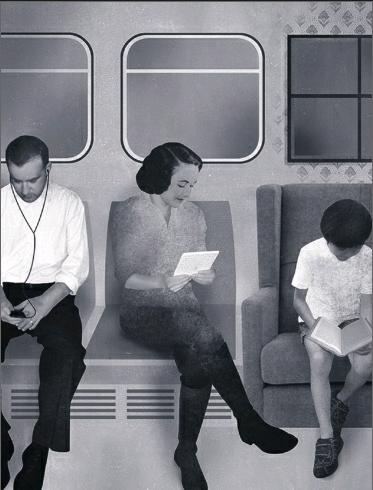

In A History of Reading, the Canadian novelist Alberto Manguel describes a remarkable transformation of human consciousness, which took place around the 10th century A.D.: the advent of silent reading. Human beings have been reading for thousands of years, but in antiquity1, the normal thing was to read aloud. When Augustine (the future St. Augustine) went to see his teacher, Ambrose, in Milan, in 384 A.D.,2 he was stunned to see him looking at a book and not saying anything. With the advent of silent reading, Manguel writes,... the reader was at last able to establish an unrestricted relationship with the book and the words. The words no longer needed to occupy the time required to pronounce them. They could exist in interior space, rushing on or barely begun, fully deciphered or only half-said, while the readers thoughts inspected them at leisure, drawing new notions from them, allowing comparisons from memory or from other books left open for simultaneous perusal.3
To read silently is to free your mind to reflect, to remember, to question and compare. The cognitive scientist Maryanne Wolf calls this freedom “the secret gift of time to think”: When the reading brain becomes able to process written symbols automatically, the thinking brain has time to go beyond those symbols, to develop itself and the culture in which it lives.
A thousand years later, critics fear that digital technology has put this gift in peril4. The Internets flood of information, together with the distractions of social media, threaten to overwhelm the interior space of reading, stranding us in what the journalist Nicholas Carr has called “the shallows,” a frenzied flitting from one fact to the next.5 In Carrs view, the “endless, mesmerizing buzz” of the Internet imperils our very being: “One of the greatest dangers we face,” he writes, “as we automate the work of our minds, as we cede control over the flow of our thoughts and memories to a powerful electronic system, is ... a slow erosion of our humanness and our humanity.”6
Theres no question that digital technology presents challenges to the reading brain, but, seen from a historical perspective, these look like differences of degree, rather than of kind. To the extent that digital reading represents something new, its potential cuts both ways7. Done badly, the Internet reduces us to mindless clickers, racing numbly to the bottom of a bottomless feed; but done well, it has the potential to expand and augment8 the very contemplative space that we have prized in ourselves ever since we learned to read without moving our lips.
The fear of technology is not new. In the fifth century B.C., Socrates worried that writing would weaken human memory, and stifle9 judgment. In fact, as Wolf notes in her 2007 book Proust and the Squid: the Story and Science of the Reading Brain, the opposite happened: Faced with the written page, the readers brain develops new capacities. We may not keep the Iliad in our heads any longer, but were exquisitely10 capable of reflecting on it, comparing it to other stories we know, and forming conclusions about human beings ancient and modern.
The Internet may cause our minds to wander off, and yet a quick look at the history of books suggests that we have been wandering off all along. When we read, the eye does not progress steadily along the line of text; it alternates between saccades—little jumps—and brief stops, not unlike the movement of the mouses cursor across a screen of hypertext.11 From the invention of papyrus around 3000 B.C., until about 300 A.D., most written documents were scrolls, which had to be rolled up by one hand as they were unrolled by the other: a truly linear presentation.12 Since then, though, most reading has involved codices, bound books or pamphlets, a major advantage of which (at least compared to the scroll) is that you can jump around in them, from chapter to chapter (the table of contents had been around since roughly the first century B.C.); from text to marginal gloss,13 and, later, to footnote.
In the age of print, nonlinear reading found its most elaborate support in the “book wheel,” invented by the Italian engineer Agostino Ramelli in 1588: a “rotary14 reading desk” which allowed the reader to keep a great number of books at once, and to switch between them by giving the wheel a turn. The book wheel was—unfortunately!—a rarity15 in European libraries, but when you think about all the kinds of reading that print affords, the experience of starting a text at its beginning and reading all the way to the end, which we now associate with “deep” reading, looks less characteristic of print in general than of the novel in particular: the one kind of book in which, we feel, we might be depriving ourselves of something vital if we skipped or skimmed.
The German historian Rolf Engelsing argues that a “reading revolution” took place at the end of the 18th century: Before that point, the typical European reader had only a few books—the Bible, an almanac, maybe a work of devotional literature—and he read them over and over, so that they were deeply impressed on his consciousness.16 Afterward, Europeans read all kinds of material—novels, periodicals, newspapers—and they read each item only once before racing on to the next. Contemporary critics were doubtless appalled, but on the other hand, from that flood of printed matter, we got the Enlightenment, Romanticism, the American and French revolutions.
Its true that studies have found that readers given text on a screen do worse on recall and comprehension tests than readers given the same text on paper. But a 2015 study by the German educator Johannes Naumann suggests the opposite. He gave a group of high-school students the job of tracking down certain pieces of information on websites; he found that the students who regularly did research online—in other words, the ones who expected Web pages to yield17 up useful facts—were better at this task (and at ignoring irrelevant information) than students who used the Internet mostly to send email, chat, and blog.
A new generation of digital writers is building on video games, incorporating their interactive features—and cognitive sparks—into novelistic narratives that embrace the capabilities of our screens and tablets. Samantha Gorman and Danny Cannizzaros 2014 iPad novella, Pry, tells the story of a demolitions expert returned home from the first Gulf War, whose past and present collide, as his vision fails.18 The story is told in text, photographs, video clips, and audio. It uses an interface19 that allows you to follow the action and shift between levels of awareness. As you read text on the screen, describing characters and plot, you draw your fingers apart and see a photograph of the protagonist20, his eyes opening on the world. Pinch your fingers shut and you visit his troubled unconscious;21 words and images race by, as if you are inside his memory. Pry is the opposite of a shallow work; its whole play is between the surface and the depths of the human mind. Reading it is exhilarating22.
在《閱读的历史》中,加拿大小说家阿尔维托·曼古埃尔指出了大约公元10世纪时人类意识的伟大转型:默读时代的到来。人类读书的历史已有上千年,但此前都是朗读。公元384年,奥古斯丁(即后来的圣奥古斯丁)到米兰去见他的老师圣安波罗修,当他看到老师默默地看着一本书时吓了一跳。曼古埃尔写道,默读的到来,使读者终于能够与书本和文字建立起不受限制的联系。文字不再念出声省出了原本所需的时间。它们在自己的空间中既可以一气呵成,也可以徐徐道来,可以详尽阐述,也可以留人遐思。而读者则有充分的时间在阅读时去审视文字,阐发新的奥义,将其与记忆和手边同时在研读的其他书籍做一番参照比较。
默读解放了你的大脑,使其可以反思,可以记忆,可以提问,可以比较。认知科学家玛莉安·沃尔夫把这种自由称作“思考时间的神秘馈赠”:大脑负责阅读的区域学会自动处理书写符号之后,负责思考的区域就有时间跳出字面来发展思维和其扎根的文化。
一千年后,评论家们开始担心数字技术会使这一馈赠面临风险。互联网上大量涌现的信息,社交媒体带来的注意力分散,逐渐侵蚀着阅读的内在空间,将我们置于记者尼古拉斯·卡尔所说的“浅薄”之中,在一个又一个的事实中狂躁地闪过。在卡尔看来,互联网“无尽而诱人的嗡鸣”正危及着我们的存在。他写道:“当我们使大脑自动运转,并将思想和记忆的掌控权让渡给强大的电子系统时,我们面临的巨大的威胁之一就是,作为人的资格和人性的逐渐消蚀。……