不同静脉采血方法导致溶血的比较及护理对策
2017-06-19钱艳
钱艳
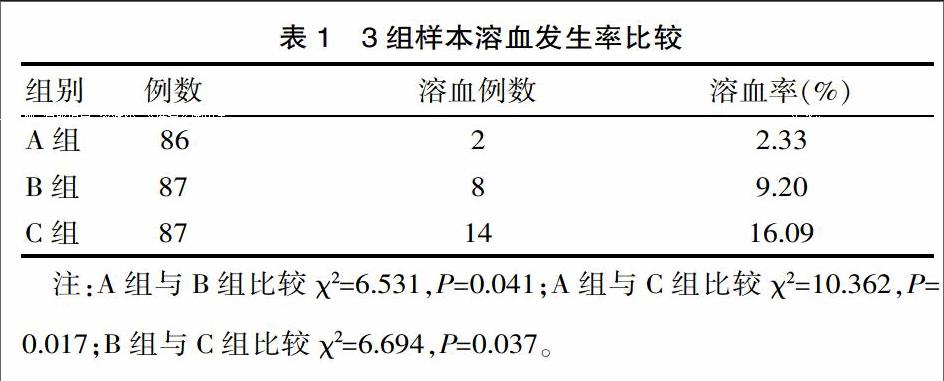
[摘要] 目的 探讨不同静脉采血方法下血液样本溶血的发生率及减少溶血发生的护理方法,为临床提高血液采样的有效性提供借鉴和参考。方法 方便选取2016年1月—2017年1月于该院行静脉采血的260例患者为研究对象,根据采血方法不同将入选病例分为A组(真空采血法,86例)、B组(采血针连接静脉留置针采血法,87例)和C组(注射器连接静脉留置针采血法,87例)。3组静脉采血均严格按照护理相关规程进行操作,样本采集到以后即刻送检。对比观察3组样本的溶血发生情况。结果 A组患者发生溶血者有2例,其发生率2.33%,B组发生溶血有8例患者,其发生率为9.20%,C组发生溶血的患者有14例,其发生率为16.09%,A组溶血发生率显著低于B组和C组,比较差异有统计学意义(P<0.05)。结论 单纯以真空采血管进行采血的溶血发生率最低。采血过程中,通过护理人员的规范化护理操作,能进一步降低溶血发生几率,提高血液样本有效性。
[关键词] 静脉采血;溶血;护理
[中图分类号] R472 [文献标识码] A [文章编号] 1674-0742(2017)04(c)-0150-03
[Abstract] Objective To discuss the incidence rate of blood samples hemolysis in different venous blood collection methods and nursing method of reducing the occurrence of hemolysis and provide reference for the clinical improvement of effectiveness of blood sampling. Methods 260 cases of patients with venous blood collection in our hospital from January 2016 to January 2017 were convenient selected and divided into two groups according to different blood collection methods, the group A with 86 cases adopted the vacuum tube for blood collection, the group B with 87 cases adopted the blood taking needle and venous indwelling needle, and the group C with 87 cases adopted the injector and venous indwelling needle, and the three groups conducted the operation strictly according to the nursing related procedures, and the samples were submitted immediately after collection, and the occurrence of hemolysis of the three groups was observed. Results In the group A, the incidence rate of hemolysis was obviously lower than that in the group B and group C(2 cases, 2.33% vs 8 cases, 9.20%, 14 cases, 16.09%), and the differences between groups were statistically significant(P<0.05). Conclusion The incidence rate of hemolysis of simple vacuum blood collection tube is lowest, and in the blood collection course, the standardized nursing operation of nursing staff can further reduce the occurrence probability of hemolysis and improve the effectiveness of blood samples.
[Key words] Venous blood collection; Hemolysis; Nursing
血液檢查是检测疾病血液学特征的有效方法,临床常见有血常规、血生化、交叉配血等。静脉采血是血液检查的首要环节,采集有效的静脉血液样本对实验室检查、疾病诊断和鉴别及预后判断的正确性而言至关重要[1]。溶血是血液样本采集过程中的常见现象,是影响血液检查结果的重要因素,因此,如何降低静脉采血过程中溶血的发生率成为实验室血液分析前质量控制的关键一环[2]。目前,临床所用静脉采血方法主要包括真空采血和留置针连接注射器/采血器,文章现以2016年1月—2017年1月于该院行静脉采血的260例患者为例,对不同静脉采血方式下的溶血发生率及有效护理对策进行分析和探讨,现报道如下。……