木薯叶片厚度、蜡质含量和气孔密度与抗朱砂叶螨的关系
2017-05-30肖建辉周颖叶剑秋覃新导
肖建辉 周颖 叶剑秋 覃新导

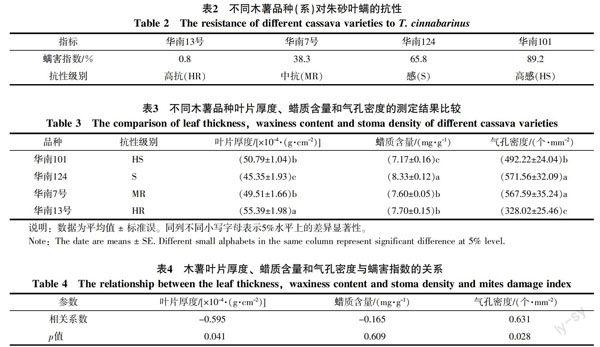
摘 要 为明确不同木薯品种的叶片组织结构与抗朱砂叶螨的关系,通过对木薯田间螨害情况的调查,计算出感、抗性稳定的感螨品种华南101、华南124和抗螨品种华南7号、华南13号的螨害指数,同时对叶片的相关物理性状进行测定,分析了叶片厚度、蜡质含量和气孔密度与木薯抗朱砂叶螨的关系。结果表明:4份木薯种质华南101、华南124、华南7号和华南13号的螨害指数依次为89.2%、65.8%、38.3%和0.8%;木薯叶片厚度与螨害指数呈显著负相关;气孔密度与螨害指数呈显著正相关;蜡质含量与螨害指数无显著相关性。上述结果为深入探究木薯抗螨机制提供了初步的理论基础。
关键词 木薯;朱砂叶螨;抗性;物理性状
中图分类号 S533 文献标识码 A
Abstract In order to determine the relationship between the tissue structure of cassava leaf and the cassava resistance to Tetranychus cinnabarinus, several cassava germplasms including SC101, SC124, SC7 and SC13 were employed to calculate the damage parameters of spider mites by investigating the mite damage in the field. And some related physical characteristics of cassava leaves were studied to research the relationship between the leaf thickness, waxiness content and stoma density and the cassava resistance to T. cinnabarinus. The results showed that the mites damage index of 4 cassava germplasms was 89.2%, 65.8%, 38.3% and 0.8%, respectively. The leaf thickness of cassava indicated the distinct negative correlation with the mites damage index. The stoma density showed the distinct positive correlation with the mites damage index. The contents of cassava leaf waxiness showed indistinct correlation with the mites damage index. The results laid a primary theoretical foundation for further study on the resistance mechanism of cassava germplasms to spider mites.
Key words cassava; Tetranychus cinnabarinus; resistance; physical characteristics
doi 10.3969/j.issn.1000-2561.2017.03.024
木薯(Manihot esculenta Crantz)屬于大戟科植物,与红薯、马铃薯并称世界3大薯类,综合利用价值极高,具有耐旱耐瘠的特性。除了供人类食用和用于动物饲料,木薯淀粉或干片还用于发酵酒精,且已成为中国“非粮”燃料乙醇生产中唯一一个达到规模化生产的作物[1-2]。目前中国栽培木薯的省份多分布在华南地区,其中以广西、广东和海南栽培最多[3],但木薯病虫害成了制约国内木薯种植产业的一大阻碍。在危害木薯的主要虫害中,朱砂叶螨害有加重趋势,严重时可导致减产50%~ 70%[4]。朱砂叶螨(Tetranychus cinnabarinus)属蛛形纲真螨目叶螨科,其寄主植物广泛,为世界性害螨,主要以幼螨、若螨和成螨在叶子背面刺吸汁液,使木薯叶片失绿黄化,影响光合作用效率。国内曾报道了113种作物受到螨害,包括棉花、豆类、瓜类和甘薯等在内,遍及10多个省[5]。……