综合护理措施对高龄初产妇产后抑郁失眠的干预效果分析
2017-04-27刘慧慧吴绍长夏朝云
刘慧慧 吴绍长 夏朝云

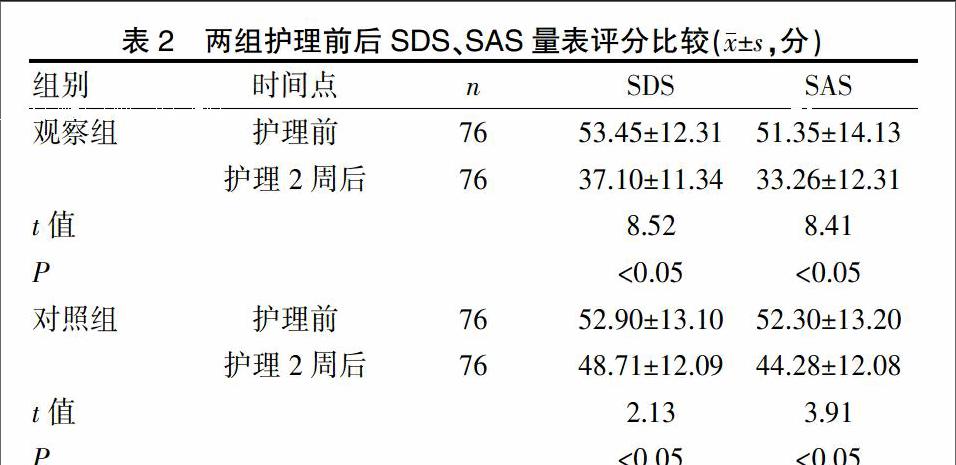

[摘要] 目的 探讨综合护理措施对高龄初产妇产后抑郁失眠的干预效果。 方法 选取2015年8月~2016年8月我院收治的152例高龄产后抑郁失眠产妇,将其按照随机数字法分为观察组和对照组,每组76例,对照组予产后一般护理,观察组予综合护理措施,分别在护理前及护理2周后采用抑郁自评量表(SDS)、焦虑自评量表(SAS)对两组患者的心理状况进行评定,采用 SF-36 量表[生理功能(PF)、生理职能(RP)、躯体疼痛(BP)、总体健康(GH)、活力(VT)、社会功能(SF)、情绪职能(RE)、心理健康(MH)]对两组的生活质量进行评定,同时采用自行设计的问卷对护理满意度进行调查,并比较两组子宫复旧情况。 结果 护理2周后两组SDS、SAS评分均显著降低(t≥2.13,P均<0.05),但观察组降低更为明显(t=6.12、5.57,P均<0.05)。护理2周后SF-36 量表各维度PF、RP、BP、GH、VT、SF、RE、MH评分均较治疗前显著上升(t≥2.24,P均<0.05),但观察组上升更为明显(t=4.43、4.60、5.96、10.24、5.31、4.47、8.32、6.01,P均<0.05)。观察组护理满意度为98.68%,显著高于对照组的84.21%(χ2=10.18,P<0.05)。护理1周及2周后两组子宫三径之和均显著降低(t≥6.19,P均<0.05),但观察组降低更为明显(t=7.53、10.87,P<0.05)。护理2周后两组PSQI评分较护理前显著降低(t=23.47、17.38,P均<0.05),但观察组降低更为明显(t=8.30,P均<0.05)。 结论 综合护理措施有利于降低高龄初产妇产后抑郁程度,提高生活質量和护理满意度,促进子宫复旧,改善睡眠质量,值得临床推广。
[关键词] 综合护理措施;高龄初产妇;产后抑郁;失眠
[中图分类号] R473.71 [文献标识码] B [文章编号] 1673-9701(2017)06-0143-04
[Abstract] Objective To explore the effect of comprehensive nursing measures on postpartum depression and insomnia in elderly primipara. Methods A total of 152 elderly patients with postpartum depression and insomnia in our hospital from August 2015 to August 2016 were enrolled. They were randomly divided into two groups including observation group(n=76) and control group(n=76) according to random number method. The control group was given postpartum routine care, and the observation group was treated with comprehensive nursing measures. The self-rating depression scale(SDS) and the self-rating anxiety scale(SAS) were used to assess the psychological status of the two groups before and two weeks after nursing. SF-36 including physical function(PF), role physical(RP), body pain(BP), general health(GH), vitality(VT), social function(SF), emotional function(RE), mental health(MH) was used to assess the quality of life between the two groups. At the same time, self-designed questionnaires were used to investigate nursing satisfaction. And uterine recovery situation between two groups was compared. Results After two weeks of nursing, the scores of SDS and SAS significantly decreased in both groups(t≥2.13, P<0.05), but the scores in the observation group were more obvious(t=6.12, 5.57, P<0.05). The scores of PF, RP, BP, GH, VT, SF, RE and MH in SF-36 scale were significantly higher than those before treatment(t≥2.24, P<0.05), while the observation group rose more obviously(t=4.43, 4.60, 5.96, 10.24, 5.31, 4.47, 8.32, 6.01, P<0.05). The satisfaction rate of observation group was 98.68%, higher than that of the control group(84.21%)(χ2=10.18, P<0.05). The sum of three diameters in both groups significantly decreased after one week and two weeks of nursing(t≥6.19, P<0.05), but the observation group decreased more significantly(t=7.53, 10.87, P<0.05). After two weeks of nursing, the PSQI scores were significantly lower than those before care in two groups(t=23.47, 17.38, P<0.05), while the observation group decreased more significantly(t=8.30, P<0.05). Conclusion Comprehensive nursing measures are beneficial to reduce the postpartum depression of elderly primipara and improve the quality of life and nursing satisfaction. It can also promote uterine recovery and improve sleep quality, which is worthy of clinical promotion.
[Key words] Comprehensive nursing measures; Elderly primipara; Postpartum depression; Insomnia
近年来随着社会发展、女性受教育程度的提高及高端辅助生殖技术的应用,加之女性婚育年龄的推迟,高龄(≥35岁)初产妇人数是20世纪80年代的3倍[1]。高龄初产妇的阴道和宫颈弹性相对减退,加之妊娠并发症发病率的升高,导致高龄初产妇比适龄初产妇承担的风险更大,从而加大了高龄产妇的紧张、焦虑、抑郁、恐惧等心理,据报道高龄初产妇产后抑郁的发生率高达36.9%,比正常产妇抑郁的发生率高11%~25%[2]。而产妇产后抑郁不仅影响自我生活质量,还可能对新生儿产生厌烦感,缺乏母婴之间的沟通,从而阻碍新生儿正常的生长发育[3]。本研究针对高龄产后抑郁初产妇采用综合护理措施,取得一定的效果,现报道如下。……